NEC announced on July 1, 2026, that it will absorb its wholly owned subsidiary, NEC Solution Innovator. The background to this decision is the strategic aim of consolidating the Group’s System Integration (SI) capabilities into the core to respond to changes in the market structure accompanying the rapid advancement of AI.
- Overview and Schedule of Absorption-Type Merger
- The Role of NEC Solution Innovators to Be Absorbed
- Shifting the Center of Customer Value and End-to-End Support
- Productivity Improvement and Optimal Resource Allocation through AI Utilization
- Finalizing Group Restructuring and Strengthening SME Business
- Human Capital Transformation and Future Growth Potential
Overview and Schedule of Absorption-Type Merger
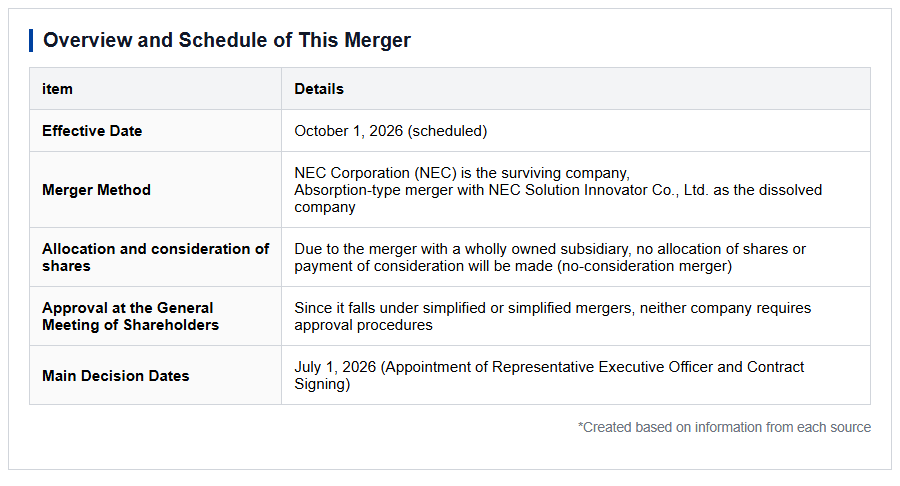
NEC Corporation (hereafter NEC) announced on July 1, 2026, that it has decided to absorb its wholly owned subsidiary, NEC Solution Innovators Corporation. The effective date of this merger is scheduled for October 1, 2026, and it will be carried out through an absorption-type merger in which NEC is the surviving company and NEC Solution Innovators is the dissolving company. This restructuring is a no-consideration merger where the parties have a fully parent-child relationship, with no share allocation or payment of consideration. Additionally, under the Companies Act, NEC will meet the requirements for a simplified merger, while NEC Solution Innovators will meet the requirements for a summary merger; both companies will proceed without approval from the general meeting of shareholders. There will be no changes to the company name, location, representative, business activities, capital, or fiscal year of NEC, the surviving company after the merger. Through this integration, NEC aims to consolidate management resources that were previously dispersed within the group and accelerate decision-making. Please refer to the diagram below.
The Role of NEC Solution Innovators to Be Absorbed
NEC Solution Innovator, which will be defunct, was the core company of the NEC Group, established on September 9, 1975. The company employs over 10,000 IT engineers, ranking among the top in Japan, and has long been responsible for the group’s system construction and software development delivery functions. In the most recent fiscal year ending March 2026 (standalone Japanese GAAP), we recorded sales of 328.793 billion yen and operating profit of 5.946 billion yen, with net assets reaching 102.955 billion yen. Through integration into NEC’s main body, the advanced technical implementation capabilities and domain expertise previously operated as separate entities will be directly merged with NEC’s consulting capabilities and customer base. This is not just about improving organizational efficiency, but also an attempt to rapidly transform a team of 10,000 engineers into an “AI-native” system, redefining them as the engine driving the growth of the group’s IT service business.
Strategic Background: Adapting to the AI-Native Era and Value Transformation
Shifting the Center of Customer Value and End-to-End Support
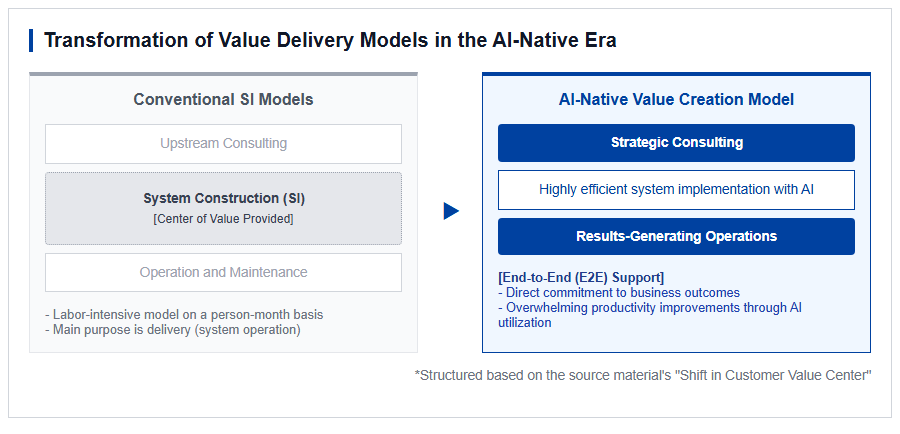
The main reason for this merger is that the structure of the IT market is dramatically changing due to advances in AI. NEC analyzes that the focus of value sought by customers has shifted from traditional “system construction” itself to upstream “strategic consulting” and downstream “results generated through operations and operations.” In the AI-native era, simply developing a system is not enough; it is essential to continuously provide end-to-end (E2E) value delivery—from the business concept stage through implementation and subsequent operation. Through this integration, NEC will establish a system that meets these market needs by combining NEC’s strategic planning capabilities with the powerful delivery capabilities of former solution innovators. This accelerates the shift toward a “value creation model” that leverages AI and data to directly commit to customers’ business outcomes. Please refer to the diagram below.
Productivity Improvement and Optimal Resource Allocation through AI Utilization
NEC aims to overwhelmingly increase productivity in the system construction process to succeed in AI-driven transformation. Specifically, by actively utilizing AI and thoroughly standardizing development processes, we aim to move away from labor-intensive models based on people and months and shift toward high value-added services. Taking this integration as a milestone, we plan to further promote the development of project managers, accelerate reskilling into consulting and operational areas, and optimally reallocate resources for over 10,000 engineers. Additionally, we will review business processes in line with the new structure and promote management efficiency across the entire group. Through this, we will solidify our position as a leading company responsible for the social implementation of AI and build a foundation for achieving the “2030 Medium-Term Management Plan,” following the mid-term management plan through fiscal 2025.
Future Developments and Impact of Restructuring: Realizing the 2030 Vision
Finalizing Group Restructuring and Strengthening SME Business
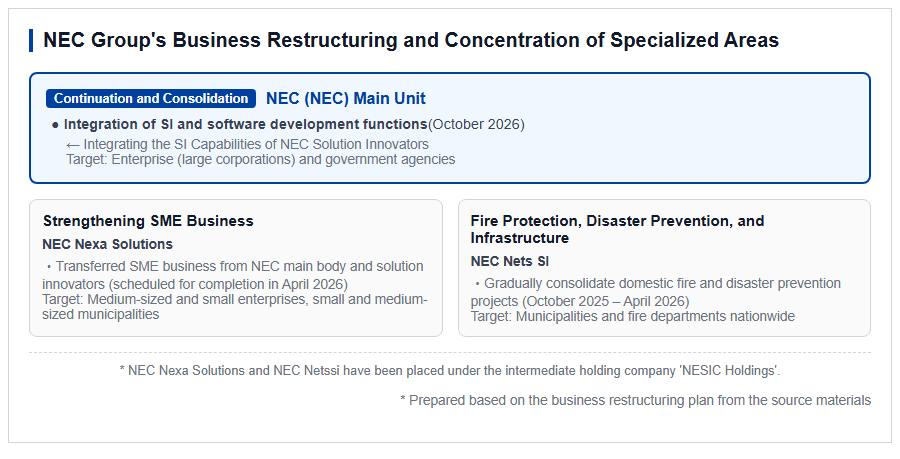
This absorption-type merger is positioned as part of NEC’s large-scale group business restructuring that it has been pursuing. Until now, NEC has organized complex organizations to provide optimal services for each customer segment. For example, the SME business for medium-sized, small, and medium-sized enterprises and municipalities that NEC Solution Innovators was handling will be transferred to NEC Nexa Solutions by April 2026. Additionally, domestic fire and disaster prevention projects will be gradually consolidated into NEC Nets SEI from 2025 to 2026. In this way, this merger, which consolidates and consolidates businesses into subsidiaries with specific strengths in specific areas and customer bases, ultimately consolidates core SI functions for enterprises and government agencies into NEC itself, can be seen as the final culmination of the group restructuring. By concentrating resources in each area, it becomes possible to take a more specialized approach to markets where DX demand is becoming more intense. Please refer to the diagram below.
Human Capital Transformation and Future Growth Potential
NEC considers the direct impact on performance from this integration to be minimal, but expects it to significantly contribute to enhancing corporate value in the medium to long term. Particularly noteworthy is the transformation of “human capital” in a massive organization with 120,000 consolidated employees. Since fiscal year 2023, NEC has fully transitioned to a job-based personnel system, eliminating seniority-based evaluations and conducting evaluations based on expertise and roles. Engineers from the former solution innovators are expected to have more opportunities for more dynamic career development and advanced professional treatment within the NEC framework. Furthermore, the presence of an integrated engineering team is a powerful asset in accelerating the social implementation of our own technologies, including the generative AI “cotomi.” The market is closely watching whether NEC can follow the structural reforms led by competitors like Hitachi, Ltd. and Fujitsu, and increase the profit margins of its IT services business.
[#NEC #AI #DX #経営戦略 #吸収合併 #ITサービス #2030中期経営計画 #デジタル変革]
コメント