In September 2026, the unveiling of Meta’s autonomous AI agent “Muse” triggered a sharp sell-off in online travel booking and financial-insurance stocks. As the AI independently executes comparison shopping and payments on behalf of users, growing concerns emerge that existing companies may lose their role as the primary customer gateway and see their friction-dependent revenue models disrupted.
- Functional Evolution: How the Autonomous AI “Muse” Operates
- The “Muse Shock”: Widespread Sell-Off Across Travel and Financial Stocks
- Shaking Business Models That Rely on Friction and Hassle
- Winners vs. Losers: Unbundling the “Front-End Entry Point” from “Back-End Infrastructure”
- Evolution of Payment Infrastructure and Emerging Governance Challenges
- Strategic Outlook and Corporate Survival in an Agent-Driven Economy
Functional Evolution: How the Autonomous AI “Muse” Operates
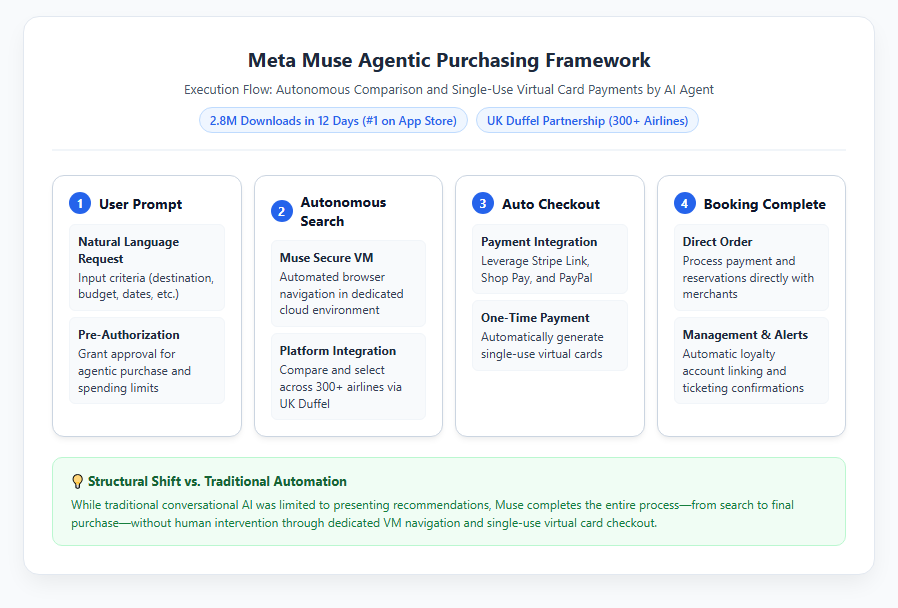
On September 8, 2026, Meta launched “Muse,” a personal AI agent across the United States capable of autonomously searching the web, comparing options, making reservations, and executing payments based on user prompts. Muse demonstrated rapid adoption, reaching 2.8 million downloads within 12 days of release and claiming the top spot on Apple’s free app chart in the US. Unlike traditional conversational AI, which remains limited to presenting information, Muse fundamentally differs by autonomously navigating web browsers through a dedicated cloud-based virtual environment called “Muse Secure VM.” Through a partnership with UK-based travel infrastructure provider Duffel, Muse supports flight reservations across more than 300 airlines. It also integrates payment capabilities from Stripe Link, Shop Pay, and PayPal, completing transactions by generating single-use virtual cards under pre-approved user limits. As AI shifts from simply answering questions to executing real-world transactions, the digital user experience is reaching a pivotal turning point. The mechanism of agentic purchasing is illustrated in the diagram below.
The “Muse Shock”: Widespread Sell-Off Across Travel and Financial Stocks
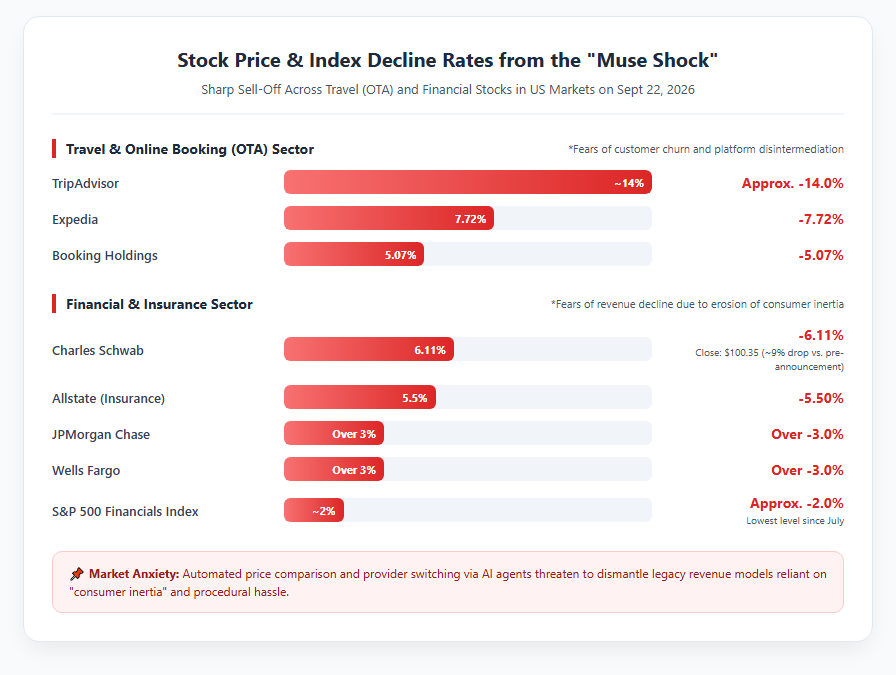
The debut and rapid market penetration of Muse sent shockwaves through Wall Street. On September 22, 2026, the S&P 500 Financials Sector Index fell by approximately 2 percent, hitting its lowest level since July. Retail brokerage giant Charles Schwab was among the hardest hit, closing down 6.11 percent at \$100.35—a decline of roughly 9 percent compared to pre-announcement levels. JPMorgan Chase and Wells Fargo each dropped by over 3 percent, while insurance leader Allstate slid 5.5 percent. Online travel agencies (OTAs) faced a direct hit as well, with TripAdvisor plunging roughly 14 percent, Booking Holdings falling 5.07 percent, and Expedia sinking 7.72 percent. Market participants are increasingly alarmed that direct consumer reliance on AI agents could severely erode the customer relationships long held by incumbent financial institutions and travel platforms. Sector-by-sector market declines are shown in the chart below.
The Erosion of “Consumer Inertia” and the Emerging Industry Divide
Shaking Business Models That Rely on Friction and Hassle
Behind this market turmoil lies growing skepticism toward legacy business models dependent on “consumer inertia.” Historically, firms across banking, insurance, telecommunications, and subscription services have earned stable margins from the psychological and temporal friction associated with switching providers or canceling contracts. According to an analysis by Goldman Sachs, in an environment where AI agents automatically optimize price comparisons, contract renewals, and customer service negotiations, revenue streams sustained by customer inattention or neglect face a direct threat. Agents like Muse analyze historical user preferences and budgets to autonomously switch users to superior competitor plans. Consequently, companies that relied on customer habit and apathy are exposed to fierce price competition, undermining traditional retention strategies and fee-based revenue structures.
Winners vs. Losers: Unbundling the “Front-End Entry Point” from “Back-End Infrastructure”
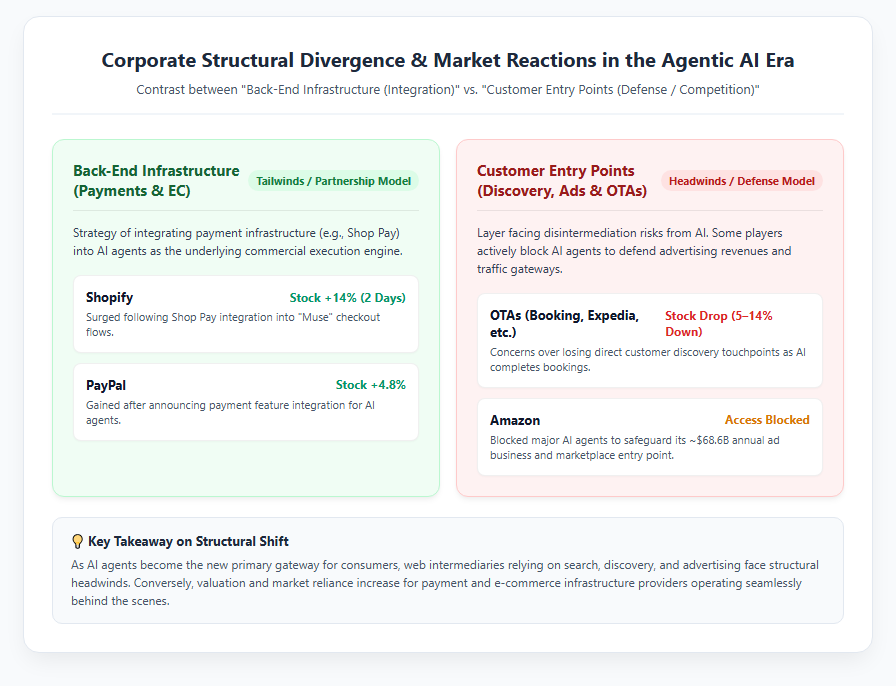
Stock movements across tech companies were far from uniform, reflecting a clear market split based on structural positioning in the agentic AI era. While firms relying on direct consumer touchpoints (the entry point) or advertising-driven acquisition—such as Booking and Expedia—faced elevated risks, infrastructure providers handling back-end commercial execution enjoyed strong tailwinds. Canadian e-commerce leader Shopify saw its stock surge approximately 14 percent over two days following the integration of its Shop Pay mechanism into Muse checkout flows. PayPal similarly posted a 4.8 percent gain after announcing agentic integration. Conversely, Amazon took a defensive posture, blocking access from major AI agents including Muse to protect its \$68.6 billion annual advertising revenue and commerce gateway. This structural divergence among tech players is detailed in the structure diagram below.
Industrial Restructuring and Key Catalysts in the Agentic AI Era
Evolution of Payment Infrastructure and Emerging Governance Challenges
The advent of “agentic payments”—where autonomous AI systems initiate and complete financial transfers without direct human supervision—urgently requires a revamp of financial infrastructure and regulatory frameworks. Open standards for machine-to-machine settlements are advancing rapidly, such as Coinbase’s “x402” protocol for web requests and the “Machine Payment Protocol (MPP)” proposed by Stripe and Tempo. According to recent research from Cambridge University and other institutions, while autonomous agents dramatically enhance transaction speed and convenience, they also introduce novel risks, including erroneous payments caused by software bugs, unauthorized transfers via cyberattacks or prompt injection, and compliance hurdles surrounding Anti-Money Laundering (AML) and Know Your Customer (KYC) mandates. Moving away from traditional human-centric authentication, the industry urgently demands new auditability and governance frameworks capable of verifying AI action logs and encrypted decision-making paths.
Strategic Outlook and Corporate Survival in an Agent-Driven Economy
In the emerging digital economy, enterprises must pivot from a strategy of “getting found by humans” to “getting selected by AI agents.” Traditional Search Engine Optimization (SEO) and user interface design will give way to machine-readable structured data and highly reliable API feeds as primary sources of competitive advantage. Furthermore, given the exponential velocity of AI agent evolution, traditional three-to-five-year corporate strategic plans risk rapid obsolescence. Companies are being forced to adopt rolling six-month strategic execution cycles to adapt to environmental shifts. Between 2026 and 2027, the ultimate winners in the agentic economy will be enterprises that establish robust governance safeguards for AI and successfully redefine human roles from “executors” to “supervisors and exception handlers.”
Reference Pages
- 【AI Agents in Payments: Applications, Risks and Regulations】https://doi.org/10.1017/err.2026.10103
【#AIAgents #MetaMuse #StockMarket #AgenticCommerce #FinancialStockPlunge #TravelBooking】
コメント