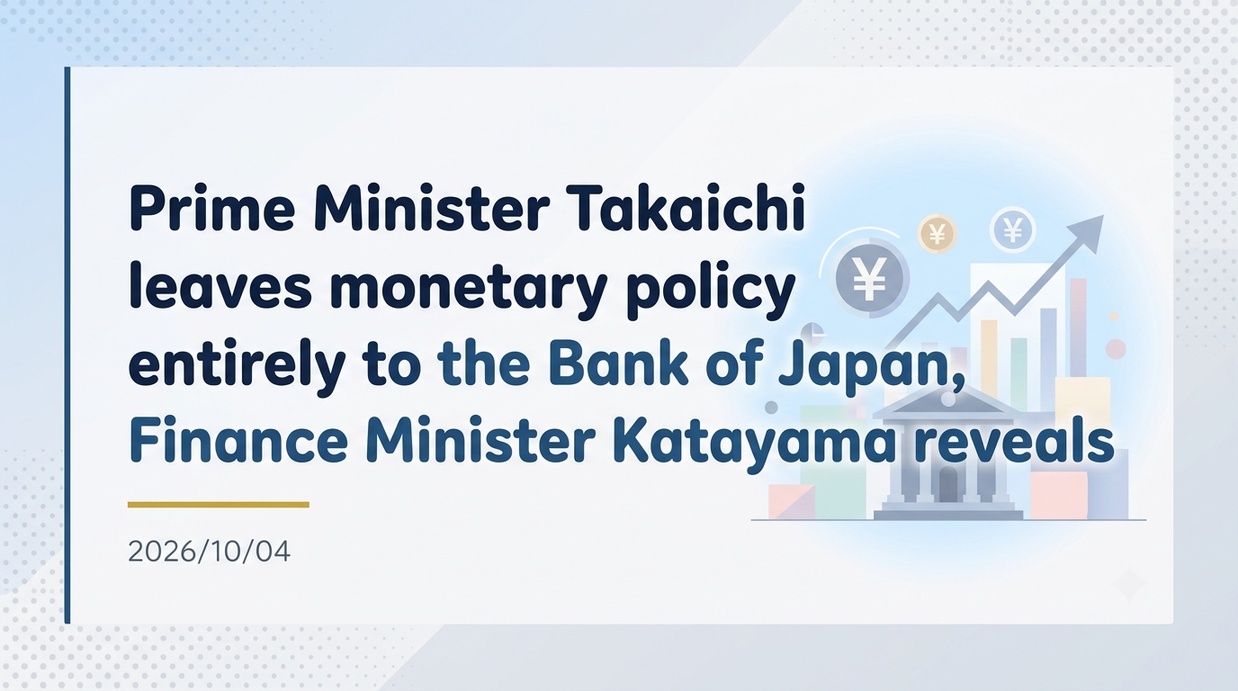
Finance Minister Satsuki Katayama revealed in an exclusive interview with TBS that Prime Minister Sanae Takaichi intends to leave monetary policy entirely to the Bank of Japan. By emphasizing as an administration that Prime Minister Takaichi is not a reflationist, the move aims to dispel growing market concerns over political restraint on interest rate hikes, thereby preventing currency depreciation and stabilizing the market.
- Background to Finance Minister Katayama’s Statement “Leaving It to the Bank of Japan”
- Prime Minister Takaichi’s “Rejection of Reflationists” and Alignment Within the Administration
- Acceleration of the Takaichi Trade and Materialization of Yen Depreciation Risks
- Reports on the Prime Minister-Governor Meeting and Central Bank Independence
- Cost-Push Inflation and Challenges in Protecting Livelihoods
- Key Points to Watch and the BOJ’s Pace of Rate Hikes
Background to Finance Minister Katayama’s Statement “Leaving It to the Bank of Japan”
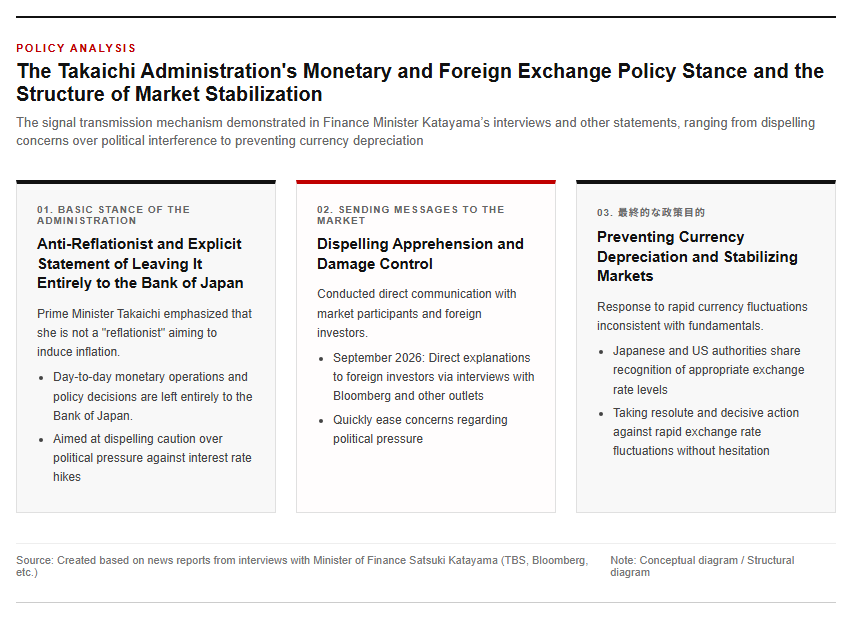
Finance Minister Satsuki Katayama, in an exclusive interview with TBS, emphasized that Prime Minister Sanae Takaichi is not a reflationist aiming to generate inflation through large-scale monetary easing and proactive fiscal policy, while also making it clear that routine monetary adjustments and policy decisions will be left to the Bank of Japan. While concerns had been spreading among market participants that Prime Minister Takaichi was reluctant to see additional interest rate hikes by the BOJ and might exert political pressure, Finance Minister Katayama’s latest remarks serve to quell these fears.
In addition, Finance Minister Katayama stated in a Bloomberg interview on September 25, 2026, that she was asked directly by Prime Minister Takaichi herself to explain to foreign investors that the Prime Minister is not a reflationist. Regarding the recently accelerating depreciation of the yen, she pointed out that Japanese and U.S. authorities share the recognition that the current exchange rate level is not appropriate in light of purchasing power and economic fundamentals. Building on that, she once again made clear her stance to take decisive foreign exchange intervention measures without hesitation against rapid currency fluctuations.
Prime Minister Takaichi’s “Rejection of Reflationists” and Alignment Within the Administration
Prime Minister Takaichi herself has stated since the early spring of 2026 that she is not a reflationist, taking the position that the adjustment of financial markets is the exclusive purview of the Bank of Japan, the central bank. The sharing of policy directions is also progressing within the administration; at a post-Cabinet press conference on September 25, 2026, Minister of State for Economic and Fiscal Policy Minoru Kiuchi expressed the view that the current Japanese economy is not in a phase to promote conventional reflationary policies that combine monetary easing with flexible fiscal stimulus.
Behind this series of remarks lies the intention to clearly separate the responsible proactive fiscal policy advocated by the Takaichi administration from the Bank of Japan’s monetary policy decisions, and to dispel the view that it is hindering monetary tightening. When the administration first took office, the market was wary that aggressive spending expansion policies might curb the BOJ’s interest rate hikes. However, with cabinet ministers unanimously playing down reflationary inclinations and demonstrating a stance of respecting the BOJ’s judgment, the relationship between the government and the central bank has been redefined. A clear division of roles is emerging, wherein the government focuses on growth and crisis-management investments, while leaving the steering of monetary policy to the BOJ.
Spillover to Financial Markets and the Independence of the Bank of Japan
Acceleration of the Takaichi Trade and Materialization of Yen Depreciation Risks
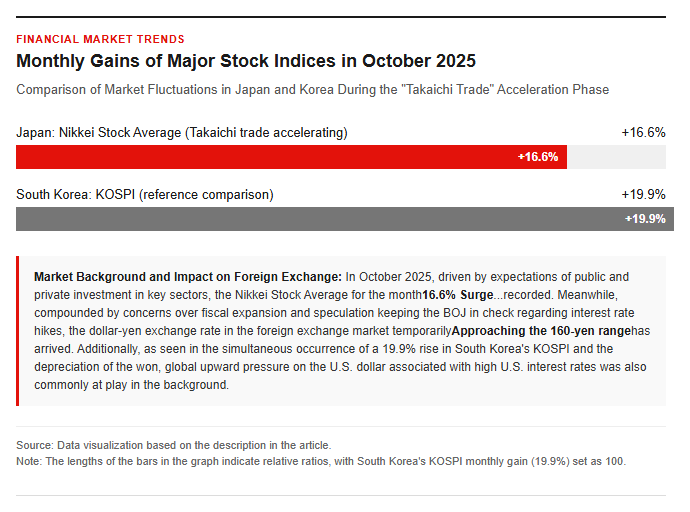
Following Prime Minister Takaichi’s victory in the Liberal Democratic Party leadership election in October 2025, market movements known as the so-called “Takaichi trade” accelerated. Driven by expectations for the creation of public-private investment frameworks and resilience policies in critical areas such as semiconductors, artificial intelligence, and defense, the Nikkei Stock Average recorded a massive monthly gain of 16.6% in October 2025. Meanwhile, concerns over fiscal expansion and speculation regarding efforts to check the Bank of Japan’s interest rate hikes drove a rapid depreciation of the yen in the foreign exchange market, with the dollar-yen exchange rate briefly nearing the 160 yen level.
However, these market fluctuations are not limited to factors unique to Japan alone. During the same period, South Korea’s financial markets experienced similar dynamics—such as the benchmark KOSPI surging 19.9% in a month alongside the depreciation of the won—indicating that global strong-dollar pressures driven by rising U.S. interest rates were at play in both cases. Domestically, however, the combination of expanding fiscal spending amid inflation and the maintenance of low interest rates suggested a negative trend in real interest rates, acting as a factor that heightened concerns over the decline in currency value.
Reports on the Prime Minister-Governor Meeting and Central Bank Independence
In Japan’s financial system, the new Bank of Japan Act, revised in 1997 and enacted in April 1998, clearly guarantees the independence of monetary policy decisions in Article 3. At the same time, Article 4 stipulates consistency with the government’s economic policy and close communication. Regarding the meeting held on February 16, 2026, between Prime Minister Takaichi and BOJ Governor Kazuo Ueda, when media outlets reported on February 24 that the Prime Minister had shown reluctance toward an additional interest rate hike, expectations for rate hikes receded in the foreign exchange market, leading the yen to briefly depreciate to the lower 156-yen range against the dollar.
In response, the government expressed a denial, reporting that Governor Ueda had made no particular requests, and sought to calm market turmoil. The intersection of central bank independence and political pressure significantly impacts market participants’ interest rate forecasts and investment decisions. Including the composition of the BOJ Policy Board and personnel trends among deliberation members, ensuring transparency regarding the influence of politics on monetary policy has become an essential element in maintaining the credibility of the currency and the sound formation of the market.
Impact on Daily Life and Future Outlook
Cost-Push Inflation and Challenges in Protecting Livelihoods
The ideal scenario of inflation targeted by the government and the Bank of Japan is a demand-pull virtuous cycle in which wage growth and expanding consumption are linked alongside the revitalization of economic activity. In contrast, the price increases currently underway strongly exhibit aspects of cost-push inflation stemming from soaring overseas energy prices and rising import costs associated with a rapid depreciation of the currency. Cost-push price hikes, when not accompanied by a rise in real wages, directly erode household purchasing power and impose a severe burden on the livelihoods of citizens, particularly centering on low-income groups.
The Takaichi administration is considering livelihood support measures such as cutting the consumption tax on food and introducing various benefits, but it has harbored a contradiction in that the depreciation of the yen, driven by political restraint on interest rate hikes, prolongs high inflation. A decrease in the risk of political intervention and the stabilization of the exchange rate are of vital importance in protecting citizens’ livelihoods through the calming of import prices. Striking a balance between building an environment for sustainable wage increases and curbing inflation has become the utmost priority in the administration’s economic and fiscal management.
Key Points to Watch and the BOJ’s Pace of Rate Hikes
Bank of Japan Governor Ueda maintains his stance that, if economic and price conditions develop as expected, he will proceed with gradual policy rate hikes at the Monetary Policy Meeting after carefully assessing the contents of the data. With Finance Minister Katayama explicitly stating Prime Minister Takaichi’s stance of leaving monetary policy entirely to the BOJ this time, it can be said that an environment has been established where the BOJ can detach itself from political motives and smoothly advance the normalization process based purely on macroeconomic data and wage hike trends in the Shunto (spring labor-management wage negotiations).
The future focus is on the pace at which the Bank of Japan will raise its policy rates. If gradual rate hikes toward the level of the neutral interest rate proceed, it will put the brakes on the extreme depreciation of the yen driven by interest rate differentials. At the same time, however, new impacts will materialize, such as rising mortgage rates and increased corporate borrowing costs. As the transition to a world with interest rates progresses, attention will be focused on how the effects of growth investments driven by responsible and active fiscal policy can harmonize with the BOJ’s normalization of monetary policy, leading to the sound development of the Japanese economy.
Reference Page
- 【Prime Minister Takaichi “Intends to Leave Monetary Policy to the Bank of Japan,” Finance Minister Satsuki Katayama Reveals in Exclusive TBS Interview】https://newsdig.tbs.co.jp/
【#TakaichiAdministration #MonetaryPolicy #BankOfJapan #SatsukiKatayama #BOJIndependence #ForeignExchangeMarket #InflationCountermeasures】


コメント