Meta has unveiled its new proprietary AI smart glasses, “Meta Glasses,” alongside advanced features for its autonomous AI agent, “Muse.” Behind the announcement lies an escalating battle for dominance over the next-generation platform to replace smartphones through wearable devices and AI agents.
- Key Highlights: Major Announcements at Meta Connect 2026 and Device Lineup
- Capabilities of Autonomous AI Agent “Muse” and the Vision for Personal Superintelligence
- Camera-Free “Ray-Ban Meta Audio” and Privacy Protection Technologies
- 100g Ultra-Lightweight “Meta VR Glasses” and the Evolution of Spatial Interfaces
- Strategic Rivalry: “Google vs. Meta” and Massive AI Infrastructure Investments
- Outlook and Key Watchpoints: Mainstream Adoption Challenges and the Post-Smartphone Era
Key Highlights: Major Announcements at Meta Connect 2026 and Device Lineup
At its annual Meta Connect 2026 event on September 23, 2026, Meta announced its latest wave of wearable hardware—led by its own branded AI smart glasses, “Meta Glasses”—and introduced its proprietary autonomous AI agent, “Muse.” The centerpiece of this rollout, the entry-level “Adventurer” style of Meta Glasses, starts at \$249, offering an accessible entry point compared to previous Ray-Ban collaboration models. The broader hardware lineup includes the third-generation “Ray-Ban Meta Gen 3,” the display-integrated “Meta Ray-Ban Display” (\$799), the camera-free “Ray-Ban Meta Audio” (\$349) engineered for privacy and extended battery life, and the ultra-lightweight “Meta VR Glasses” (\$1,299) weighing roughly 100 grams. Meta also showcased “Muse Charm,” a keychain-style pocket device designed for continuous voice interactions. The diagram below illustrates Meta’s AI glasses lineup and integration ecosystem.
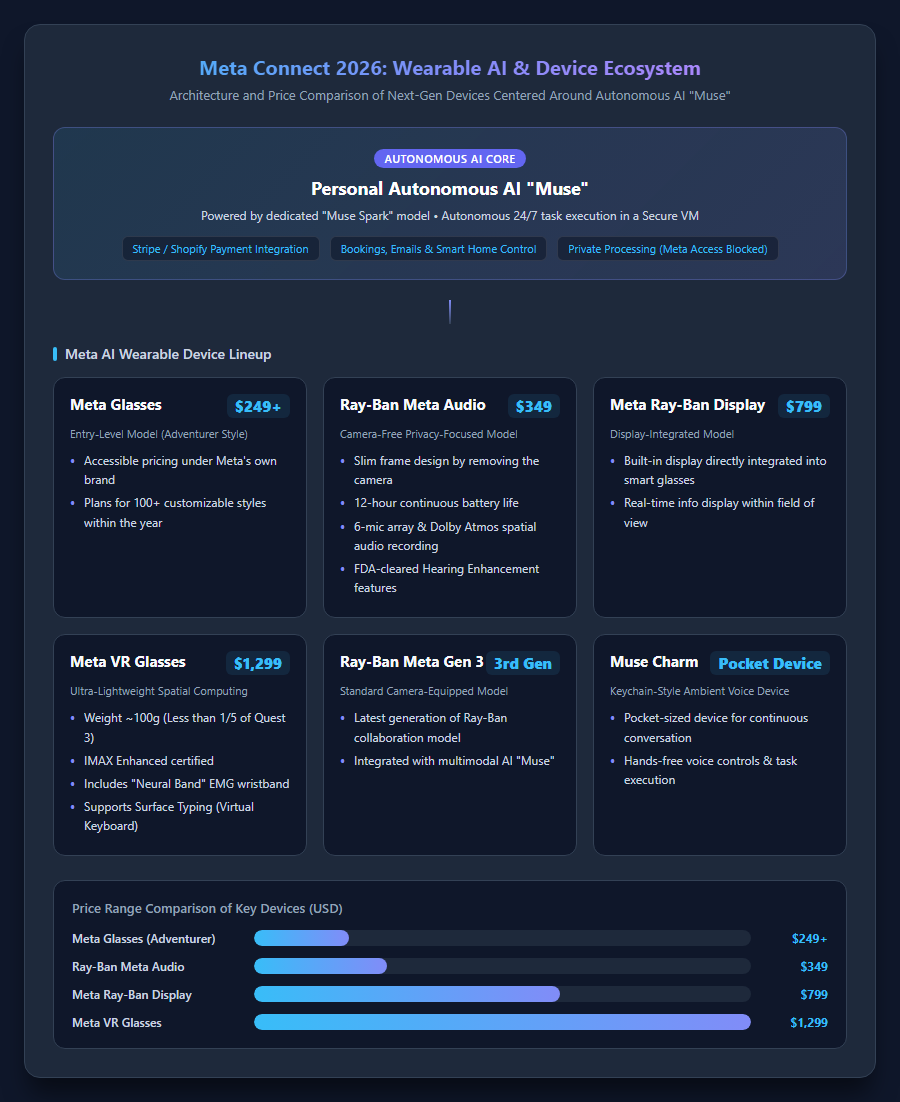
With plans to release more than 100 customizable styles within the year, Meta aims to bring seamless AI experiences to hundreds of millions of users through everyday fashion eyewear.
Capabilities of Autonomous AI Agent “Muse” and the Vision for Personal Superintelligence
At the heart of these announcements is “Muse,” an autonomous AI agent capable of executing real-world tasks 24/7 on behalf of users, going far beyond answering queries like conventional chatbots. Powered by the dedicated “Muse Spark” model, it operates within an isolated, secure virtual machine (Secure VM / Confidential VM) tailored to each user, guaranteeing maximum privacy. Muse autonomously handles travel and restaurant bookings, sends emails, manages smart home systems, and provides fitness coaching. It also integrates with major services like Stripe, Shopify, Instacart, Walmart, and Best Buy to carry out automated purchases and financial transactions. CEO Mark Zuckerberg framed this shift as a strategic transition from virtual reality toward “Personal Superintelligence.” Less than two weeks after its US launch, Muse surpassed 2.5 million downloads, claiming the top spot on app store free charts and demonstrating immense market demand.
Camera-Free “Ray-Ban Meta Audio” and Privacy Protection Technologies
To address privacy concerns—long viewed as the primary barrier to wearable AI adoption—Meta unveiled a new camera-free audio eyewear model, “Ray-Ban Meta Audio.” Priced at \$349, shipments will begin on October 13, 2026. Designed directly in response to public apprehension regarding surreptitious filming, removing the camera enabled a slimmer frame design and a 12-hour continuous battery life. The device features a six-microphone array, open-ear high-fidelity speakers, and Dolby Atmos spatial audio recording. Beyond handling voice calls and music playback, it incorporates FDA-cleared Hearing Enhancement features for individuals with mild-to-moderate hearing loss. On the AI processing side, Meta introduced server-side Private Processing, ensuring that even Meta itself cannot access user data, thereby safeguarding confidential conversational data during features such as real-time live translation.
Market Dynamics, Technological Foundations, and the Future of Wearable AI
100g Ultra-Lightweight “Meta VR Glasses” and the Evolution of Spatial Interfaces
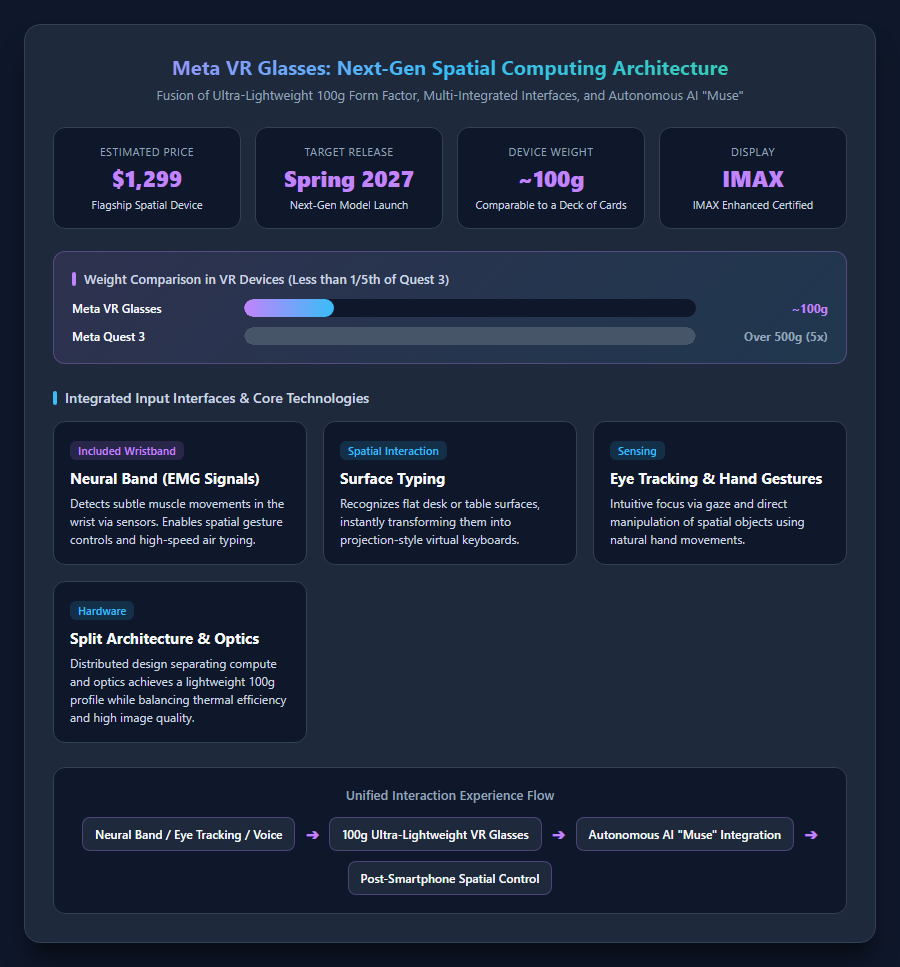
A major technological breakthrough came with the preview of “Meta VR Glasses,” scheduled to ship in spring 2027 for \$1,299. Weighing approximately 100 grams—less than one-fifth the weight of Meta Quest 3—it achieves a form factor roughly equivalent to a standard deck of cards. Utilizing a split processing architecture and a custom optical display system, it became the world’s first VR device to achieve “IMAX Enhanced” certification. Its input system integrates eye tracking, hand gesture recognition, and voice controls, alongside a Surface Typing feature that transforms any flat tabletop into a virtual keyboard. Additionally, the included “Neural Band” wristband detects subtle electromyographic (EMG) muscle signals in the wrist, enabling hands-free air typing and spatial gesture control. As illustrated in the concept diagram below, it offers a novel spatial computing experience powered by autonomous AI.
Strategic Rivalry: “Google vs. Meta” and Massive AI Infrastructure Investments
The wearable AI race intensified in May 2026 when Google unveiled its Gemini-powered smart glasses at Google I/O. While Google collaborates with eyewear brands like Warby Parker to focus on information access tools like search and navigation, Meta leverages both Ray-Ban partnerships and its own brand to merge social connectivity with autonomous AI. Underpinning Meta’s competitive strength is over a decade of massive infrastructure spending. The company projects capital expenditures between \$130 billion and \$145 billion in 2026, building world-leading compute capacity through bulk purchases of NVIDIA GPUs, proprietary custom silicon development, and Phison NAND storage controller adoption. Spurred by this infrastructure backbone and the early success of Muse, Meta’s stock price surged roughly 35% in a single month to \$744.10, driving CEO Mark Zuckerberg’s net worth to \$257 billion.
Outlook and Key Watchpoints: Mainstream Adoption Challenges and the Post-Smartphone Era
With the launch of Muse and its expanded hardware ecosystem, autumn 2026 represents the dawn of the “Wearable AI Era,” transitioning smart glasses from niche gadgets into everyday essentials. Looking ahead, three critical areas demand close observation. First is the growth and monetization of the commerce ecosystem; while partnerships with Shopify advance, platforms like Amazon have blocked AI access, signaling ongoing platform friction. Meta offers token usage for free while generating revenue through transaction fees, a monetization strategy whose long-term viability remains to be tested. Second is the evolving legal and regulatory landscape regarding continuous recording and photography in public spaces. Third is the expansion into international markets, including Japan. As user interaction shifts away from staring down at smartphone screens toward ambient AI integrated with human senses, the battle for supremacy in the post-smartphone era has officially begun.
Reference Pages
-
[Meta Official Announcement: EssilorLuxottica Partnership & Meta Glasses Launch] https://about.fb.com/news/2026/06/meta-essilorluxottica-partner-launch-meta-glasses/
-
[Meta Official Blog: Introducing Meta Glasses] https://www.meta.com/ja-jp/blog/introducing-meta-glasses-a-range-of-new-styles-from-meta-and-essilorluxottica-starting-at-299/
[#Meta #AISmartGlasses #Muse #MetaGlasses #WearableAI #MarkZuckerberg #Privacy #MetaConnect2026]


コメント