On October 1, 2026, Canon launched a cloud-based feature expansion platform that integrates generative AI and imaging technology. In the printing market, amidst ongoing paperless trends and shifting demands, the company aims to create a new experience where features continue to evolve via the cloud even after purchase.
- Key Points on the Launch of the Cloud-Based Extensibility Platform
- Minimizing Downtime through Monitoring Features and AI Chat
- Projected 10% Contraction of the MFP Market and Canon’s Business Strategy
- Technological differentiation from competitors such as HP and Kyocera
- Measures to Mitigate Infringement Risks Associated with Generative AI Use
- Revamping the Printing Experience and Future Highlights
Key Points on the Launch of the Cloud-Based Extensibility Platform
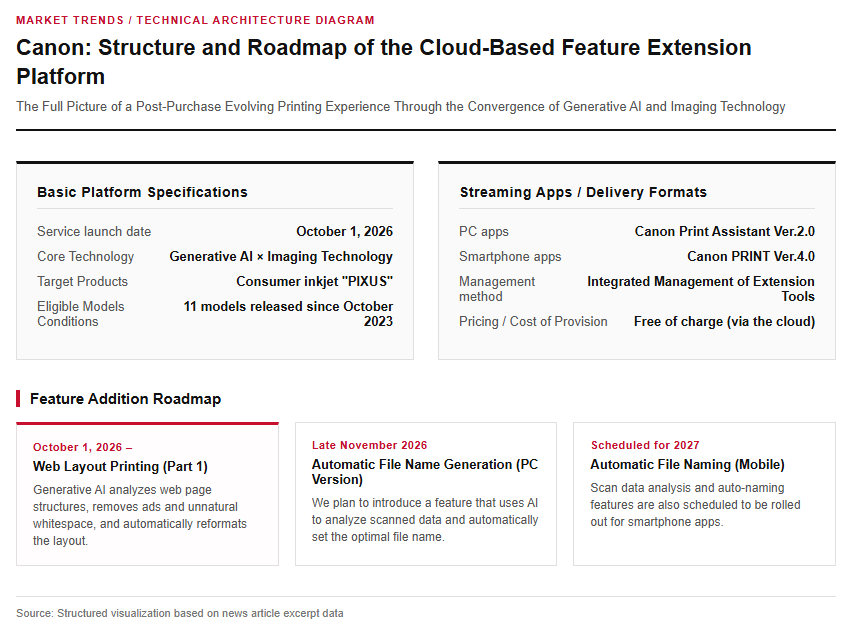
On October 1, 2026, Canon built a “cloud-based feature expansion platform” combining generative AI and its proprietary imaging technology, and began providing services. As the first phase of this initiative, it is offering a new feature expansion tool free of charge for the “PIXUS” series of home inkjet printers. The eligible models consist of 11 models released since October 2023, with a major feature being that functions can be added via the cloud even to products that users have already purchased and are currently using.
Features will be delivered for PCs via the “Canon Print Assistant Ver.2.0” printing app, and for smartphones via the “Canon PRINT Ver.4.0” mobile app. With conventional printers, users had to install separate applications for each function, posing a challenge where creating and editing layouts during printing required time and effort. With this platform, by centrally managing feature expansion tools, users can freely select and add the functions they want to use.
As the first new feature, “Web Layout Printing” uses generative AI to analyze page structures when printing web pages such as recipe or news sites, automatically re-layouting them by removing unnecessary ads and unnatural margins. This reduces wasted printing paper while improving visibility. Furthermore, in late November 2026 for the PC version and in 2027 for the mobile version, the release of an “Automatic File Name Generation” feature is also planned, which uses AI to analyze scanned data and automatically set optimal file names. As shown in the image below, the cloud and devices work together to deliver a comfortable printing experience.
Minimizing Downtime through Monitoring Features and AI Chat
Alongside the feature expansion tools, Canon has also rolled out its “DSF (Data-driven Service Foundation)” service platform—which has a proven track record in office multifunction printers—to consumer printers, and began offering a new support service starting October 1, 2026. This service is designed to help prevent issues before they occur and ensure prompt resolution by constantly monitoring the printer’s operating status.
Specifically, the “Monitoring Notification” feature allows the cloud to continuously detect risks that, if left unaddressed, could lead to reduced print quality or malfunctions, such as the device not being powered off properly. Upon detection, the system sends appropriate troubleshooting steps in real time to the user’s smartphone via the “Canon PRINT” mobile app, preventing device downtime.
Additionally, an “Advanced Chat” feature powered by generative AI with natural language processing capabilities has been implemented. Users can ask questions in free-form text via the chat interface on their PC or smartphone regarding issues such as setup procedures or printing errors. The generative AI accurately understands the intent of the user’s query and combines Canon’s product information with actual printer operational status data to summarize and present the optimal solution.
These advanced support services are available free of charge, provided that users download Canon Print Assistant or Canon PRINT, use genuine Canon ink cartridges, and preregister for the “MyPrint With” printer integration service. By consistently automating everything from issue prevention to problem resolution, they provide a comfortable operating environment.
The Landscape of AI Utilization in a Shrinking Market and Among Competitors
Projected 10% Contraction of the MFP Market and Canon’s Business Strategy
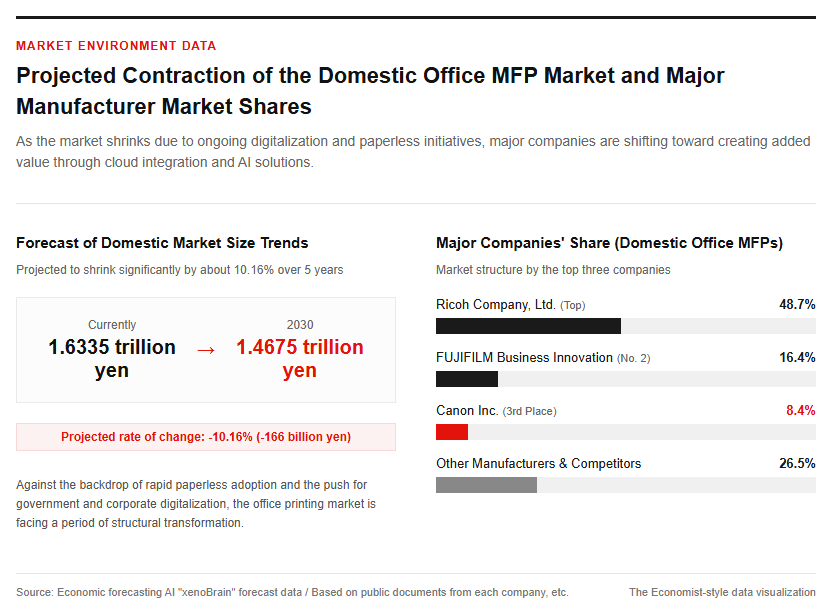
The market environment surrounding office multifunction printers and the printing industry is undergoing a major period of transformation, driven by rapid paperless adoption and the push toward digitalization in government and corporate sectors. According to forecast data from the economic prediction AI “xenoBrain,” the domestic market size for office multifunction printer manufacturers is estimated to shrink significantly by 10.16% over a five-year period, from the current 1.6335 trillion yen to 1.4675 trillion yen by 2030.
Currently, in the domestic office multifunction printer market, Ricoh Company, Ltd. holds the top share at 48.7%, followed by Fujifilm Business Innovation Corp. in second place at 16.4%, and Canon Inc. in third place at 8.4%. All companies are rushing to shift away from mere hardware sales toward the creation of added value through cloud integration and software solutions. As the market share trend chart below shows, the structural transformation of the market is clear.
To address this phase of market contraction, the Canon Marketing Japan Group has launched its “2026-2030 Long-Term Management Plan.” It has set management targets for 2030 of 850 billion yen in net sales and 75 billion yen in operating profit, with a specific strategy to expand IT solution business sales to 500 billion yen—including growing high-margin service and outsourcing sales to 200 billion yen.
We are advancing a growth strategy that simultaneously achieves higher per-unit revenue and greater profit margin purity by breaking away from standalone hardware-only sales models and strengthening maintenance and operations services and recurring businesses through a cloud-based feature-expansion platform.
Technological differentiation from competitors such as HP and Kyocera
The integration of AI into printing products is not limited to Canon; major manufacturers both in Japan and overseas are also actively pursuing it. In September 2024, Hewlett-Packard (HP) in the U.S. announced “HP Print AI” and is moving forward with the rollout of the “Perfect Output” feature, which automatically removes advertisements and adjusts margins when printing from the web.
Additionally, domestic manufacturer Kyocera has integrated AI into its multifunction printers, providing features specialized for improving office work efficiency, such as detecting folded paper or sticky notes during scanning, issuing warnings when copying confidential documents, and automatically enhancing handwritten text. Similarly, Ricoh offers an AI-OCR solution that uses AI to automatically identify and convert scanned paper documents like invoices into text, directly integrating them with accounting systems.
Canon’s advantage over these preceding examples lies in its platform-based design philosophy and integrated data management. Unlike the competing approach of requiring separate, dedicated apps for each function, Canon has established a level of scalability and convenience that enables users to select and add the tools they need within a single, common application.
In addition, the generative AI employed utilizes a pre-trained model and is designed not to perform self-learning on user data, thereby eliminating the risk of corporate and individual information leakage. Another unique strength is that it covers everything from “PIXUS” home inkjet printers to office multifunction printers with a common platform, providing a unified and smart printing and scanning environment across both the home and the office.
Ensuring AI Governance and Future Outlook
Measures to Mitigate Infringement Risks Associated with Generative AI Use
While the utilization of generative AI is expanding, the risk that generated text and images may unintentionally infringe on the rights of existing copyrighted works, characters, and individuals, as well as the reputational risk of damaging brand value, have become major social issues. When companies actively leverage generative AI, the difficulty in determining copyright infringement has been a factor hindering productivity improvement.
To address this challenge, Canon Marketing Japan Inc. entered into a basic agreement on June 9, 2026, with IPconnect Inc., a provider of AI risk visualization solutions. Aiming for the sound social implementation of generative AI, the two companies are working to build a framework for appropriately evaluating and managing the infringement risks associated with AI-generated content.
Specifically, we will leverage the “AI rights HUB” developed by IPconnect. This solution has a proven track record of winning a special award in NEDO’s prize-based program “GENIAC-PRIZE”, and is equipped with features for prompt analysis, similarity evaluation of generated images, and recording the history and audit trails of the decision-making process.
By storing verifiable records of when, by whom, and what kind of checks were performed, it provides the basis for objectively determining whether AI-generated content can be used. By deepening its collaboration with this solution, Canon is ensuring brand safety and compliance in creative activities and business use, while promoting the creation of an environment where users can utilize AI technology with peace of mind.
Revamping the Printing Experience and Future Highlights
Canon’s newly launched “cloud-based feature expansion platform” is an initiative that symbolizes a qualitative shift from conventional “buy-and-done hardware” to “software-driven devices that evolve through continued use.” Starting with “Web Layout Print,” which became available on October 1, 2026, features tailored to diverse scenarios such as office work, learning, and hobbies will be sequentially added moving forward.
As part of its future roadmap, a feature that uses AI to understand the content of scanned documents and automatically assign appropriate file names is scheduled to be released for PCs in late November 2026 and for mobile devices in 2027. Furthermore, according to the Canon Marketing Japan Group’s technology roadmap, the introduction of domain-specific AI and multimodal AI, as well as the application of AI agents that autonomously process tasks, are also envisioned for the period between 2026 and 2027.
Furthermore, the achievements of this platform, which is being spearheaded in the consumer PIXUS series, are planned to be rolled out successively to office multifunction printers and commercial printing presses. By combining Canon’s proprietary optical and imaging technologies cultivated over many years with the advanced information processing capabilities of generative AI, human labor costs associated with document creation and data management will be significantly reduced.
As a bridge between paper and data in the digital society, there is a great deal of focus on how printers will continue to create new experiential value, as well as on their future feature enhancements and market adoption trends.
Reference page
- 【Launch of “Cloud-Based Function Expansion Platform” for Printing Products】https://global.canon/ja/news/2026/20261001.html
- [Concluding a Basic Agreement with IPconnect, a Provider of AI Risk Visualization Solutions] https://prtimes.jp/main/html/rd/p/000001424.000013943.html
【#Canon #GenerativeAI #Printer #Cloud #DX #ArtificialIntelligence #Technology】

コメント