On September 25, 2026, the Nikkei 225 Stock Average rebounded sharply on the Tokyo Stock Exchange, surging by 826 yen to close near the day’s high. The rally was driven by short-covering in semiconductor stocks, alongside heightened investor focus on key U.S. economic indicators scheduled for release overnight.
- Drivers Behind the Nikkei’s 826-Yen Surge
- Capital Concentration in AI and Semiconductor Stocks Like Tokyo Electron
- Watching Key U.S. Indicators: Durable Goods Orders and Consumer Sentiment
- Impact of the U.S.-Japan Rate Differential and Dollar-Yen Shifts
- BOJ Policy Decisions and the Return to a High-Interest-Rate Environment
- Corporate Earnings and Stock Price Forecasts Toward Late 2026
Drivers Behind the Nikkei’s 826-Yen Surge
On September 25, 2026, the Tokyo stock market experienced a robust rally, with the Nikkei 225 Stock Average surging by 826 yen from the previous day and remaining near its session highs throughout trading. Following a broad-based tech recovery in Wall Street during the previous U.S. session, risk-on sentiment gained momentum in Tokyo from early morning. While recent equity markets had been weighed down by tightening monetary policy expectations and currency volatility, investor sentiment improved significantly as the rise in U.S. bond yields took a breather. Furthermore, falling crude oil prices fueled hopes for easing inflationary pressures, providing another tailwind for equity buying. Looking at internal market dynamics, bargain hunting picked up for large-cap tech and semiconductor-related shares, which had faced selling pressure in prior sessions, effectively lifting the broader index. Although positive index contribution was heavily concentrated in select semiconductor names, buying also spread across diverse sectors such as financials and precision instruments, demonstrating underlying market resilience.
Capital Concentration in AI and Semiconductor Stocks Like Tokyo Electron
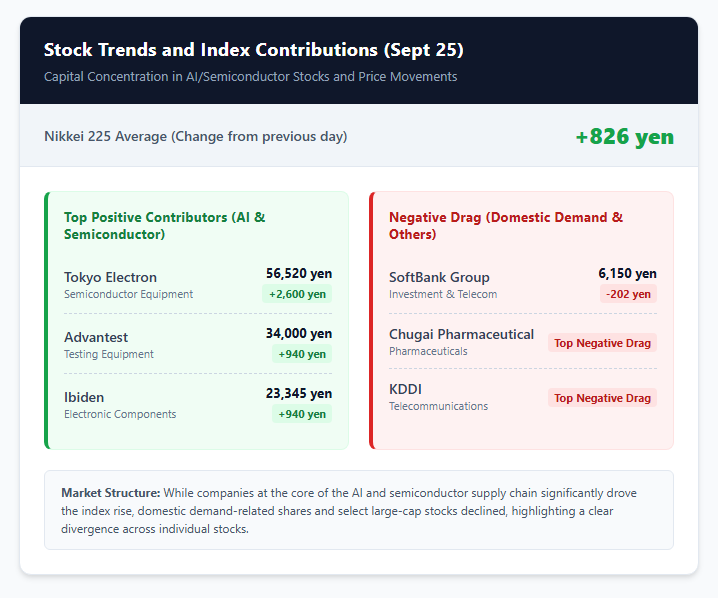
The primary engines behind the Nikkei’s gain were tech companies at the core of the global AI and semiconductor supply chain, including Tokyo Electron, Advantest, and Ibiden. Specifically, Tokyo Electron surged by 2,600 yen to close at 56,520 yen, Advantest rose 940 yen to 34,000 yen, and Ibiden gained 940 yen to 23,345 yen, together dominating the top spots for positive index contribution. Driven by expanding global AI investments and resilient data center demand, medium- to long-term earnings growth expectations remain strong for Japanese companies specializing in semiconductor manufacturing equipment and advanced materials. Conversely, performance was mixed across individual stocks: SoftBank Group dropped 202 yen to 6,150 yen, while domestic-demand and pharmaceutical shares such as Chugai Pharmaceutical and KDDI ranked among the top negative drag. This localized concentration of capital into AI and chip stocks caused a notable divergence between the gains of the Nikkei 225 and the broader TOPIX. The chart below illustrates this capital concentration in semiconductor equities and their index contributions.
Focus on U.S. Economic Indicators and Global Interest Rate and FX Dynamics
Watching Key U.S. Indicators: Durable Goods Orders and Consumer Sentiment
Throughout the trading day in Tokyo, market participants maintained a keen focus on critical U.S. macroeconomic data scheduled for release later that evening (Japan time). Specifically, attention was fixed on the August U.S. durable goods orders and the final September reading of the University of Michigan Consumer Sentiment Index. In the durable goods report, non-defense capital goods excluding aircraft (core capital goods orders)—a key gauge of business capital expenditure intent—was the central highlight, with market consensus pointing to a solid 0.5% month-on-month increase. Meanwhile, the University of Michigan’s consumer confidence metrics and 1-year and 5-year inflation expectations were closely scrutinized for their direct influence on household inflation perceptions and upcoming Federal Reserve monetary policy decisions. Analysts pointed out a dichotomy in the U.S. economy, where corporate capital investment remains active while households are strained by persistent inflation. How these figures influence future Fed rate decisions and long-term yields will be a decisive factor shaping global stock market trends in the weeks ahead.
Impact of the U.S.-Japan Rate Differential and Dollar-Yen Shifts
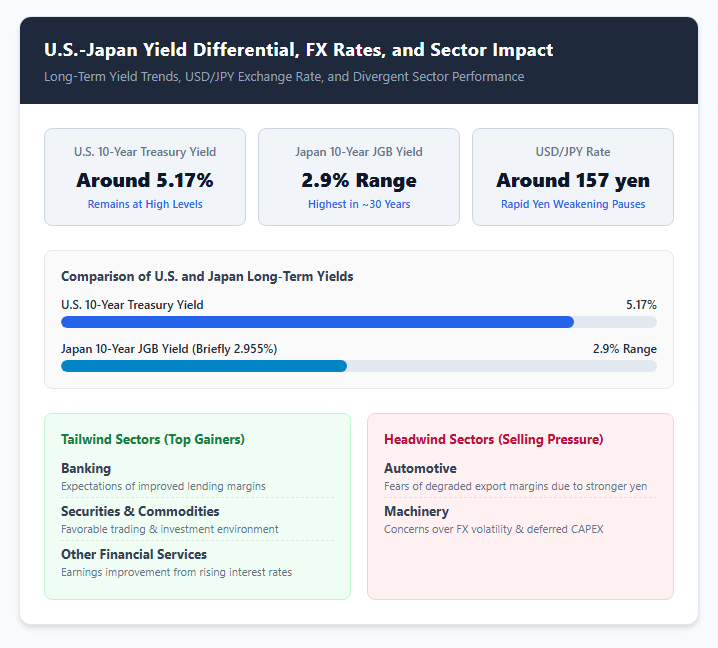
Movements in the USD/JPY exchange rate and the U.S.-Japan interest rate differential are also heavily influencing sector-by-sector stock selection. In late September 2026, the dollar-yen pair traded around 157 yen, signaling a pause in the rapid dollar-appreciation and yen-depreciation trend. While the U.S. 10-year Treasury yield hovered at a high level around 5.17%, Japan’s 10-year government bond yield rose into the 2.9% range—its highest level in roughly 30 years since September 1996. This narrowing yield spread prompted yen-buying flow. Additionally, joint concerns over excessive currency volatility expressed during the U.S.-Japan summit encouraged speculative yen-short positions to unwind. In response to these FX and yield dynamics, financial sectors such as banking, securities, commodity futures, and other financial services ranked among the top gainers on expectations of improved lending margins. On the other hand, export-oriented sectors like automotive and machinery faced selling pressure due to earnings degradation fears from a stronger yen, highlighting how differing sensitivities to interest rate rises and currency fluctuations are splitting sector fortunes. Please refer to the following figure for trends in the U.S.-Japan interest rate differential and exchange rates.
Medium- to Long-Term Outlook for Japanese Equities and Key Investment Strategies
BOJ Policy Decisions and the Return to a High-Interest-Rate Environment
In assessing the future of the Japanese market, the most crucial overarching theme is the Bank of Japan’s monetary policy normalization and the transition to a “world with interest rates.” At its September 2026 monetary policy meeting, the BOJ decided to raise its policy rate (uncollateralized overnight call rate) by 0.25% to approximately 1.25%. Governor Kazuo Ueda emphasized that the policy phase has shifted as underlying inflation approaches the 2% target, indicating an intention to continue incremental rate hikes based on economic and price developments. Japan’s 10-year government bond yield briefly reached 2.955%, marking the definitive end of the prolonged deflationary and ultra-low interest rate era. While rising interest rates signify economic normalization (“good rate increases”), a rapid pace of increase carries risks such as higher corporate borrowing costs and unrealized losses on bond holdings. Market participants are carefully evaluating the pace at which the BOJ will approach its terminal rate heading into 2027.
Corporate Earnings and Stock Price Forecasts Toward Late 2026
Despite shifts in monetary policy and macroeconomic volatility, major brokerage strategists maintain a generally bullish medium- to long-term outlook for Japanese stocks. Nomura Securities’ Market Strategy Research Department raised its end-2026 Nikkei 225 forecast from 66,000 yen to 68,000 yen and its TOPIX forecast to 4,200, reflecting stronger-than-expected earnings—particularly among AI and semiconductor companies—and corporate pricing power. Looking toward FY2027 corporate earnings, revenue and EPS growth are expected to be supported by the waning impact of Trump tariffs and the exit from deflation, facilitating a transition toward an earnings-driven market phase. However, in the short term, the Nikkei’s 12-month forward PER standing around 22x suggests potential valuation resistance compared to historical averages. Going forward, selective investment in high-performing value stocks will be key, while closely monitoring hyperscaler AI CAPEX sustainability, progress on growth investment policies under the Takaichi administration, and external shock risks stemming from Middle Eastern geopolitical tensions.
Reference Pages
- https://finance.yahoo.co.jp/news/detail/61b6de40c1b0350247c7a1df57ab7378dc20272b
【#Nikkei225 #TokyoStockExchange #SemiconductorStocks #USEconomicIndicators #MonetaryPolicy #ForeignExchange】


コメント