Taisho Kensetsu Co., Ltd., a general construction and civil engineering firm based in Kamisu, Ibaraki Prefecture, and its affiliate Taisho Co., Ltd., have ceased operations after filing for voluntary bankruptcy. Despite a strong track record in public works, the companies accumulated approximately 4.5 billion yen in total liabilities, weighed down by non-performing loans extended to the affiliate and surging costs across the broader construction industry.
- Bankruptcy Filing Context and Total Liabilities
- The Legacy of Taisho Kensetsu in Regional Infrastructure
- Non-Performing Intra-Group Loans of Approximately 900 Million Yen
- Soaring Industry Costs and the Inability to Pass On Price Increases
- Unfinished Project Sites and Regional Economic Fallout
- The 2025 Demographic Hurdle and Industry Restructuring Trends
Bankruptcy Filing Context and Total Liabilities
On September 24, 2026, civil engineering contractor Taisho Kensetsu Co., Ltd., headquartered in Kamisu City, Ibaraki Prefecture, along with its affiliate Taisho Co., Ltd., filed for voluntary bankruptcy with the Mito District Court and suspended operations. Combined liabilities for the two companies reached approximately 4.5 billion yen, consisting of roughly 2.9 billion yen for Taisho Kensetsu and about 1.6 billion yen for Taisho Co., Ltd. Operating primarily in Ibaraki and Chiba prefectures, Taisho Kensetsu was well known as a leading regional contractor handling a wide range of municipal projects, as well as private residential condominiums and commercial building construction. In recent years, however, the firm faced chronic cash flow shortages. Although it attempted to stay afloat by requesting debt rescheduling from financial institutions and increasing the proportion of bill payments to trade partners, it ultimately abandoned efforts toward self-funded restructuring. Given the company’s extensive history as a pillar of local infrastructure, the bankruptcy filing sent shockwaves through the regional construction industry and municipal governments.
The Legacy of Taisho Kensetsu in Regional Infrastructure
Founded in April 1949 and reorganized into a corporation in January 1969, Taisho Kensetsu built a long-standing history as a general contractor. It frequently secured direct public works contracts from government agencies, including the Ministry of Land, Infrastructure, Transport and Tourism, as well as Ibaraki Prefecture, Kamisu City, Chiba Prefecture, and Choshi City. Key projects under its belt include the reconstruction of Hasaki No. 1 Junior High School in Kamisu City, the construction of a regional disaster management center in the Hasaki district, and the building of a branch office for Kamisu City Hall. In civil engineering, the firm contributed significantly to local flood protection and transportation infrastructure through embankment construction along the Tone River and various road improvement projects. Even shortly before suspending operations, it completed construction of the Sharihama Seimei-no-Oka tsunami evacuation hill in Kamisu City in March 2026, maintaining active public construction work up to the end. Financially, Taisho Kensetsu posted a 20-year record high annual revenue of approximately 3.199 billion yen in the fiscal year ending June 2021. However, contract volume subsequently declined, pulling annual revenue down to about 2.023 billion yen for the fiscal year ending June 2026—a drop of roughly 1.176 billion yen (or approximately 36.8%) over five years, severely undermining the firm’s financial resilience.
Financial Factors and Structural Challenges Behind the Collapse
Non-Performing Intra-Group Loans of Approximately 900 Million Yen
A direct and decisive factor in Taisho Kensetsu’s bankruptcy was the accumulation of non-performing loans extended to its affiliate. Over the years, the firm repeatedly provided financial assistance to Taisho Co., Ltd., an affiliated entity established in April 1982. Taisho Co., Ltd. operated Inubow Terasu Terras, a commercial complex in Choshi, Chiba Prefecture, as well as senior housing projects, but suffered from ongoing underperformance and ultimately fell into negative net worth. Unrecoverable loans extended to this affiliate eventually swelled to approximately 900 million yen. This figure represented about 44.5% of Taisho Kensetsu’s most recent annual revenue (2.023 billion yen) and accounted for nearly 31% of its own 2.9 billion yen in liabilities. Already burdened by interest-bearing debt that far exceeded its annual revenue, the massive non-performing receivables severely crippled the firm’s balance sheet, exhausting its capacity to secure further support from financial lenders and leading to a complete standstill in liquidity.
Soaring Industry Costs and the Inability to Pass On Price Increases
Beyond individual financial missteps, Taisho Kensetsu’s failure reflects structural headwinds sweeping the broader construction industry. According to Teikoku Databank, corporate bankruptcies in Japan’s construction sector reached 1,890 cases in 2024, setting a 10-year high. In addition to persistently high prices for lumber, building materials, and energy, acute labor shortages and rising labor costs have severely eroded profits among small and medium-sized contractors. Of the bankruptcies recorded in 2024, 250 cases (13.2%) were attributed to inflation and surging material costs, while 99 cases stemmed from labor shortages. Furthermore, the rate of cost pass-through in the construction sector stood at just 43.7%, trailing the cross-industry average of 44.9% and highlighting the difficulty contractors face in passing inflated procurement costs onto project prices. Because construction contracts typically operate on a progress or completion payment model—requiring firms to pay upfront for materials and payroll—shrinking profit margins translate directly into immediate cash shortages, exposing companies to acute liquidity risks.
Future Outlook and Key Trends in the Construction Industry
Unfinished Project Sites and Regional Economic Fallout
A primary challenge in construction bankruptcies is handling halted job sites and mitigating cascading impacts on stakeholders. When active construction grounds to a sudden halt, contract defaults inevitably lead to disputes with property owners and project developers, incurring additional costs to secure replacement contractors and manage project delays. Moreover, due to the multi-tiered subcontracting structure typical of the construction industry, the collapse of a primary contractor leaves subcontractors and material suppliers unpaid, triggering potential chain-reaction bankruptcies and credit anxiety across the local economy. Please refer to the following diagram:
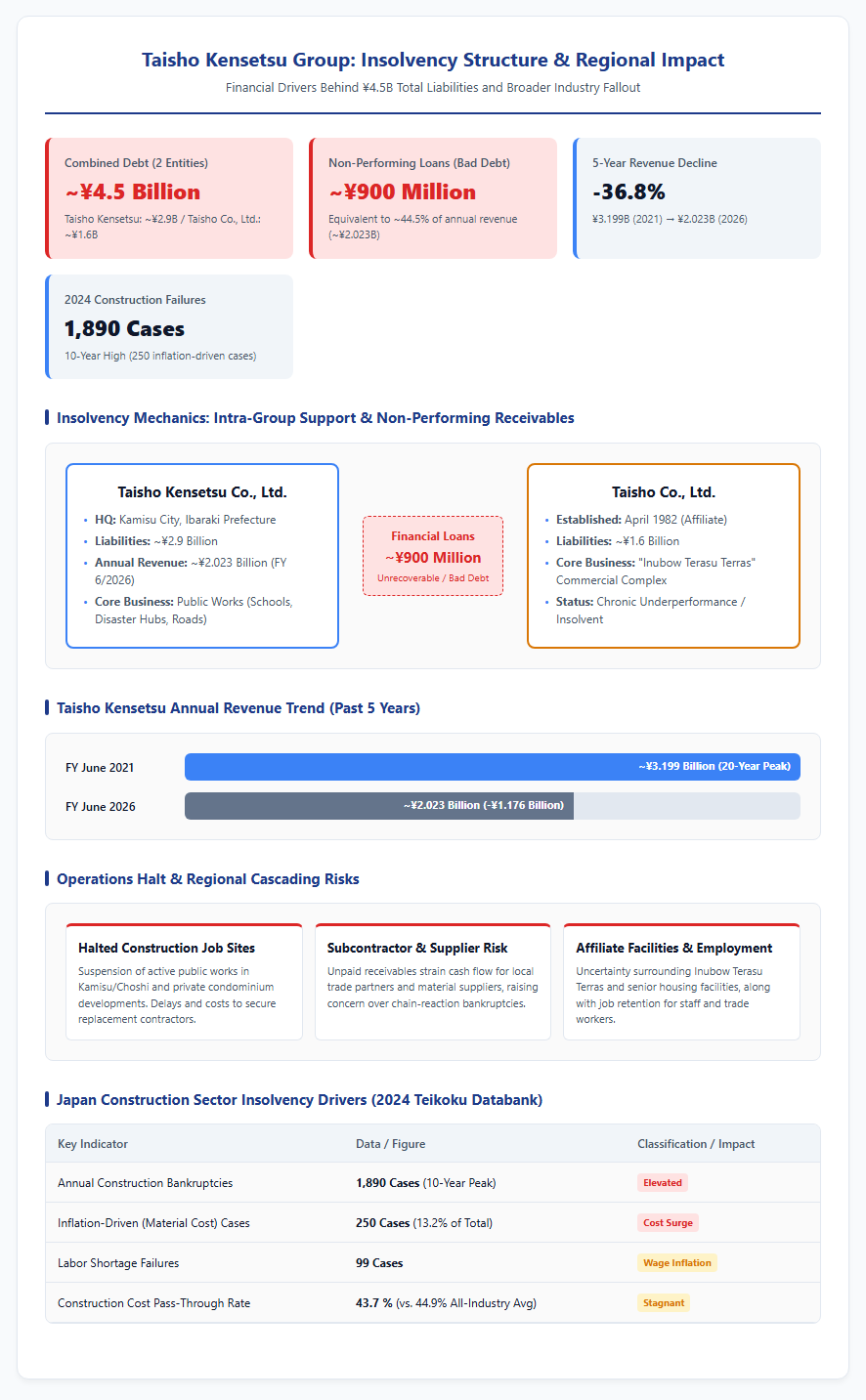
In the case of Taisho Kensetsu and Taisho Co., Ltd., which maintained numerous business relationships with subcontractors and trade partners in Kamisu City, Ibaraki Prefecture, and Choshi City, Chiba Prefecture, there are widespread concerns regarding the spillover effect of unpaid debts on the local economy. Furthermore, securing proper legal protection and providing prompt communication regarding back pay and employment safeguards for on-site tradespeople and staff remain urgent priorities.
The 2025 Demographic Hurdle and Industry Restructuring Trends
Bankruptcies in the construction sector are expected to remain elevated in the coming years. As Japan confronts the “2025 Problem”—the point at which the baby boomer generation reaches 75 or older—an increasing number of small contractors face retirement without successors, forcing business closures. Additionally, the phase-out of pandemic-era zero-zero loans and compliance with overtime caps introduced in April 2024 (the “2024 Problem”) continue to squeeze operating margins for smaller firms. Moving forward, maintaining order volume alone will not guarantee survival; contractors must enforce strict cash flow management, rigorous project profitability controls, and stronger corporate governance. As the failure of long-established firms demonstrates, relying solely on past accomplishments is no longer sufficient. Companies must proactively eliminate unprofitable units, explore M&A and business transfers, and strengthen their structural resilience to navigate an increasingly challenging market.
References
- 【Teikoku Databank Bankruptcy News: “Taisho Kensetsu Co., Ltd. and 1 Other Entity”】https://www.tdb.co.jp/report/bankruptcy/flash/5261/
【#TaishoKensetsu #Bankruptcy #ConstructionIndustry #PublicWorks #CashFlowCrisis #FinancialDistress #KamisuIbaraki】

コメント