The operator of Junglia Okinawa, a major theme park in northern Okinawa, is seeking additional loans and corporate investments to mitigate the risk of a potential cash shortage. This move follows a disappointing first year in which visitor attendance reached only about half of initial projections, leading the parent company to post a net loss of approximately 17.3 billion yen.
- Key Events and the Background Behind Additional Financing Requests
- Visitor Attendance Falling Severely Short of Initial Targets
- The 700 Billion Yen Funding Structure and Public Capital Involvement
- Limitations of Marketing Frameworks and Demand Forecasting
- Turnaround Strategy and Lowering the Breakeven Threshold
- Future Outlook and Key Factors to Watch
Key Events and the Background Behind Additional Financing Requests
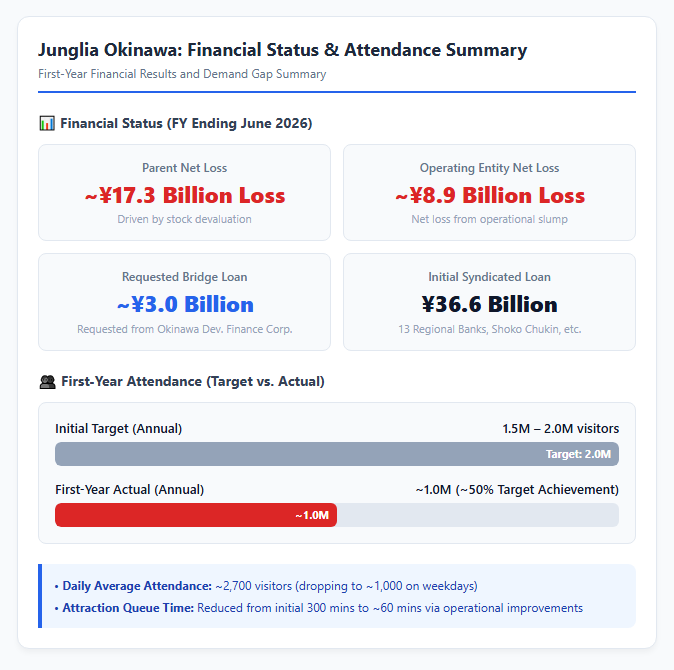
In July 2025, Junglia Okinawa—a large-scale theme park located in northern Okinawa Prefecture—opened its doors. Its operating company, Japan Entertainment, alongside parent entity Japan Entertainment Holdings, recently revealed that they are actively seeking additional bank loans and fresh corporate investors to head off an impending cash shortfall. The government-backed Okinawa Development Finance Corporation is currently evaluating a single-source bridge loan worth approximately 3 billion yen to supply immediate working capital. This new financing is expected to carry priority repayment conditions, and consent negotiations are underway with the syndicate of private banks that originally extended 36.6 billion yen in debt at launch. For the fiscal year ending June 2026, the parent company reported a net loss of roughly 17.3 billion yen, primarily driven by stock devaluation of its operating subsidiary. The operating entity itself logged a standalone loss of about 8.9 billion yen, underscoring severe financial headwinds in its inaugural year. While leadership has reaffirmed its commitment to keeping the park open, management faces an urgent need to restructure operations alongside securing new capital.
Visitor Attendance Falling Severely Short of Initial Targets
The root cause of Junglia Okinawa’s underperformance lies in visitor numbers that fell drastically short of original demand forecasts. Pre-opening business plans anticipated 1.5 million to 2 million guests in the first year. However, actual first-year attendance reached only around 1 million, representing a target achievement rate of roughly 50% to 60%. Although this averages out to about 2,700 guests per day, weekday attendance regularly dropped to around 1,000 visitors, severely depressing vital revenue streams from food, merchandise, and premium add-on attractions. Operational refinements successfully reduced peak queue times from an initial 300 minutes to roughly 60 minutes, but the park’s location in northern Okinawa continues to present a significant geographic access barrier, compounded by intense summer heat and humidity. While guest satisfaction surveys yielded high approval ratings near 90%, the park has struggled to drive repeat visits or attract broader demographics, leaving it directly exposed to the financial impact of depressed crowd sizes.
Structural Business Challenges and Demand Forecasting Issues
The 700 Billion Yen Funding Structure and Public Capital Involvement
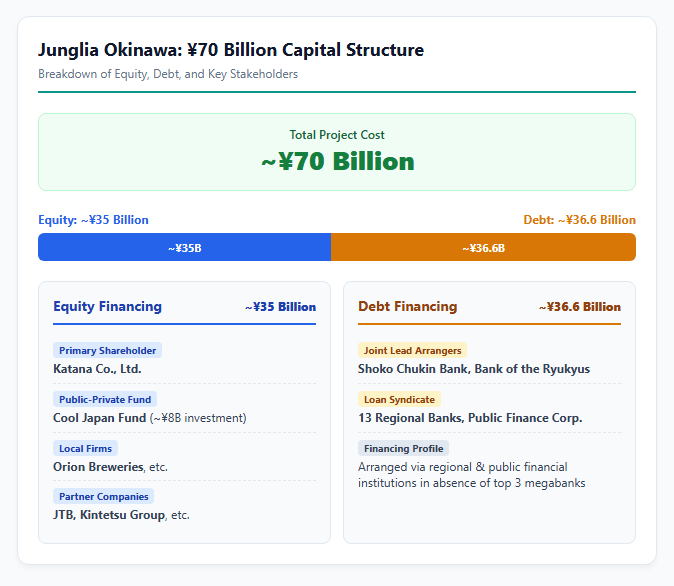
Junglia Okinawa was launched as a massive regional development project with a total price tag of approximately 70 billion yen. The initial capital stack consisted of roughly 35 billion yen in equity and 36.6 billion yen in debt financing. On the equity side, Katana Co., Ltd. serves as the primary shareholder, alongside local Okinawan firms such as Orion Breweries, travel company JTB, the Kintetsu Group, and the government-backed Cool Japan Fund, which injected approximately 8 billion yen. On the debt side, Shoko Chukin Bank and the Bank of the Ryukyus served as joint lead arrangers for a syndicated loan group comprising 13 regional banks and public financial institutions. Because both local capital and public funds are deeply invested, the park’s financial distress extends beyond a single private venture, presenting significant repercussions for regional finance and government bodies. With public funds deployed via the Cool Japan Fund and Okinawa Public Finance Corporation, the allocation of business risk and the realistic feasibility of capital recovery are coming under intense scrutiny.
Limitations of Marketing Frameworks and Demand Forecasting
The initiative was spearheaded by Katana Co., Ltd., a marketing consultancy led by Tsuyoshi Morioka, famed for his role in revitalizing Universal Studios Japan. Katana raised substantial funding based on proprietary mathematical demand forecasting models. However, critics highlight that applying turn-around strategies designed for established urban theme parks to a greenfield project in northern Okinawa—with vastly different transit access and climatic conditions—revealed clear limitations. While concept testing based on pre-launch surveys can gauge positive consumer sentiment, a pronounced gap emerged between optimistic survey responses and real-world travel purchasing decisions, where visitors must commit substantial travel budgets to endure outdoor attractions in intense heat. This outcome echoes the premature closure of another Katana-led venture in Tokyo that shuttered after roughly two years, sparking fierce industry debate over the precision of mathematical marketing models and the assessment of demand risk in novel destination concepts.
Business Restructuring and Future Outlook
Turnaround Strategy and Lowering the Breakeven Threshold
At the annual general meeting of shareholders held in Naha City on September 25, 2026, Tsuyoshi Morioka and Takeshi Kato, CEO of the operating company, offered formal apologies for crowd numbers falling dramatically below projections and presented a recovery blueprint. The central pillar presented to lenders involves transforming the operational model into one that achieves profitability even if visitor volume remains at roughly half of initial targets. To drastically lower the breakeven point, management is streamlining operations and reducing fixed costs, while evaluating operational changes such as introducing regular weekday closures (Mondays) beginning in 2027. To rebuild attendance, the park is optimizing its product lineup—introducing discounted “Flat Tickets” for short-duration visits, expanding premium tier offerings, and leveraging new ride installations like “Yanbaru Tornado,” which debuted in April 2026.
Future Outlook and Key Factors to Watch
The overarching focus for market observers is whether Junglia Okinawa can successfully restructure its business to establish itself as a viable, long-term tourism anchor. Because theme park developments require heavy upfront capital expenditures that are recovered over a multi-year horizon, first-year losses alone do not fully dictate a project’s ultimate viability. Indeed, a local study estimated an economic ripple effect of approximately 32.2 billion yen during the park’s first six months, citing positive contributions to regional employment and local business traffic. Moving forward, key determinants of success will include whether negotiations for new capital injections wrap up smoothly by year-end, and whether fresh attraction rollouts and improved transportation links can boost occupancy rates among repeat visitors and international tourists. Given the deep convergence of regional economics and public funding, stakeholders will closely monitor progress toward sustained crowd recovery and financial stabilization.
Reference Pages
- [Troubled “Junglia” Requests Additional Loans and Investment; Attendance at ~Half of Plan with “Cash Shortage Risk”: Yomiuri Shimbun] https://www.yomiuri.co.jp/economy/20260925-GYT1T00318/
[#JungliaOkinawa #AdditionalLoans #ThemeParkManagement #Katana #RegionalEconomy #DemandForecasting #Fundraising]

コメント