The City of Sapporo has fully launched demolition work on underutilized pedestrian footbridges across the city. This initiative addresses both the aging of structures erected during Japan’s rapid economic expansion—around the 1972 Sapporo Winter Olympics—and the pressing need to enhance urban accessibility while optimizing municipal maintenance costs.
- Overview of Demolition Work Due to Decreasing Usage and Aging Infrastructure
- Historical Background: Rapid Footbridge Expansion in the High-Growth Showa Era
- Establishment of the Review Committee and Formulation of Removal Guidelines
- Community Consensus Building and the Shift Toward Barrier-Free Infrastructure
- Balancing Removal Costs and Optimizing Long-Term Maintenance Budgets
- Focus Areas for Urban Infrastructure Restructuring in a Depopulating Society
Overview of Demolition Work Due to Decreasing Usage and Aging Infrastructure
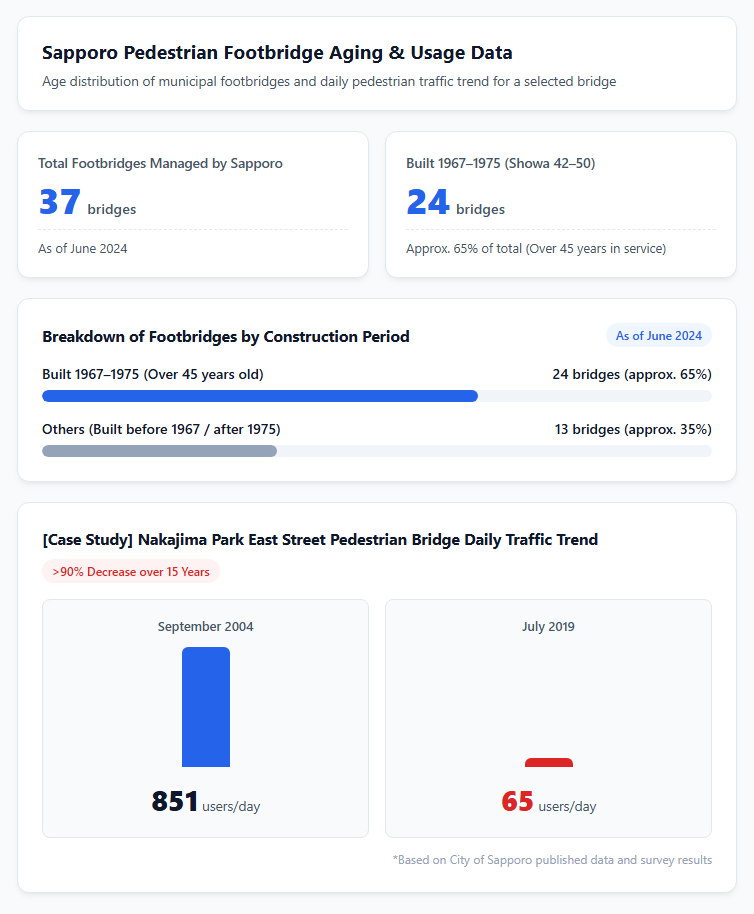
Across Sapporo, local authorities are systematically dismantling aged pedestrian footbridges that have experienced a drastic decline in daily users. As of June 2024, the City of Sapporo manages 37 pedestrian footbridges. Approximately 65% of these (24 bridges) were constructed between 1967 and 1975. Having been in service for over 45 years, these structures suffer from severe steel corrosion and concrete deterioration, making ongoing repairs and maintenance a significant financial strain on the municipal budget.
In addition, shifts in surrounding traffic conditions and pedestrian walking routes have led to a sharp drop in bridge utilization. A prominent example is the Nakajima Park East Street Pedestrian Bridge in Chuo Ward. In September 2004, it accommodated an average of 851 pedestrians per day; by July 2019, that figure had plunged to just 65 users per day—a decrease of more than 90% over 15 years. Recognizing that such footbridges no longer fulfill their intended function, the City of Sapporo decided to remove them to ensure public safety and curb long-term maintenance costs. During demolition operations, key priorities include:
- Implementing appropriate night-time road closures and traffic diversions while keeping local residents well-informed
- Mitigating noise and vibration caused by heavy machinery during disassembly
- Promoting the sorting and recycling of steel scrap and other demolition waste
With strict safety management and environmental protocols in place, the removal of obsolete infrastructure is steadily progressing.
Historical Background: Rapid Footbridge Expansion in the High-Growth Showa Era
The rapid expansion of pedestrian bridges in Sapporo traces back to the rapid rise of motorization during Japan’s high economic growth period of the late 1960s and 1970s. During this era, automobile ownership surged dramatically, leading to frequent traffic accidents—a widespread social crisis known as Japan’s “First Traffic War.” In response, municipalities aggressively constructed pedestrian overpasses as grade-separated crossings to physically isolate foot traffic from vehicular roadways.
In Sapporo specifically, urban infrastructure development received a major push ahead of the February 1972 Winter Olympics—the first Winter Games hosted in Asia. Numerous footbridges were constructed within a short span along major arterial thoroughfares, such as the Sapporo Shindo (construction started in 1969) and National Route 5 (Sosei-gawa Avenue), aiming to enhance pedestrian safety and ensure smooth vehicular flow. Notably, Sosei-gawa Avenue featured a series of distinctive footbridges equipped with spiral staircases, which served as symbols of cutting-edge engineering and traffic safety for decades.
However, nearly half a century later, footbridges requiring staircase navigation are increasingly avoided due to an aging population, heightened awareness of accessibility, and the addition of ground-level crosswalks and traffic signals. The Showa-era infrastructure that once guarded pedestrian safety is now reaching a critical turning point as society’s needs evolve.
Policy Framework and Decision-Making Committee for Footbridge Removal
Establishment of the Review Committee and Formulation of Removal Guidelines
To address declining usage and aging facilities, the City of Sapporo established the “Sapporo Pedestrian Footbridge Review Committee” in fiscal year 2012, comprising academic experts and specialists. The committee conducted usage surveys and structural health assessments across all municipal pedestrian bridges, ultimately releasing a unified set of criteria and recommendations in March 2013 regarding bridge preservation versus decommissioning.
Based on these recommendations, the city formulated the “Policy on the Removal of Pedestrian Footbridges in Sapporo,” establishing quantitative and qualitative evaluation criteria for identifying removal candidates. Sapporo reviews its candidate list every five years, conducting regular re-evaluations in December 2017 (1st review) and June 2024 (2nd review) to dynamically select bridges for removal.
When selecting candidate bridges, the following core factors are comprehensively evaluated:
- Daily footbridge pedestrian count and the ratio of users preferring ground-level crossings
- Designation as an official school route and actual daily usage by elementary school children
- Degree of impediment to accessibility for elderly citizens and individuals with disabilities who find stairways challenging
- Projected future life-cycle costs (maintenance and repainting expenses)
Through these guidelines, Sapporo established a balanced administrative procedure that considers overall urban safety and convenience rather than merely cutting maintenance costs.
Community Consensus Building and the Shift Toward Barrier-Free Infrastructure
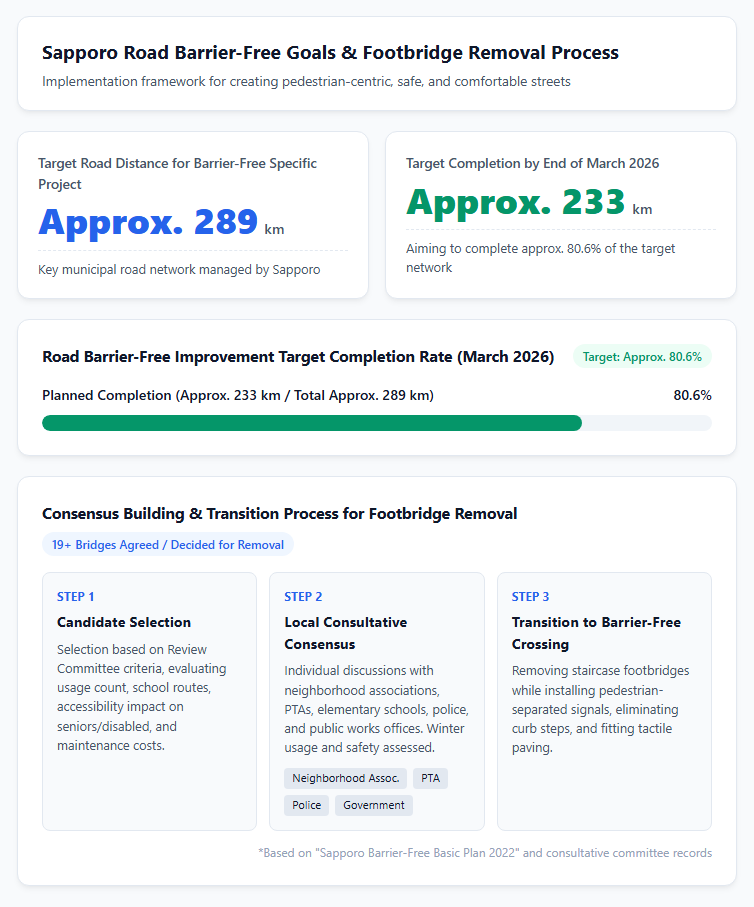
The final decision to remove a candidate footbridge is not made unilaterally by the municipal government; rather, it involves a careful consensus-building process with local communities. Sapporo’s ward offices establish dedicated local consultative committees comprising community neighborhood associations, PTAs, elementary school representatives, local police, and public works offices.
These consultative committees hold multiple discussions to deliberate whether to dismantle or preserve a bridge, relying on winter usage surveys and pedestrian traffic flow analyses. For example, regarding the aforementioned Nakajima Park East Street Pedestrian Bridge, two committee meetings were held in 2019. After confirming that demolition would cost approximately 30 million yen and that ground-level crossing safety could be maintained, a formal consensus for removal was reached. Since the removal of the Makomanai Olympic Village Footbridge in 1998, more than 19 pedestrian bridges—including those in front of the Central Library, Kikusui Nishimachi, Moiwashita, and Kotoni Elementary School—have been removed or slated for removal with local agreement.
Furthermore, footbridge removal is closely aligned with the “Sapporo Barrier-Free Basic Plan 2022” and the “Sapporo Barrier-Free Specific Project Plan.” Out of approximately 289 kilometers of municipal roads managed by Sapporo, the city aims to complete barrier-free upgrades across approximately 233 kilometers by the end of March 2026. By removing staircase-only footbridges and introducing pedestrian-separated signals, eliminating sidewalk curbs, and installing tactile paving for the visually impaired, Sapporo is transitioning toward a safer, barrier-free ground-level crossing environment for wheelchair users and senior citizens alike.
Challenges in Aging Infrastructure Management and Future Outlook
Balancing Removal Costs and Optimizing Long-Term Maintenance Budgets
One of the primary challenges in advancing footbridge demolition is securing necessary funding while optimizing overall maintenance expenditures. Demolishing a single footbridge costs tens of millions of yen. Given municipal fiscal constraints, systematic execution requires long-term budgetary planning.
Under the “Basic Policy for Road Maintenance” (revised April 2021), Sapporo adopted a “preventive maintenance” strategy for road assets such as bridges, pavements, and tunnels. Moving away from reactive repairs—where structures are fixed only after major damage occurs—the city focuses on minor repairs at early stages to minimize total life-cycle costs (LCC). For pedestrian bridges, the city prolongs the service life of essential bridges through repainting and structural repairs, while opting for early demolition of low-use bridges to avoid excessive future maintenance liabilities.
When deciding whether to maintain or remove a structure, authorities must carefully address the following operational considerations:
- Installing pedestrian-separated signals and optimizing traffic light timing to accommodate ground-level crossings
- Ensuring pedestrian safety at crosswalks and maintaining efficient snow removal operations during winter snow and ice conditions
- Minimizing temporary traffic disruptions and impacts on local logistics during demolition work
To maximize the efficiency of limited fiscal resources, strategic allocation and disciplined cost management remain essential.
Focus Areas for Urban Infrastructure Restructuring in a Depopulating Society
The removal of underutilized footbridges in Sapporo is more than a local demolition effort; it serves as a pioneering case study for local governments across Japan dealing with population decline and a super-aging society. As maintaining all infrastructure built during the high-growth period becomes financially unsustainable, transitioning toward smart infrastructure management focused on “downsizing and reorganization” is imperative.
A central focus for future urban infrastructure policy is realizing a compact city design where elderly individuals, people with disabilities, and all residents can move around easily. Replacing footbridges—built under automobile-first urban planning—with pedestrian-centric streetscapes where pedestrians and vehicles coexist enhances neighborhood vitality and urban appeal.
Moreover, managing aging infrastructure and consolidating public facilities are shared challenges for national, prefectural, and local governments throughout Japan. Sapporo’s consensus-building model, utilizing expert committees and local consultative panels, serves as a valuable benchmark nationwide. Removing footbridges that protected citizen safety for half a century represents a crucial step toward right-sizing urban space, improving accessibility, and building a sustainable city for future generations.
Reference Pages
- [Policy on the Removal of Pedestrian Footbridges – City of Sapporo] https://www.city.sapporo.jp/kensetsu/dokan/hodokyo/hodokyo.html
- [Road Barrier-Free Initiatives – City of Sapporo] https://www.city.sapporo.jp/kensetsu/stn/genzainojigyo/barrier/index.html
- [Basic Policy for Road Maintenance – City of Sapporo] https://www.city.sapporo.jp/kensetsu/doroiji/ijikanrikeikaku.html
【#Sapporo #PedestrianFootbridges #AgingInfrastructure #Accessibility #PublicWorks】


コメント