
JERA, Dell Technologies, and RHAELM have signed a memorandum of understanding regarding the standardization of AI data center infrastructure directly connected to power plants. The background behind this includes the rapidly increasing demand for AI computing and the power supply bottleneck issue where connecting to the existing power grid takes time.
- Japan’s First 400,000-kW Ultra-Large-Scale Project Underway at Chiba Thermal Power Station
- Overcoming the “10-Year Power Wait” Problem with On-Site Power Supply
- An Integrated “Molecule to Token” Approach from Molecules to AI
- Global Capital and Apollo’s Funding Strategy Involving a Billion Investment
- Revaluation and Disparity Among Major Electric Utility Stocks Holding Power Generation Assets
- Supply Chain Demand Expanding to Servers, Cooling, and Optical Communications
- Nationwide Rollout in the 2030s and the Outlook for Japan’s AI Infrastructure
Japan’s First 400,000-kW Ultra-Large-Scale Project Underway at Chiba Thermal Power Station
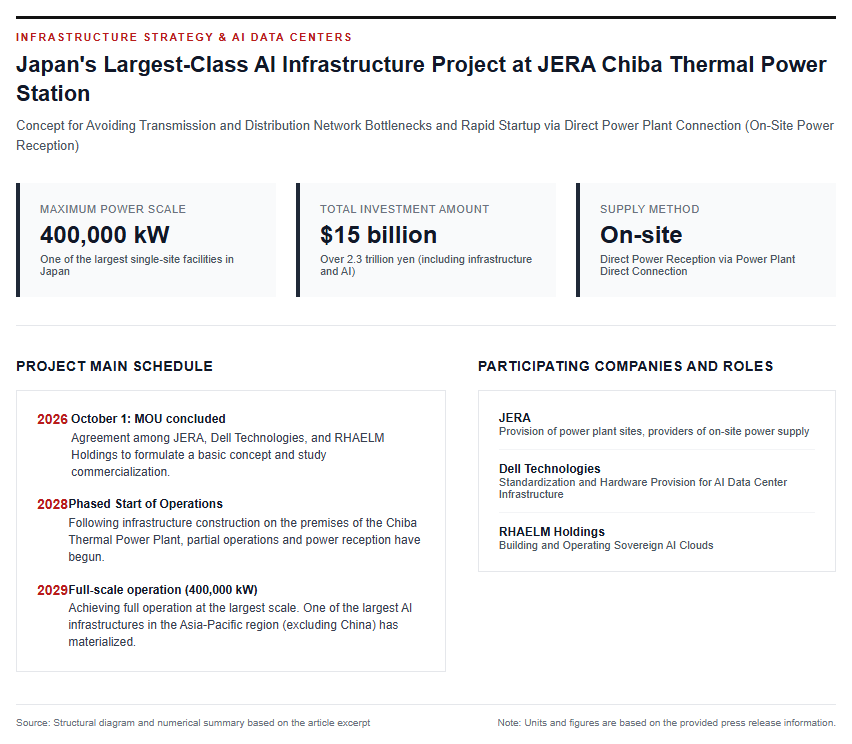
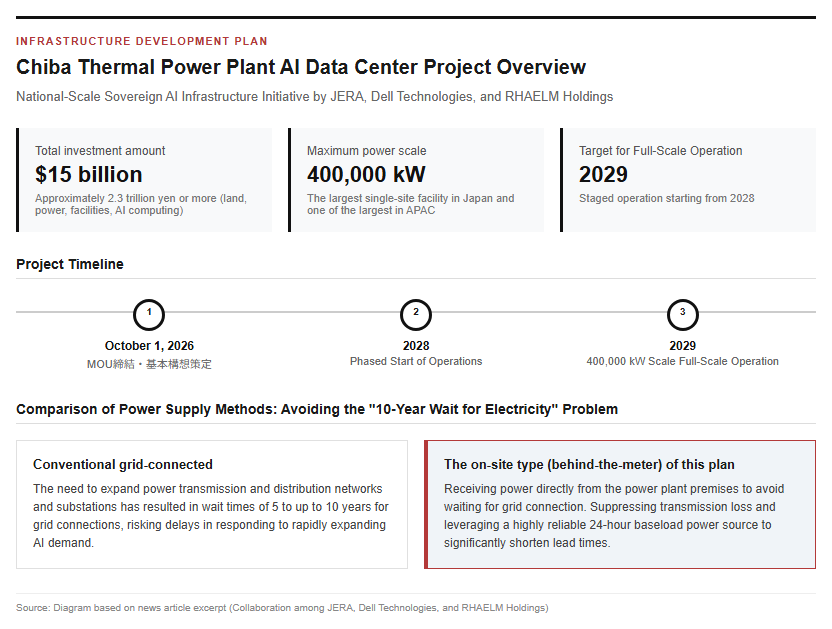
On October 1, 2026, major power generator JERA, IT giant Dell Technologies, and RHAELM Holdings, a provider of sovereign AI clouds, signed a memorandum of understanding (MOU) regarding the formulation of a basic concept and a commercialization study for national-scale AI infrastructure development in Japan. As the first project under this initiative, plans were announced to build an AI data center with a capacity of up to 400,000 kW on the grounds of JERA’s Chiba Thermal Power Plant in Chiba City, Chiba Prefecture. The project aims to begin phased operations in 2028, with full-scale operations at the 400,000 kW scale targeted for 2029.
The key features of this project are as follows.
– Total investment is expected to exceed 15 billion US dollars (approximately 2.3 trillion yen), including land, power infrastructure, facility construction, and AI computing capacity.
– As a single site, it is currently the largest in Japan and one of the largest AI deployments in the Asia-Pacific region excluding China.
– Adopting an “on-site power supply” model that receives electricity directly from existing thermal power generation facilities
By locating data centers on power plant premises, the initiative aims to achieve direct power reception that bypasses the transmission grid, thereby significantly shortening the lead time for infrastructure construction.
Overcoming the “10-Year Power Wait” Problem with On-Site Power Supply
While the development of AI data centers is rapidly surging domestically, the biggest obstacle facing operators is delays in connecting to the power supply grid. In the Tokyo metropolitan area and major urban centers, expansion work for substations and transmission and distribution networks cannot keep pace with the accelerating pace of demand, leading to a severe “waiting for power” issue where grid connections face delays of anywhere from 5 to nearly 10 years. Continuous, stable, and large-scale power is essential for the training and inference of AI models, marking a turning point where the speed of infrastructure procurement determines corporate competitiveness.
The on-site power generation method adopted by this project offers distinct advantages compared to conventional grid-connected systems.
– By adopting a “behind-the-meter” configuration that bypasses the transmission and distribution network, grid connection wait times can be avoided.
– capable of securing highly reliable power 24 hours a day by utilizing the baseload power of thermal power plants while minimizing transmission loss
– By integrating power infrastructure and computing resources, conventional development times can be shortened by a scale of several years.
This pioneering initiative is attracting significant attention as an effective solution to Japan’s structural challenge of power constraints.
Standardized Model and Business Structure through Three-Company Collaboration
An Integrated “Molecule to Token” Approach from Molecules to AI
The core concept of this three-company collaboration is the “Molecule to Token” business model, which seamlessly optimizes everything from fuel procurement to AI output generation. Up until now, AI infrastructure development has involved the separate design and procurement of power generation, power reception and transformation, cooling, server installation, and cloud operations, making extended development timelines and engineering complexities the norm. The three companies will establish a specialized working group to build a system that modularizes and standardizes each component to provide them in an integrated manner.
The roles played by each company are clearly divided.
– JERA: Responsible for fuel procurement through the LNG value chain, power generation, site provision, and on-site power supply
– Dell Technologies: Delivering Pre-integrated Rack-Scale AI Infrastructure with “Dell AI Factory”
– RHAELM: Responsible for driving development across the entire project, constructing and operating data centers, and providing sovereign AI cloud.
By eliminating custom designs and establishing a standard model, rapid rollout across Japan and global markets becomes possible.
Global Capital and Apollo’s Funding Strategy Involving a Billion Investment
Supporting the massive capital investment of $15 billion (approximately 2.3 trillion yen) for the first project in Chiba is U.S. alternative asset management giant Apollo Global Management. Apollo is participating as RHAELM’s strategic investment and financing partner, establishing a long-term funding structure using advanced project finance techniques. This demonstrates that AI infrastructure investment has transcended the realm of conventional IT capital investment and is transforming into large-scale real estate and energy asset investments on a national infrastructure scale.
The characteristics of the global funding model include the following elements:
– Creating a long-term revenue foundation by packaging power generation assets and land, data center buildings, and computing GPUs into a unified package
– Enter into long-term contracts with tech companies and cloud providers based on on-site PPAs (Power Purchase Agreements)
– Leverage the capital of infrastructure investment funds to generate long-term, stable cash flows.
This model, formed by a trinity of energy companies, global financial institutions, and IT vendors, has the potential to become a benchmark for future global digital infrastructure investment.
Industrial Structure and Spillover Effects on the Stock Market
Revaluation and Disparity Among Major Electric Utility Stocks Holding Power Generation Assets
The establishment of a business model that attracts and co-locates AI data centers on land adjacent to power plants will bring significant changes to the revenue structure of the electric power industry. For Chubu Electric Power and Tokyo Electric Power Company Holdings, the parent companies of JERA, in addition to the increased asset value of their owned power plant sites, revenue growth is expected through large-scale electricity sales contracts, transmission and distribution network usage revenue, and equity-method investment profits from JERA. The addition of a high-margin business pillar that stands apart from existing retail electricity competition is expected to lead to a market revaluation.
Meanwhile, in the stock market, the risk of diverging fortunes among electric power companies is also being pointed out.
– Chubu Electric Power and TEPCO HD: Revenue Growth Expected Through Capturing Large-Scale Demand in the Tokyo Metropolitan Area and Site Utilization
– Kyushu Electric Power and Hokkaido Electric Power: Concerns that falling behind in directly attracting large-scale data centers will widen the growth gap with competitors
– US Independent Power Producers: Like frontrunners such as Vistra, the ability to offer power generation assets and adjacent land as a set will act as a stock catalyst
The dynamic in which companies that have secured power infrastructure hold strong bargaining power upstream in the AI chain is becoming increasingly pronounced.
Supply Chain Demand Expanding to Servers, Cooling, and Optical Communications
The operation of an unprecedented 400MW-scale, high-density AI data center will trigger a strong demand ripple effect across the hardware and peripheral infrastructure markets. Because the high-density servers to be deployed by Dell will be heavily equipped with cutting-edge GPUs and high-bandwidth memory (HBM), an increase in orders is anticipated for electronic component manufacturers such as Japan Electronic Materials, which handles semiconductor testing and manufacturing equipment components. Furthermore, because heat generation per rack will be extremely high, conventional air-cooling methods will no longer suffice, making the adoption of liquid-cooling systems and highly heat-resistant insulation and structural materials essential.
The main affected sectors along the supply chain are as follows.
– Semiconductor inspection equipment: Expanding demand for probe cards for GPU and HBM wafer testing
– Cooling Infrastructure and High-Performance Materials: Increased demand for Teijin’s strong high-performance materials, such as aramid and carbon fibers, for liquid cooling system enclosures.
– Optical Interconnects: Increased adoption of optical transceivers and optoelectronic fusion components supporting ultra-high-speed communication inside data centers
The ripple effects of AI investment are rapidly expanding beyond semiconductors alone to power, cooling, and high-speed communication networks.
Nationwide Rollout in the 2030s and the Outlook for Japan’s AI Infrastructure
JERA and RHAELM are considering expanding the standardization model established in the pioneering project in Chiba across the remaining 25-plus thermal power plants owned by JERA domestically. They aim to build a total scale of several million kW of AI computing capacity throughout Japan in the 2030s, which is deeply aligned with the watt-bit integration and the GX Strategy Zone system promoted by the Ministry of Economy, Trade and Industry. From the perspective of data sovereignty as well, ensuring that processing environments for critical data and autonomous AI agents are maintained on domestic infrastructure is a crucial national strategic issue.
The future outlook and key points to watch are as follows.
– Construction Progress of the Chiba Project and Demonstration Results Toward Phased Operation in 2028
– Materialization of the 2nd and 3rd Projects at Thermal Power Plants in Other Domestic Regions and the Effect on Mitigating Grid Congestion
– Expansion of the Japan-originated “power-plant-direct and standardized model” into overseas markets, with a primary focus on the Asia-Pacific region
Building sustainable AI infrastructure that integrates energy and IT will be the single most critical factor determining Japan’s digital industrial competitiveness.
Reference Page
- [JERA Co., Inc. Press Release] https://www.jera.co.jp/news/information/20261001_2535
【#AIDataCenter #JERA #Dell #PowerInfrastructure #Standardization #DigitalTransformation】

コメント