The total amount of initial budget requests for fiscal 2027 has swelled to a record high of over 143 trillion yen, making the approach to fiscal policy under the reshuffled Takaichi Cabinet a major focus. In the background are the creation of new growth investment frameworks and a sharp increase in interest payments associated with rising interest rates, putting both fiscal sustainability and inflation control to the test.
- Overview of the Record-Breaking Over 143 Trillion Yen and Factors Behind the Expansion of Expenditures
- The “Strong and Prosperous Japan” Investment Framework and the Structural Exit from Dependence on Supplementary Budgets
- The Risk of Expanding Government Bond Interest Payments Due to Rising Interest Rates
- The Chain of Market Fiscal Concerns, Yen Depreciation, and Declining Bond Prices
- The Ministry of Finance’s Strict Assessment and the Screening of the “17 Strategic Fields”
- Securing Stable Revenue Sources, Future Diet Deliberations, and Fiscal Discipline
Overview of the Record-Breaking Over 143 Trillion Yen and Factors Behind the Expansion of Expenditures
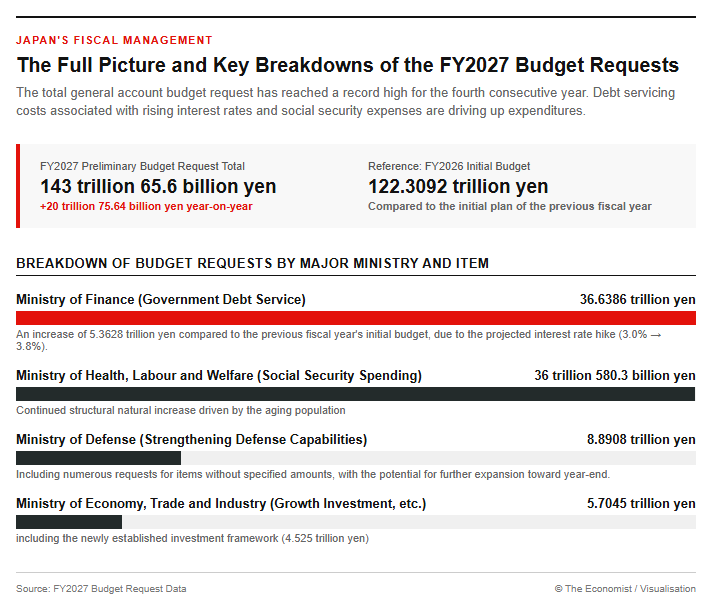
The approximate budget requests for fiscal 2027 (Reiwa 9), which closed on August 31, 2026, reached a total general account request of ¥143.0656 trillion, setting a record high for the fourth consecutive year. This represents a substantial increase of approximately ¥20.7564 trillion compared to the initial budget of ¥122.3092 trillion for the previous fiscal year. The main drivers behind this expenditure expansion are not limited to the natural growth of social security costs and the reinforcement of defense capabilities; the new budget framework introduced by the Takaichi administration and the rise in long-term interest rates are also having a direct impact.
The breakdown of major budget requests by ministry is as follows:
- Ministry of Finance (National Debt Service): 36.6386 trillion yen (an increase of 5.3628 trillion yen from the previous fiscal year’s initial budget)
- Ministry of Health, Labour and Welfare: 36.5803 trillion yen (increase in social security expenses)
- Ministry of Defense: 8.8908 trillion yen (including numerous requests without specified amounts)
- Ministry of Economy, Trade and Industry: 5.7045 trillion yen (including 4.525 trillion yen for the investment framework)
National debt expenses, allocated for the payment of interest and redemption of government bonds, surged due to a significant hike in the assumed interest rate from 3.0% to 3.8% per annum. In addition, social security expenditures by the Ministry of Health, Labour and Welfare reached a record high, with structural spending pressures associated with the aging population continuing. Numerous itemized requests without specified amounts are also included, centering on defense spending, and the actual budget scale may expand even further ahead of the year-end budget compilation. Please refer to the figure below.
The “Strong and Prosperous Japan” Investment Framework and the Structural Exit from Dependence on Supplementary Budgets
The structural background behind the swelling of this fiscal request to the scale of 143 trillion yen lies in the new budget compilation policy based on the “responsible expansionary fiscal policy” advocated by the Takaichi administration. A major feature is the establishment of the “Strong and Prosperous Japan” investment frame, which allows various government ministries and agencies to apply for budgets in growth and crisis management fields without a request ceiling. For this investment frame alone, requests totaling 12.173 trillion yen for the general account poured in, exceeding the 10 trillion yen initially anticipated by the government.
Furthermore, aiming to break away from the “reliance on supplementary budgets” that had become habitual in conventional fiscal management, a policy was set forth to consolidate permanent economic measures and subsidy programs into the initial budget. When compared with the combined total of 140.6126 trillion yen, consisting of the fiscal 2025 supplementary budget (18.3034 trillion yen) and the fiscal 2026 initial budget (122.3092 trillion yen), some estimates indicate that the actual increase in the fiscal 2027 budget requests will remain at around 2.4 trillion yen (an increase of about 2%). While the aim is to enhance transparency by comprehensively recording expenditures starting from the initial budget stage, it is undeniable that the removal of request caps has simultaneously fueled a surge in ministries’ eagerness to secure budgets.
Market Risks Brought by Fiscal Expansion and Their Spillover Effects on Interest Rates and Foreign Exchange
The Risk of Expanding Government Bond Interest Payments Due to Rising Interest Rates
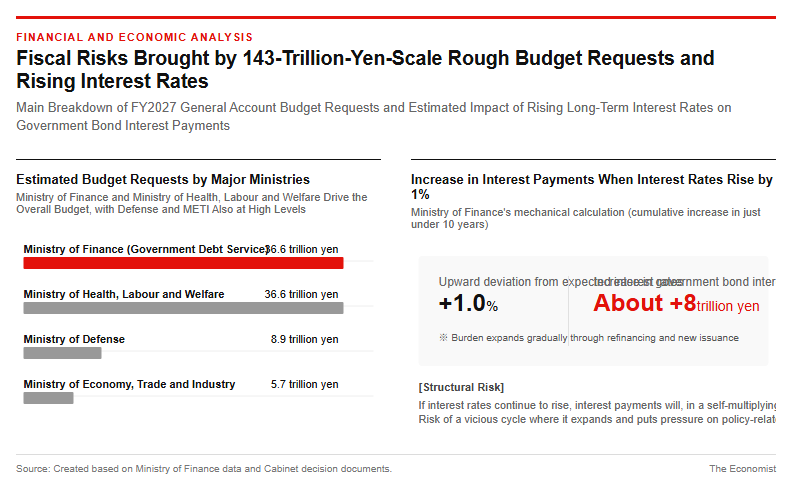
As the Japanese economy transitions to a “world with interest rates,” the impact of massive budget formulation on future government bond interest payments has become a serious concern. Due to the influence of existing bonds issued during the low-interest-rate era, the effective interest rate borne by the government is currently kept around 1%. However, as long-term interest rates rise toward the 3% range, the effective interest rate will gradually rise as the refinancing and new issuance of government bonds progress.
According to mechanical projections by the Ministry of Finance, if interest rates rise by 1% above expectations, government bond interest payments will increase by approximately 8 trillion yen in just under 10 years. The increase in interest payments accompanying higher interest rates will squeeze other policy expenditures, such as social security and education expenses. While a fiscal collapse will not occur immediately as long as the nominal GDP growth rate exceeds the effective interest rate, if interest rates continue to rise, national debt expenses will balloon in a self-multiplying manner, heightening the risk of falling into a vicious cycle where “borrowing to repay debt” increases. Please refer to the figure below.
The Chain of Market Fiscal Concerns, Yen Depreciation, and Declining Bond Prices
In response to the fiscal expansion stance of the Takaichi administration, selling pressure driven by concerns over lax fiscal discipline has been intensifying in the financial markets. In the foreign exchange market, the depreciation of the yen rapidly accelerated, temporarily pushing the rate from the 157 to the 158 yen per dollar range, while in the bond market, the rise in long-term interest rates (falling bond prices) also accelerated. Large-scale fiscal stimulus that induces excess demand has heightened inflation expectations, resulting in a downward push on the value of Japan’s currency.
Market participants and economists point out a vicious cycle in which excessive expansion in spending generates a widening trade deficit and pressure to buy the US dollar and sell the yen, further fueling high prices. To prevent side effects such as the market turbulence caused by excessive tax cuts and fiscal expansion in the UK (the Truss shock), it is essential for the administration to demonstrate a disciplined fiscal management stance. Amid the possibility of monetary tightening by the Bank of Japan and market interventions by the Ministry of Finance and the BOJ, maintaining market confidence has become the central focus.
Focus in Future Budget Compilation and Challenges for Fiscal Consolidation
The Ministry of Finance’s Strict Assessment and the Screening of the “17 Strategic Fields”
Regarding the 143 trillion yen in rough budget requests submitted at the end of August, the Ministry of Finance is conducting rigorous screening as it works toward finalizing the government budget proposal at the end of the year. The investment framework assessment policy outlined by the Ministry clearly demonstrates a stance that places the highest priority not merely on the scale of expenditures, but on their substantial impact on economic growth and their ability to stimulate private investment. Specifically, the following review criteria have been established.
- Clarification of 5W1H (who, by when, what, and how it will be done)
- Presentation of the logical rationale (winning strategy) for monetizing the supported technology
- Establishing a mechanism to monitor and review progress
The “17 strategic fields” set forth by the government in its Japan Growth Strategy (such as AI and semiconductors, quantum, biotech, defense, disaster prevention and national resilience, and GX) span a wide range of areas, requiring strict screening to prevent indiscriminate budget allocation and the dispersion of policy resources. During the budgeting process, the question is whether projects with little growth impact can be cut and intensive investments can be directed toward fields that truly lead to enhanced competitiveness.
Securing Stable Revenue Sources, Future Diet Deliberations, and Fiscal Discipline
In the Second Takaichi Reshuffled Cabinet, which was formed in October 2026, the biggest hurdle will be the budget compilation and discussions on fiscal consolidation targets leading up to the extraordinary Diet session in the autumn and the Cabinet decision at the end of the year. In the Basic Policy 2026, the framework for fiscal targets was shifted from the conventional primary balance (PB) surplus target to “the stable reduction of the government debt-to-GDP ratio.” However, there is also criticism that shifting to an indicator dependent on the growth of nominal GDP—the denominator—will hollow out single-year fiscal discipline.
Furthermore, securing permanent and stable revenue sources for the food consumption tax cut bill championed by Prime Minister Takaichi and the defense spending increase remains unclear. Attention is focused on how to balance growth support and fiscal sustainability ahead of Diet deliberations between the ruling and opposition parties in the extraordinary Diet session convened in October, and the Cabinet decision on the government budget draft in late December. Whether the government can curb excessive reliance on government bond issuance and demonstrate its commitment to fiscal discipline to the market will determine the credibility of the Japanese economy.
Reference page
- [Ministry of Finance: FY2027 General Account Budget Estimate Requests and Demands] https://www.mof.go.jp/policy/budget/budger_workflow/budget/fy2027/sy20260904.pdf
- [Ministry of Finance: Perspectives on Budget Compilation for the “Strong and Prosperous Japan” Investment Framework] https://www.mof.go.jp/policy/budget/budger_workflow/budget/fy2027/tousiwaku1.pdf
【#TakaichiAdministration #FY2027Budget #BudgetRequests #143TrillionYen #FiscalExpansion #RisingInterestRates #ResponsibleProactiveFiscalPolicy #EconomicPolicy】


コメント