At a post-Cabinet press conference on October 2, 2026, Minister of Economy, Trade and Industry Ryosei Akazawa announced that the government intends to support the restructuring of the domestic power semiconductor business. In the background are the difficulties faced in integration talks among three companies—Mitsubishi Electric, Toshiba, and Rohm—as well as a strong sense of crisis regarding the global scale-expansion competition and the rapid rise of Chinese players.
- METI Minister Akazawa’s Remarks Amid Stalled Negotiations and the Government’s Aim
- Structural Factors Behind the Stalling ROHM Bidding War and Three-Company Integration Talks
- Shifts in the EV Market and the Investment Burden Surrounding Next-Generation SiC Semiconductors
- Expanding scale to counter the fierce pursuit by Chinese rivals and Western giants
- Lessons from Past Hinomaru Semiconductor Integrations and the Barrier of Real Synergy
- Strengthening the Domestic Supply Chain and Medium- to Long-Term Industrial Outlook
METI Minister Akazawa’s Remarks Amid Stalled Negotiations and the Government’s Aim
Minister of Economy, Trade and Industry Ryosei Akazawa stated at a post-Cabinet press conference on October 2, 2026, that regarding the power semiconductor business—which is essential for next-generation social infrastructure such as automobiles, artificial intelligence, and data centers—the Ministry of Economy, Trade and Industry will strongly support business restructuring and collaboration among domestic companies. Domestically, in March 2026, Mitsubishi Electric, Toshiba, and Rohm signed a basic agreement toward the business integration of their power semiconductor operations and had been proceeding with talks aiming for a definitive agreement around the summer of 2026, but the coordination work has been taking longer than initially expected. Emphasizing that power semiconductors are vital materials supporting the foundation of diverse industries, Minister Akazawa indicated his intention to use government leadership to encourage the consolidation of domestic players in order to establish a stable domestic supply system and strengthen industrial competitiveness.
Structural Factors Behind the Stalling ROHM Bidding War and Three-Company Integration Talks
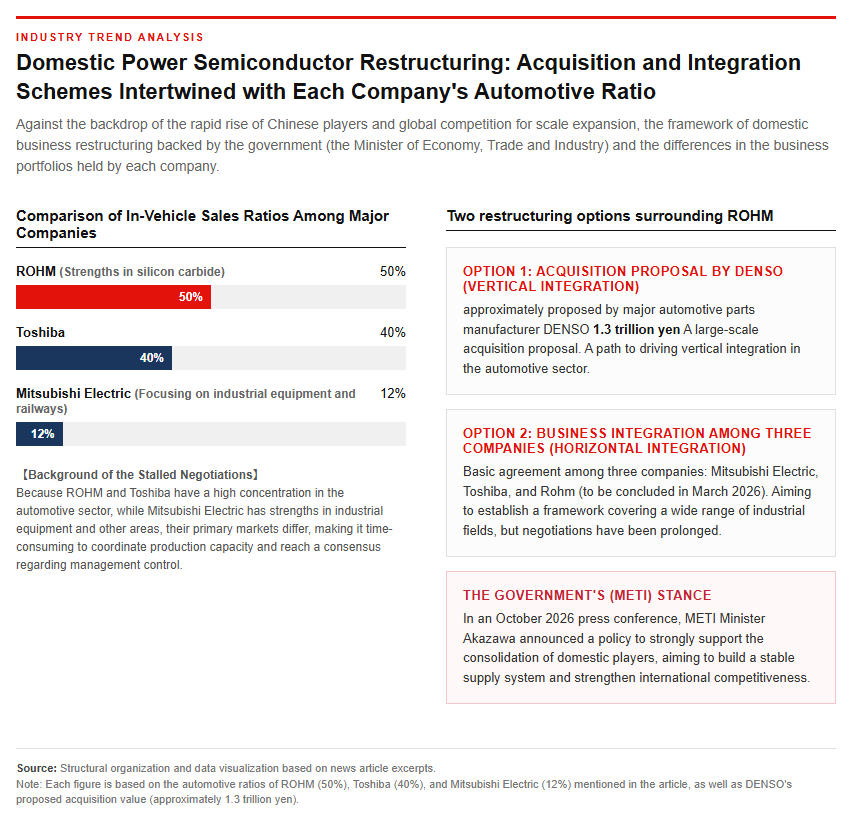
At the center of this restructuring drama is ROHM, which boasts strengths in automotive semiconductors and silicon carbide technology. In March 2026, an acquisition proposal worth approximately 1.3 trillion yen from major automotive parts supplier DENSO came to light, sending massive shockwaves through the industry. For ROHM, two options exist: entering under DENSO’s umbrella to pursue vertical integration in the automotive sector, or partnering with Toshiba and Mitsubishi Electric to pursue horizontal integration covering a wide range of industrial fields. However, the respective strategies and interests of the companies are intricately intertwined behind the scenes of the integration talks. While ROHM has a high automotive ratio of 50% and Toshiba 40%, Mitsubishi Electric focuses primarily on industrial equipment and railway applications, with its automotive ratio remaining at just 12%. Reaching a consensus is taking time due to adjustments over target primary markets and production capacities, as well as debates surrounding post-integration management control, which are the factors causing the negotiations to stall. The diagram below illustrates the interrelationships and restructuring structure of various companies in the domestic power semiconductor industry.
Shifts in the EV Market and the Investment Burden Surrounding Next-Generation SiC Semiconductors
Power semiconductors are electronic components responsible for power conversion and control. SiC (silicon carbide) power semiconductors have been attracting attention as a material directly linked to extending the cruising range of electric vehicles (EVs) and improving rapid charging performance. Recently, however, due to the global slowdown in the EV market and the recovery in demand for hybrid vehicles, the SiC market has been hit by temporary oversupply and falling prices. ROHM posted its first net loss in 12 years in its financial results for the fiscal year ending March 2025, forcing it to revise its capital expenditure plans. Furthermore, the burden of upfront investment is weighing heavily on companies, as evidenced by major US SiC manufacturer Wolfspeed filing for Chapter 11 bankruptcy protection in June 2025. Massive funds are required for research and development and the transition to 8-inch wafers necessary for the mass production of next-generation semiconductors, and the fact that standalone companies are reaching their limits in continuing investments is increasing consolidation pressure.
The Intensification of Global Competition and the Winning Strategy for the Hinomaru Alliance
Expanding scale to counter the fierce pursuit by Chinese rivals and Western giants
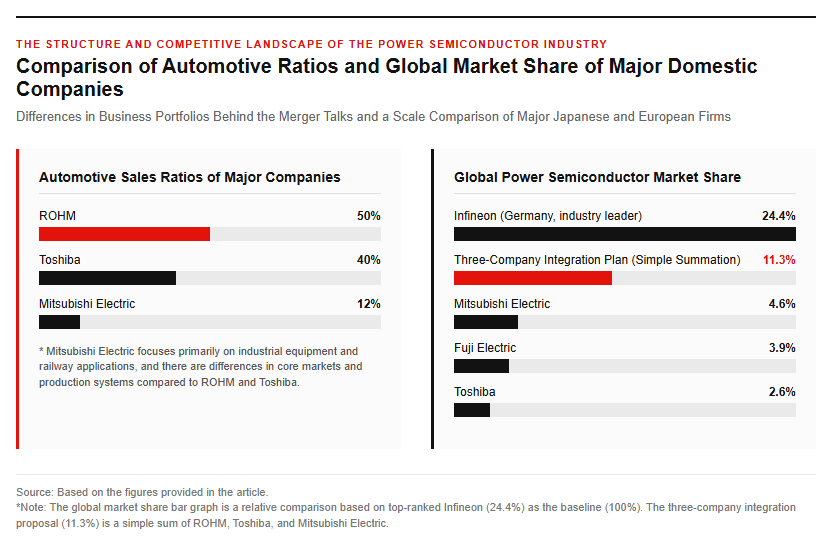
In the global power semiconductor market, Germany’s Infineon Technologies holds the top spot with a global market share of approximately 24.4%, while major US and European firms like ON Semiconductor lead the market by leveraging their massive investment power and economies of scale. In contrast, Japanese players—such as Mitsubishi Electric with about 4.6%, Fuji Electric with about 3.9%, and Toshiba with about 2.6%—feature a crowded field of mid-sized companies and have found themselves at a disadvantage in terms of individual corporate scale. If ROHM, Toshiba, and Mitsubishi Electric were to integrate their operations, their simple combined market share would reach approximately 11.3%, creating the world’s second-largest power semiconductor group. However, the recent rise of state-backed Chinese competitors has been formidable; a subsidiary of EV giant BYD has surpassed ROHM to break into the global top 10, and their aggressive push armed with low prices poses a threat to Japanese companies. Securing scale through the consolidation of domestic players has become an urgent task.
Lessons from Past Hinomaru Semiconductor Integrations and the Barrier of Real Synergy
However, expanding business scale alone is no guarantee of winning global competition. Looking back at the history of past “Hinomaru semiconductor” restructuring, there are numerous examples of post-merger management failure, such as the bankruptcy of Elpida Memory—created through the integration of DRAM businesses—and the prolonged slump of Japan Display, which integrated small-and-medium LCD businesses. Renesas Electronics CEO Hidetoshi Shibata has also adopted a wait-and-see approach regarding the current three-way integration talks until the locus of leadership becomes clear. A structure resembling a merger of equals is prone to internal power struggles and delayed decision-making. To achieve true synergy from the integration, strong governance is essential to swiftly execute the restructuring of overlapping production bases and the consolidation of production lines, such as ROHM’s Miyazaki Plant, Kaga Toshiba Electronics, and Mitsubishi Electric’s new Fukuoka and Kumamoto plants. The following image is a clean room conceptual image of a next-generation power semiconductor plant.
Strengthening the Domestic Supply Chain and Medium- to Long-Term Industrial Outlook
According to Fuji Keizai’s projections, the global power semiconductor market is expected to expand to 7.3495 trillion yen by 2035, with next-generation power semiconductors such as SiC and GaN accounting for 2.5077 trillion yen of that total. Along with this market expansion, the wave of demand is extending beyond automotive applications to power supplies for data centers driven by the proliferation of generative AI, as well as to power transmission and distribution infrastructure for renewable energy. If ROHM’s automotive technology, Toshiba’s analog and power supply technology, and Mitsubishi Electric’s high-voltage and industrial infrastructure technology can be combined, it will be possible to build a business portfolio that is resilient to fluctuations in specific markets. From the perspective of economic security as well, maintaining and strengthening the domestic supply chain for power semiconductors—which are critical materials—is of paramount importance for Japanese industry as a whole, and reaching a final agreement in negotiations during 2026 and the subsequent execution will determine the future of Japan’s semiconductor industry.
Reference Page
- [Akazawa, Minister of Economy, Trade and Industry, “Will Support” Domestic Restructuring of Power Semiconductor Business Following Difficult Integration Talks Involving ROHM and Others – ITmedia NEWS] https://www.itmedia.co.jp/news/articles/2610/02/news197.html
【#PowerSemiconductors #METI #IndustryConsolidation #ROHM #MitsubishiElectric #Toshiba #SiC #Semiconductors】

コメント