After being acquired by Nippon Steel, US Steel is now on track to dramatically turn a profit. Behind this lies the management integration that overcame political tensions between Japan and the United States, and on-site reforms brought by Nippon Steel through advanced production technology.
- Completion of acquisition and projected profits of 220 billion yen
- Signs of revival seen in the third quarter of fiscal year 2024
- Aging equipment and the implementation of on-site reforms
- A massive investment of 3.6 trillion yen and the price of ‘golden stocks’
- Transition to next-generation steel processes and synergies
- Future Highlights and Remaining Risks
Completion of acquisition and projected profits of 220 billion yen
Nippon Steel’s acquisition of US Steel followed an unprecedented development, escalating into diplomatic and political issues between Japan and the United States. After the acquisition announcement in December 2023, former President Biden issued a trade ban order in January 2025 citing national security concerns, but in April of the same year, President Trump instructed the Committee on Foreign Investment in the United States (CFIUS) to re-examine the deal, and the partnership was ultimately approved on June 13. On June 18, 2025, the acquisition was officially completed, making US Steel a wholly owned subsidiary of Nippon Steel.
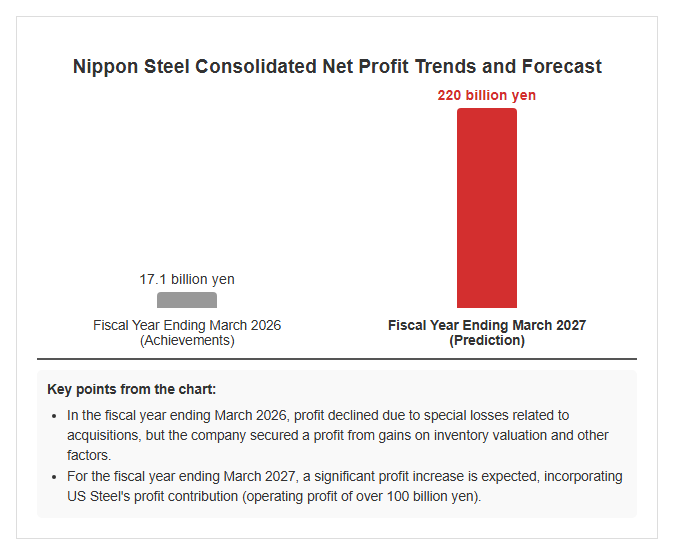
Following this historic integration, Nippon Steel’s consolidated financial results for the fiscal year ending March 2026, announced on May 13, 2026, recorded sales revenue of 10.0632 trillion yen, a 15.7% increase year-on-year. Notably, the outlook going forward is forecast: net profit for the fiscal year ending March 2027, which includes US Steel’s profit contribution, is expected to expand significantly from 17.1 billion yen in the previous fiscal year to 220 billion yen. Even on a business profit basis, excluding fluctuations in inventory valuation, US Steel alone is estimated to generate profits exceeding 100 billion yen, clearly indicating the strengthening of profitability through the acquisition. Please refer to the diagram below.
Signs of revival seen in the third quarter of fiscal year 2024
Even in the third quarter of 2024 financial results, which were in the midst of the integration process, US Steel delivered solid results. Net income for the quarter was $119 million ($0.48 per share), and adjusted EBITDA reached $319 million. Although this was a decline compared to net income of $299 million in the same period last year, it demonstrated resilience in a challenging market environment with a declining average selling price, as well as a diverse product mix and increased contract volume.
In particular, in the core of the post-acquisition growth strategy, the “minimill” segment, adjusted EBITDA margin remains at 11%, excluding a temporary startup cost of $40 million from strategic projects. Additionally, the state-of-the-art electric furnace equipment “Big River 2 (BR2)” is scheduled to begin its first shipments in Q4 2024, and growth investments exceeding $4 billion are beginning to bear fruit. These achievements confirm that US Steel had been advancing its own modernization even before full-scale technical support from Nippon Steel began.
[Background of Management and Strategy] Technological Innovation Brought by Nippon Steel
Aging equipment and the implementation of on-site reforms
Behind US Steel’s eagerness to become a subsidiary of Nippon Steel was the aging of equipment and declining production efficiency, which were difficult to resolve on its own. At the time of the acquisition announcement, the company’s site still had ’90-year-old equipment,’ and some factories had defect rates as high as 50%, indicating an extremely serious situation. Despite being a long-lived company founded in 1901, most of its profits over the past 100 years have not been accumulated as internal reserves, and before 2021, retained earnings were almost zero, resulting in a financial structure with limited investment capacity.
To overcome this situation, Nippon Steel dispatched a specialized team of about 100 people, mainly engineers, to the site. They identify 260 specific areas for improvement on-site and are promoting gritty site reforms that leverage Japan’s expertise in manufacturing. Through this, the company aims to improve the “yield rate,” which indicates the ratio of good products to raw materials, and is outlining a strategy to ensure the capture of demand for high value-added steel materials such as automotive applications by upgrading aging blast furnaces and upgrading production technology.
A massive investment of 3.6 trillion yen and the price of ‘golden stocks’
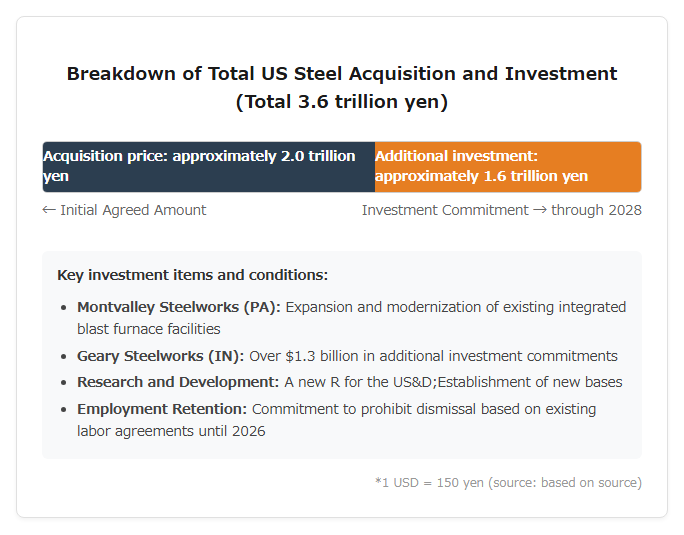
The price Nippon Steel paid to close this deal far exceeded initial expectations. As of December 2023, the acquisition price was estimated at about 2 trillion yen, but after political persuasion in the U.S., concessions to labor unions, and promises of additional capital investment, the total cost has ballooned to around 3.6 trillion yen as of now. This includes an investment of $11 billion (approximately 1.6 trillion yen) in US Steel by 2028, with plans to expand the Montbury steel mill in Pennsylvania and establish a new research and development base. Please refer to the diagram below.
Additionally, to address national security concerns, Nippon Steel accepted the unusual measure of issuing a “golden share” to the U.S. government. This gave the U.S. government the authority to appoint and remove independent directors of US Steel and exercise strong consent rights regarding the closure of existing sites, procurement from outside the U.S., and reductions in capital expenditures. Even if it meant paying the “excessively high price” of certain restrictions on management freedom, Nippon Steel prioritized securing a base in the North American market, where growth potential was expected.
[Mid- to Long-Term Outlook] Decarbonization and the Future of Global Strategies
Transition to next-generation steel processes and synergies
One of the biggest shared goals pursued by both companies through the integration is achieving carbon neutrality by 2050. US Steel is planning to shift from conventional carbon reduction steelmaking to hydrogen direct reduction furnaces and large electric melting furnaces (melters), and Nippon Steel’s technology, a global leader in this field, will provide a decisive competitive advantage. Nippon Steel has already succeeded in reducing CO2 emissions by 43%, the world’s highest level, by using heated hydrogen in its test furnaces, and plans to accelerate decarbonization by introducing this expertise to US Steel’s sites.
On the product side, strong synergy is expected in the production of “high-performance electromagnetic steel sheets (NGOs),” which are essential for electric vehicle (EV) drive motors. Nippon Steel possesses the world’s first commercial production technology for top-grade electromagnetic steel sheets integrated with electric furnaces, and by transplanting this technology to the latest electric furnaces such as US Steel’s Big River Steel, it aims to expand its market share in the North American EV market. Thus, the positive effects of integration are becoming increasingly clear in both low-carbon technologies and high value-added products.
Future Highlights and Remaining Risks
While turning a profit is becoming a reality, there are still many issues that require close attention. First, the relationship with the United States Steelworkers Union (USW). Initially, the union side strongly opposed the acquisition, but after President Trump’s ‘conditional approval’ and Nippon Steel’s promises of job retention and massive investment, they effectively shifted their stance. However, as improvement activities and equipment rationalization progress on-site, the risk of conflicts over labor practices and emotional backlash still remains.
Geopolitical fluctuations are also a major source of uncertainty. The rising energy and material costs due to the escalating tensions in the Middle East are directly driving up steel costs. Nippon Steel President Imai has indicated a policy to pass on cost increases to product prices as much as possible, but depending on market demand trends, this could put pressure on profits. Whether the massive investment of 3.6 trillion yen will be remembered in history as a “successful deal” depends on how much effective synergy can be demonstrated in the years following the integration.
[#USスチール #日本製鉄 #黒字化 #M&A #鉄鋼業界 #経済ニュース #ビジネス戦略]


コメント