
OpenAI has begun considering postponing its initial target IPO within the year until 2027. This is driven by CEO Sam Altman’s desire to maintain a massive $1 trillion valuation and concerns about financial risks associated with astronomical computational resource costs.
- Rethinking OpenAI’s IPO schedule
- The contradiction between massive losses and rapidly expanding business scale
- The deepening rift between the CEO and CFO over the timing of the listing
- The Burden of Investment in Astronomical Computational Resources
- Threat of a pre-IPO from competitor Anthropic
- Google’s Rise Threatening Its Technological Leadership
- Transition to Public Benefit Corporation and Its Impact
- Capital Circulation and Expectations for the AI Industry Toward 2027
Rethinking OpenAI’s IPO schedule
On June 25, 2026, it was reported that OpenAI, known for its conversational AI “ChatGPT,” began considering postponing its initial public offering (IPO) until 2027. In June 2026, the company had just filed a private IPO application with the U.S. Securities and Exchange Commission (SEC), but has shifted to a cautious stance in response to changes in the market environment. The main reasons for the postponement include overall volatility in technology stocks and the fact that the stock price of SpaceX, a space development company that went public earlier, fell from its recent high of $202 to $153, indicating cooling demand from individual investors. To management, bankers have presented two options: to wait until 2027 and aim for a $1 trillion (about 161.7 trillion yen) listing valuation, or to lower the target valuation and go public early, but CEO Sam Altman has refused to change the $1 trillion target.
The contradiction between massive losses and rapidly expanding business scale
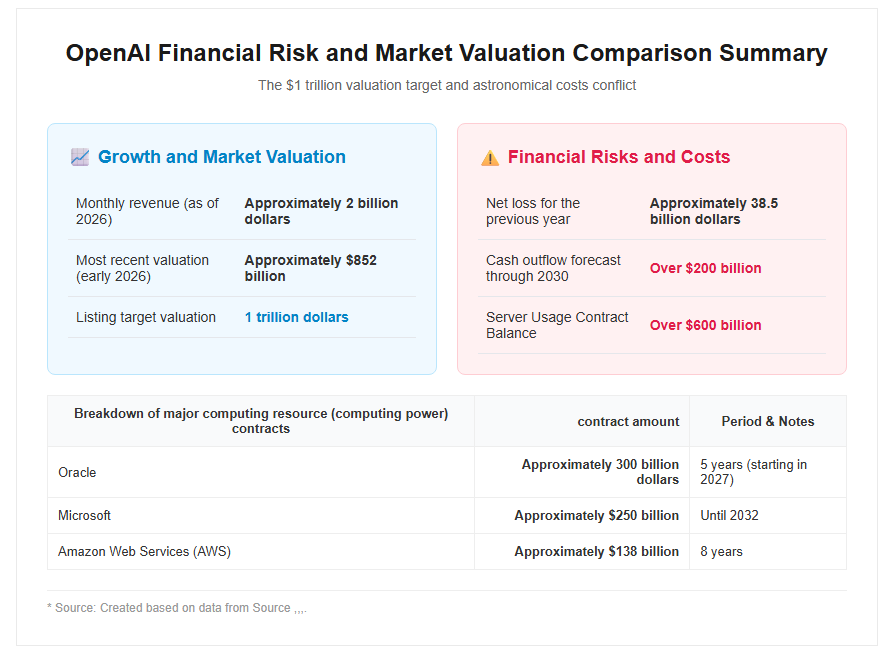
OpenAI’s financial situation is unique, with phenomenal revenue growth coexisting with massive deficits. The company’s monthly revenue reached a record $2 billion (about 320 billion yen), and by early 2026, it had completed a large funding round of $122 billion. However, according to the most recent audited financial statements, the previous year recorded a substantial net loss of $38.5 billion (approximately 6.2 trillion yen). The main driver of this loss was the $34 billion (about 5.5 trillion yen) spent on securing computing power, research and development, and organizational restructuring. Among investors, skepticism has begun to emerge as to whether massive investments in generative AI will yield sufficient returns in the future, and further profitability improvements are needed to justify current valuations. The chart below shows the balance between OpenAI’s financial risk and market valuation.
Management Conflicts and Serious Financial Risks
The deepening rift between the CEO and CFO over the timing of the listing
Within OpenAI, there is a serious disagreement between CEO Sam Altman and CFO Sarah Fria (Chief Financial Officer) over the timing of the IPO. Altman wants to push ahead with the IPO in Q4 2026 to get ahead of its biggest competitor, Anthropic, but Freia considers it “premature” and takes the opposite stance. This conflict has also affected the organizational structure, and since August 2025, Mr. Fria has stepped outside Altman’s reporting line—an extremely unusual situation for a major tech company. There have been increasing instances where Altman removes Julia from key financial planning discussions, and the discord between the two top executives has emerged as a major governance concern ahead of the IPO.
The Burden of Investment in Astronomical Computational Resources
The main reason CFO Sarah Furia is cautious about going public is the astronomical expenditure obligation associated with securing “computing power (computing resources),” which is essential for future AI model development. OpenAI has warned investors that Cashburn by 2030 could exceed $200 billion (about 31.9 trillion yen), more than double its initial forecast. Specific server usage contracts include $300 billion with Oracle, $250 billion with Microsoft, and $138 billion with Amazon Web Services (AWS), totaling over $600 billion (about 95.8 trillion yen) in the coming years. Mr. Julia doubts whether these massive spending commitments can be fully covered by current sales growth, and he is concerned that upfront investment risks could threaten the company’s survival.
Intensifying competition and technical barriers in the AI market
Threat of a pre-IPO from competitor Anthropic
OpenAI’s rush to make an IPO decision is driven by the moves of its rival, Anthropic. Anthropic has filed a secret SEC filing ahead of OpenAI and is moving toward a listing as early as October 2026. Anthropic has rapidly expanded its revenue from its programming tool series “Claude,” with reports indicating that the intrinsic value of unlisted shares has recently surged to $1.4 trillion. For CEO Altman, the top priority is to list at a higher valuation than Anthropic and without missing the right timing to clearly establish his position as a leader in the AI industry. However, there are limits to the scale of losses the market can tolerate, and the IPOs of both companies are seen as the biggest touchstone for testing the sustainability of the AI boom.
Google’s Rise Threatening Its Technological Leadership
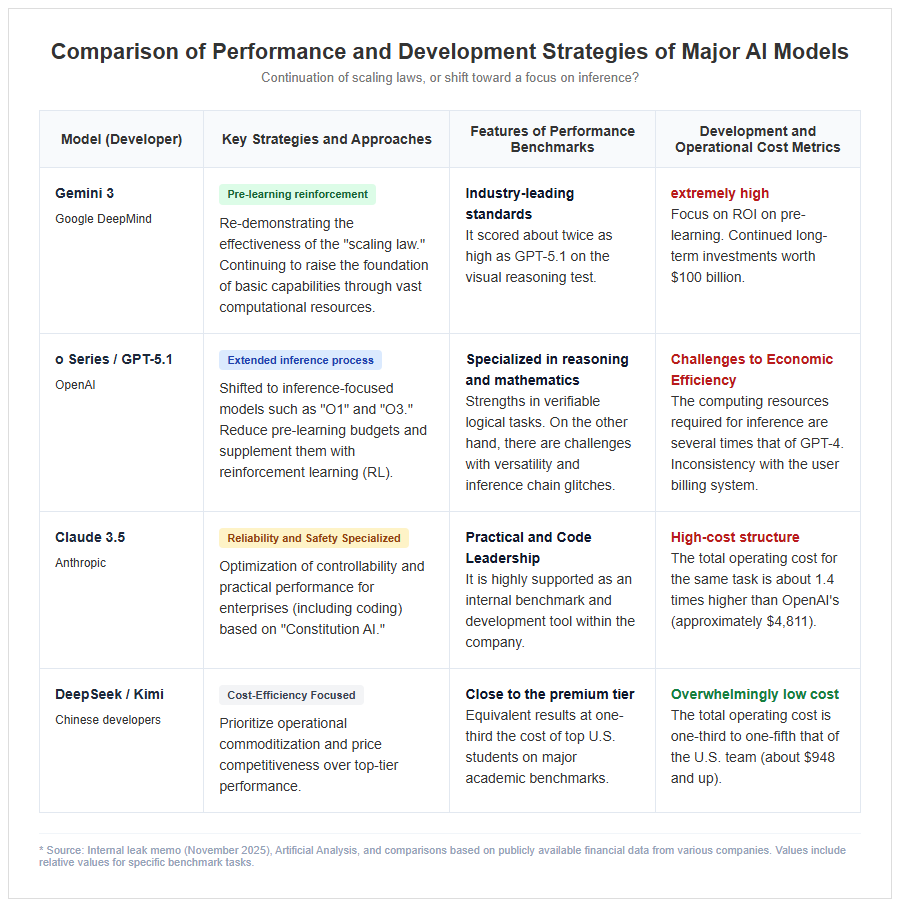
On the technical side, OpenAI is also facing a tough situation. According to an internal memo leaked in November 2025, Google’s released “Gemini 3” outperformed OpenAI’s latest model in key benchmarks. In the memo, CEO Altman openly acknowledged Google’s achievements and called on employees to “face temporary economic headwinds” and transition to a “wartime regime.” OpenAI foresaw the “end of the scaling law,” where existing learning methods approached their limits, steering toward the inference-focused “o-series” model. However, Google is still achieving dramatic performance gains through investment in pre-training, raising concerns that OpenAI’s strategic “bet” could backfire. The chart below compares the performance and development costs of major AI models.
Future Outlook and Key Points for Investors
Transition to Public Benefit Corporation and Its Impact
OpenAI is planning to transition its organizational structure to a Public Benefit Corporation (PBC), anticipating upcoming large-scale fundraising and going public. Following the October 2025 restructuring, longtime partner Microsoft holds about 27% of the new organization’s shares, valued at approximately $135 billion. This transition will allow OpenAI to break away from traditional nonprofit control and establish a system to accept capital from the market in a manner closer to typical companies. However, the challenge of balancing our mission (contribution to all humanity) with shareholder interests remains, which will be a key governance test point for our 2027 listing.
Capital Circulation and Expectations for the AI Industry Toward 2027
The decision to postpone the IPO to 2027 represents a strategic shift for OpenAI from “offense” to “defensive.” Over the next year, the focus will be on building concrete monetization models to justify the $1 trillion valuation and optimizing computational resource costs. On the other hand, significant cash conversion opportunities are being offered to prevent the loss of top talent, such as raising the limit for employee secondary stock sales to $30 million. Investors will be closely watching the development progress of next-generation models like the “Shalotte Pete,” which is expected to be announced throughout 2026, as well as the trajectory of the technology race with Google. OpenAI’s journey toward 2027 is not just about preparing a single company to go public, but is entering a long-term battle that will determine the future of the entire AI industry.
[#OpenAI #IPO #AIビジネス #サムアルトマン #テックニュース #経済]

コメント