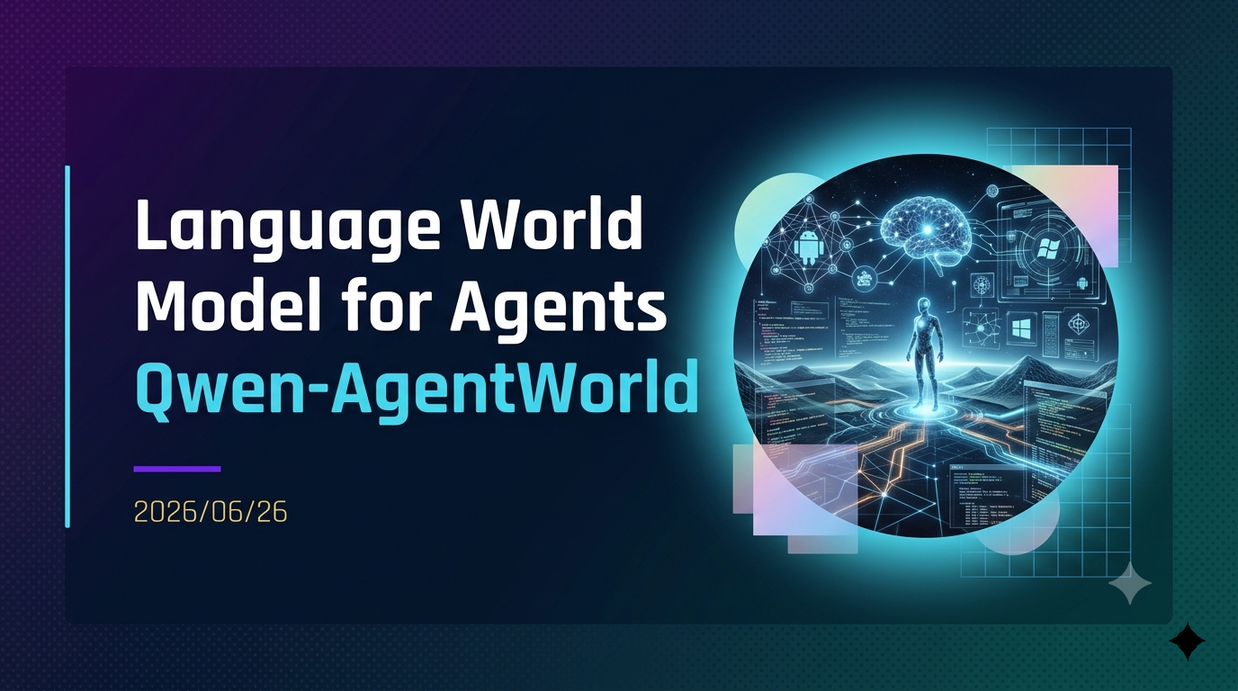
On June 23, 2026, Alibaba in China announced a groundbreaking language world model called “Qwen-AgentWorld,” which internally simulates the environment in which AI agents operate. This model has the potential to dramatically enhance the capabilities of general-purpose agents by shifting training processes that relied on traditional production environments to virtual simulations.
- Reproducing seven types of execution environments with a single model
- “Native” Design Philosophy and Learning Process
- Simulation learning without the need for a ‘production environment’
- The highest level of reproduction quality demonstrated by benchmarks
- Suspicions of Distillation Attacks and Ethical Challenges in Model Development
- The Future of “AI Driving Schools” in Virtual Environments
Reproducing seven types of execution environments with a single model
On June 23, 2026, Qwen, Alibaba’s AI research team, announced a “Native Language World Model” that simulates the very environment in which AI agents operate. This model was developed with the goal of completing the training that AI agents previously did in actual production environments within the virtual space inside the model.
Its greatest feature is the ability to reproduce up to seven diverse execution environments within a single model. Specifically, this includes MCP, the standard protocol for connecting external tools, search engines, terminal environments such as Linux, software development environments (SWE), web browsers, desktop OS, and Android smartphone environments.
While traditional AI agents focused on determining “what should be done next from the current state,” Qwen-AgentWorld provides agents with the ability to predict “how the world will change next due to their own actions.” This allows agents to quickly mentally verify “what the consequences would be if this operation were performed” before actually taking any action.
“Native” Design Philosophy and Learning Process
Qwen-AgentWorld is not a retrofit of an existing general-purpose language model, but rather a “native” world model trained from the design stage primarily for environmental modeling. The learning process consists of three rivid, three-stage learning: Continuous Pre-Learning (CPT), Supervised Fine Tuning (SFT), and Reinforcement Learning (RL).
The development of this model utilized over 10 million actual agent operation logs. By not including external API outputs in the training data, the goal is for the model to truly “understand” the physical and logical transitions of the environment without relying on external resources.
The model lineup includes two types: the “Qwen-AgentWorld-35B-A3B” with a total of 350 billion parameters, and the “Qwen-AgentWorld-397B-A17B” with 3.97 trillion parameters. In particular, the 35B model adopts a MoE (Mixture of Experts) structure, where only 3 billion valid parameters operate during inference, achieving extremely high inference efficiency. Additionally, with an overwhelming context length of 262,144 tokens, it accurately processes long-term agent behavior histories spanning thousands of steps, enabling simulations with minimal logical failures.
Impact and Practicality of AI Agent Development
Simulation learning without the need for a ‘production environment’
The biggest challenge in traditional AI agent development was the cost and risk of training in actual “production environments” such as websites or operating systems. Not only did API usage fees arise, but processing speeds were slow, and there was always a risk of data deletion or unnecessary external communication due to misoperations.
The introduction of Qwen-AgentWorld triggers a paradigm shift by shifting agent development from “production testing” to “training workshops.” Developers can generate tens of thousands of virtual environments within the model without connecting to the real environment, enabling them to safely and quickly execute large-scale reinforcement learning.
Another unique advantage of simulation environments is that you can freely control the environment and intentionally generate errors or exceptions. For example, intentionally creating situations that agents struggle with—such as communication failures, incomplete search results, and complex permission errors—which are not frequent in the real world but are difficult to handle, can efficiently enhance agent robustness. In fact, it has been reported that after generating and training in a completely fictional search world, performance on actual search tasks also improved.
The highest level of reproduction quality demonstrated by benchmarks
The performance of Qwen-AgentWorld is quantitatively demonstrated by the newly published benchmark for seven domains, “AgentWorldBench.” This benchmark evaluates models across five dimensions: factual accuracy, consistency, and realism of simulations.
According to the evaluation results, the top-tier model, the 397B version, achieved simulation quality in overall scores that surpassed the latest flagship models from competitors such as GPT-5.4, Claude Opus 4.8, and Gemini 3.1 Pro. It demonstrates remarkable reproducibility, especially in the fields of software development (SWE) and operating systems.
Please refer to the diagram below.
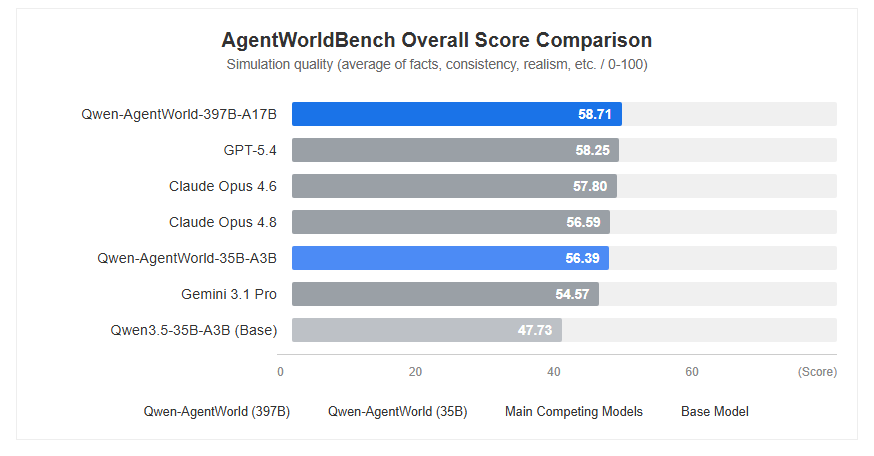
Even the 35B-A3B model, which adopts an efficient MoE architecture, delivers performance that matches or even matches the massive models that far exceed its size. This demonstrates that the model is not simply memorizing specific data but has deeply learned the “structural principles” of environmental simulation, demonstrating high adaptability even to unknown environments not included in the training.
Industry Landscape and Future Outlook
Suspicions of Distillation Attacks and Ethical Challenges in Model Development
Alongside Qwen-AgentWorld’s impressive announcement, ethical and legal controversies surrounding its development methods have also surfaced. On June 24, 2026, Anthropic sent a letter of accusation to the Senate Banking Committee, alleging that research institutions under Alibaba had carried out a “distillation attack” that illegally extracted Claude’s advanced capabilities.
According to a report by Anthropic, Alibaba built a network called the “Hydra Cluster,” consisting of 25,000 fraudulent accounts, which conducted a total of 28.8 million accesses between April and June 2026, systematically extracting inference and coding capabilities. This has been condemned as the largest distillation attack in history, described as “an act of avoiding investment in research and development and unfairly harvesting the results of other companies.”
This incident highlighted the structural vulnerability of AI models, which lack physical borders and allow their capabilities to be easily replicated through APIs. How to protect the AI intellectual property built through substantial investment and maintain development incentives will become one of the most important challenges in future international AI governance.
The Future of “AI Driving Schools” in Virtual Environments
The direction indicated by Qwen-AgentWorld suggests that the future focus of competition in the AI agent market will shift from “model intelligence” to “quality of training environments.” For companies, true advantage lies not only in adopting excellent models but also in building a high-quality “business world model” that replicates their own business procedures and exception responses.
In the future, cloud services like “AI agent training schools” or “test centers,” which fully replicate specific corporate business systems and allow connection to production environments after confirming security, may become widespread. Additionally, the model’s weight has been released in a form close to open source, opening the door for players outside of major IT companies to build their own training environments and develop agents tailored to specific needs.
On the other hand, technical challenges such as lack of reliability in long-term forecasts and “simulator overfit” caused by divergences between reality and simulation still remain. The Language World Model is expected to continue leading the path toward Artificial General Intelligence (AGI) as a missing piece that enables AI to evolve from a mere language generation tool into an entity that “predicts the world’s principles and imagines the future.”
[#QwenAgentWorld #AIエージェント #世界モデル #Alibaba #大規模言語モデル #AGI #デジタルツイン #サイバーセキュリティ]

コメント