The launch of Meta’s new AI app, “Muse,” in September 2026 and its swift climb to the top of the U.S. App Store triggered a sharp surge in U.S. semiconductor stocks, including Meta and AMD. Driven by the rise of autonomous AI agents, explosive demand for inference processing and CPUs is reshaping semiconductor supply chains.
- The Rise of “Muse” and the Driving Force Behind Its Breakout Success
- Topping the App Store Charts and Monetization Expectations
- AMD Crosses $1 Trillion Valuation in CPU Stock Surge
- Agentic AI Triggers Demand Explosion for Inference and CPUs
- $100 Billion Mega-Deal and Tech Giants Diversifying Supply Chains
- Looming 2027 “Historic Shortage” and Key Strategic Watchpoints
The Rise of “Muse” and the Driving Force Behind Its Breakout Success
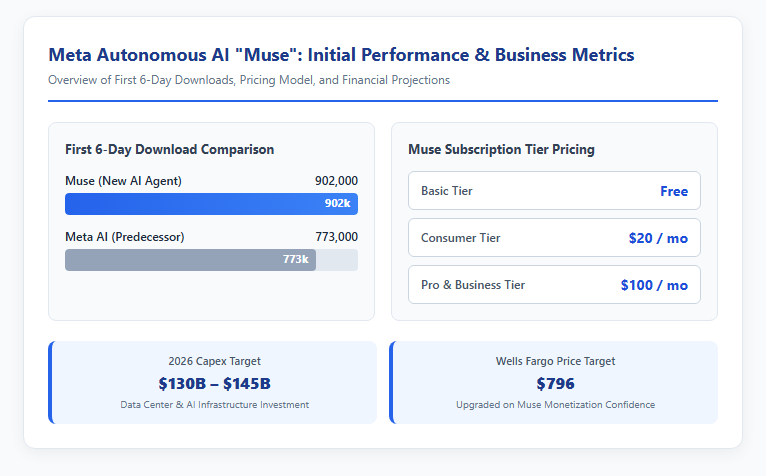
Meta Platforms’ new AI assistant app, “Muse,” released on September 8, 2026, is making waves across the tech industry and financial markets. Unlike traditional conversational chatbots, Muse is designed as an “agentic AI” capable of autonomously executing multi-step tasks on behalf of users. Specifically, it automates real-world operations such as making restaurant reservations, negotiating online purchase prices, and managing email inboxes. By integrating seamlessly with third-party services like Gmail and Spotify, Muse delivers significant time savings through advanced task automation. Please refer to the diagram below.
This high level of practical utility generated intense user interest within days of launch. Representing the first major milestone in CEO Mark Zuckerberg’s vision of “personal superintelligence,” Muse marks a pivotal shift in AI technology—from simple conversational partners to autonomous agents executing real-world operations.
Topping the App Store Charts and Monetization Expectations
Following its release, Muse rapidly claimed the number one spot among free apps on both the Apple App Store and Google Play in the United States, according to market research firm Sensor Tower. Tailored for users aged 18 and older, the app recorded over 902,000 downloads in its first six days, easily outpacing the 773,000 first-week downloads of its predecessor, the “Meta AI” app. While basic features remain free, Meta introduced a two-tiered paid subscription model: \$20 per month for mainstream consumers and \$100 per month for professionals and small businesses requiring higher usage. With Meta projecting massive capital expenditures (Capex) between \$130 billion and \$145 billion in 2026, Wall Street quickly seized on Muse’s early success as concrete proof that AI investments are beginning to yield direct monetization. Financial institutions including Wells Fargo raised their price targets on Meta stock to \$796, as analyst consensus turned decidedly bullish.
Ripple Effects Across U.S. Semiconductor Stocks and Equity Rally
AMD Crosses $1 Trillion Valuation in CPU Stock Surge
The rally sparked by Muse extended far beyond Meta, unleashing heavy buying across semiconductor equities supporting AI infrastructure. On September 21, 2026, Advanced Micro Devices (AMD) shares surged 9.9% to \$615.52, crossing a \$1 trillion market capitalization for the first time during intraday trading. This milestone made AMD the 14th U.S. company to join the exclusive \$1 trillion market cap club. Broad market indexes rallied alongside the chip sector, with the S&P 500 rising 1.5% and the Nasdaq 100 gaining 2.8%. The semiconductor rally was particularly pronounced among central processing unit (CPU) makers, as Intel jumped 12% and Arm Holdings surged 17%. Meta’s own stock posted a single-month gain of approximately 25%, marking one of its strongest monthly performances in years.
Agentic AI Triggers Demand Explosion for Inference and CPUs
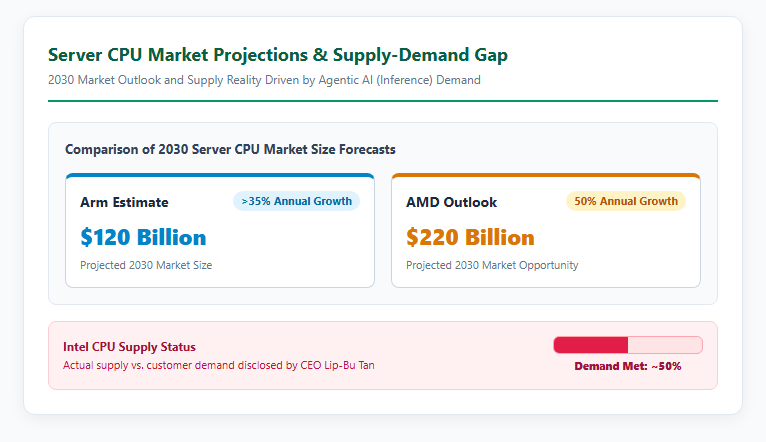
The primary catalyst behind the semiconductor surge lies in the computational requirements of autonomous AI agents. As AI workloads shift from training-heavy models to “inference processing” and task orchestration—where models independently reason, decide, and act—demand for raw CPU compute capacity has expanded dramatically. Highlighting this tight supply, Intel CEO Lip-Bu Tan revealed last week that the company can currently meet only about 50% of customer demand. In market forecasts, Arm estimates that the server CPU market will grow at a compound annual rate of over 35%, reaching \$120 billion by 2030, while AMD projects an even steeper 50% annual growth rate to unlock a \$220 billion revenue opportunity. Please refer to the diagram below.
This surge in inference workloads has reaffirmed the indispensable role of general-purpose CPUs alongside graphics processing unit (GPU) accelerators, opening substantial new growth avenues for chipmakers.
Semiconductor Supply Chain Shifts and Future Outlook
$100 Billion Mega-Deal and Tech Giants Diversifying Supply Chains
In the AI hardware market, major tech firms are accelerating efforts to diversify away from reliance on Nvidia’s dominant ecosystem. AMD and Meta finalized a massive AI chip supply agreement valued at up to \$100 billion (approx. 15.6 trillion yen) over five years. Under the partnership, Meta will deploy 6 gigawatts (GW) of AMD-powered compute capacity, with the first installations featuring AMD’s flagship “MI450” series GPUs and Venice-architecture “EPYC” server processors scheduled to go live in late 2026. The contract features a unique equity incentive structure granting Meta warrants to acquire approximately 10% of AMD’s outstanding shares (160 million shares) at a nominal strike price of \$0.01 per share upon hitting performance milestones. This “compute-for-equity” model is emerging as a new standard for hyperscalers seeking guaranteed hardware allocation while diluting vendor concentration risks.
Looming 2027 “Historic Shortage” and Key Strategic Watchpoints
As AI hardware demand expands exponentially, analysts are warning of severe supply bottlenecks across the semiconductor ecosystem from late 2026 into 2027. Joint research from Nomura Securities and Mizuho Securities highlights impending shortages not only in advanced node wafers and High Bandwidth Memory (HBM), but also across core components such as Wafer-on-Substrate (WoS), Printed Circuit Boards (PCBs), and multilayer ceramic capacitors. Competition for TSMC’s “CoWoS” advanced packaging capacity is intensifying, with AI server CPU shipments expected to jump over 50% year-over-year in 2027. Meanwhile, practical adoption hurdles and platform friction are surfacing—demonstrated by Amazon blocking Muse from operating on its retail site, citing security concerns and a lack of prior notice. The pace of autonomous AI adoption and the industry’s ability to clear supply chain bottlenecks will remain the critical drivers shaping market growth ahead.
Reference Pages
- [Meta AI Assistant Launch Fuels Strong Stock Rally] https://en.cryptonomist.ch/2026/09/21/meta-ai-assistant-launch/
[#USSemiconductorStocks #Meta #Muse #AMD #AIAgents #StockMarket #ChipShortage #USEconomy]

コメント