Difficulties in project execution and cash flow have surfaced in Oracle’s AI data center business, including struggles with power procurement and a drop in the pricing of an $18 billion loan. Behind this are a rapid infrastructure expansion dependent on massive debt and the rising risk of operational delays associated with environmental permitting and local community opposition.
- The Slump in Billion Financing and the Stagnation of “Project Jupiter”
- The Barrier to Power Procurement and the Escalation of Conflicts Surrounding Environmental Permitting
- The Impact of Over 0 Billion in Debt and the S&P Downgrade
- Accounting “Off-Balance Sheet” and 0 Billion in Uncommenced Lease Liabilities
- Funding Bottlenecks in the Capital Cycle Surrounding OpenAI Dependency and the “Stargate” Initiative
- Structural Shifts in AI Infrastructure Investment and Key Areas to Watch
The Slump in Billion Financing and the Stagnation of “Project Jupiter”
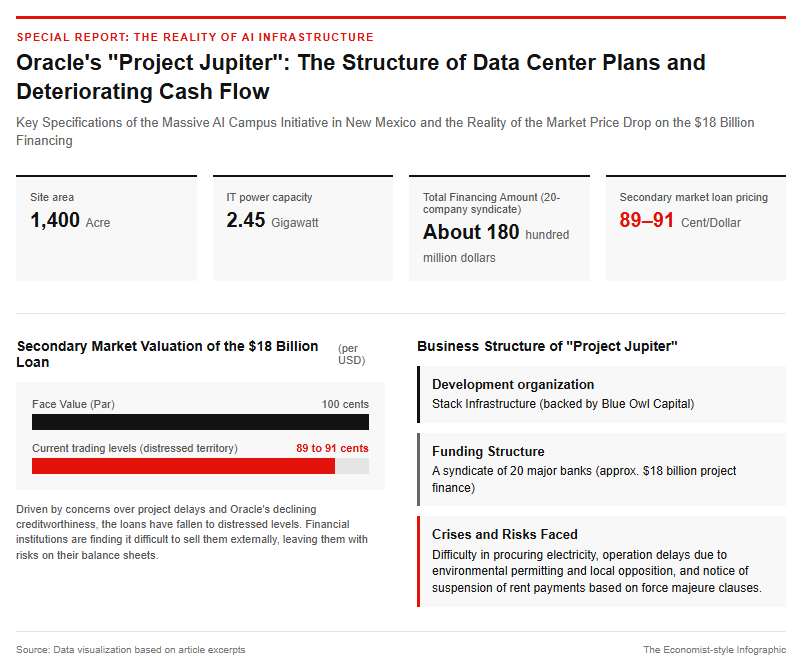
In September 2026, serious delays were reported in both financial markets and on-site development for an artificial intelligence (AI) data center project advanced by U.S. tech giant Oracle. “Project Jupiter,” which the company is developing on a 1,400-acre site in Doña Ana County, New Mexico, is a massive campus initiative boasting an IT power capacity of 2.45 gigawatts. To fund its construction, a syndicate of 20 major banks arranged approximately $18 billion in project finance loans late last year. However, due to concerns over project delays and a decline in Oracle’s creditworthiness, the loans have been trading on the secondary market at distressed levels of 89 to 91 cents on the dollar.
Furthermore, Oracle sent a notice to the development entity, Stack Infrastructure (a subsidiary of investment firm Blue Owl Capital), postponing the start of rent payments citing a force majeure clause. Originally, the contract had strict terms making payment mandatory regardless of whether power could be secured; however, Oracle’s move to delay fulfillment has caused intense anxiety among financial institutions and investors. Financial institutions leading the loan syndicate are finding it difficult to sell the debt externally and face the risk of having to absorb it onto their own balance sheets. The initial concept and development structure of the data center are as follows.
The Barrier to Power Procurement and the Escalation of Conflicts Surrounding Environmental Permitting
The primary factor preventing Project Jupiter from proceeding as planned is not a lack of massive capital, but rather the physical and regulatory bottlenecks of securing power infrastructure and strong local opposition. Initially, the facility planned to generate its own electricity using gas turbines, but it encountered fierce protests from local residents and environmental groups concerned about environmental pollution and the depletion of water resources. Furthermore, the New Mexico State Land Office’s rejection of the application to lay a natural gas pipeline forced a fundamental overhaul of the original energy procurement plan.
Although Oracle proposed an alternative plan to switch the power generation method to Bloom Energy fuel cells, the state environmental regulator’s review of the air quality permit is facing difficulties. In August 2026, the state supreme court issued an order temporarily halting the proceedings, and even after procedures resumed, the deadline for the permit decision has dragged on until late November 2026. Furthermore, the scheduled opening of the pipeline supplying gas to the fuel cells has been delayed by about six months to February 2027. The initial operational target of March 2028 is expected to be pushed back by at least a year or more, highlighting the difficulty of building local consensus—something that cannot be resolved through technical prowess and financial power alone.
The Financial Risks Posed by Massive Liabilities and Off-Balance-Sheet Transactions
The Impact of Over 0 Billion in Debt and the S&P Downgrade
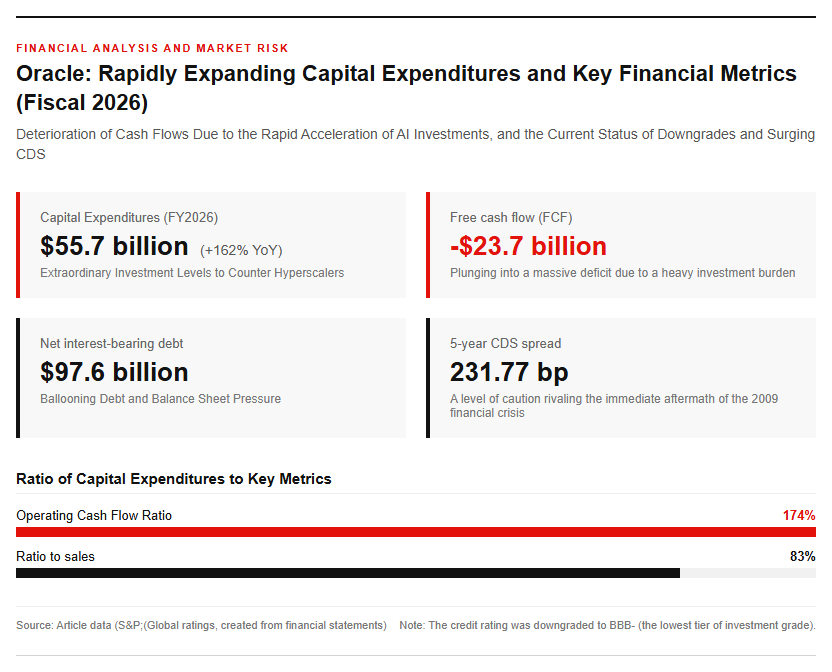
Amid the recent AI boom, in order to compete with major hyperscalers (Microsoft, Amazon, and Google), Oracle has expanded its capital expenditures at an unprecedented pace exceeding its own cash-generation capacity. For fiscal year 2026, capital expenditures surged 162% year-over-year to reach $55.7 billion, recording an extraordinary level equivalent to 83% of revenue and 174% of operating cash flow. As a result, free cash flow for the fiscal year plunged to a negative $23.7 billion, and net debt ballooned to $97.6 billion.
Following this rapid deterioration in its financial condition, major rating agency S&P Global downgraded Oracle’s long-term credit rating by one notch from “BBB” to “BBB-” in July 2026. This is the lowest tier of investment grade, standing just one step above speculative (junk) status. Following the downgrade, the premium rate on 5-year credit default swaps (CDS), which indicate market default risk, surged to 231.77 basis points (bps), reaching a level of alarm comparable to the immediate aftermath of the 2009 global financial crisis. The rising cost of funding has triggered a negative chain reaction that is squeezing core business cash flows, including demands for additional collateral for data center developments in other states. A comparison of capital efficiency among major companies is as follows.
Accounting “Off-Balance Sheet” and 0 Billion in Uncommenced Lease Liabilities
What financial analysts and legal experts are watching particularly closely regarding Oracle’s financial risks is massive “off-balance-sheet” future liabilities that utilize provisions of U.S. Generally Accepted Accounting Principles (GAAP). Under GAAP accounting rules, data center borrowings and lease liabilities are recorded on the balance sheet for the first time only when the facility becomes operational (lease commencement). In the notes to its annual report (Form 10-K), Oracle discloses that future operating lease commitments for facilities not yet operational amount to approximately $260 billion. Many of these contracts span long-term periods of 15 to 19 years.
To address these accounting disclosure gaps, litigation risks from shareholders and bondholders are rising rapidly. In July 2026, the Sterling Heights Police and Fire Retirement System filed a class-action lawsuit against Oracle in a Tennessee trust court. The plaintiffs claim that when issuing public corporate bonds, the company concealed the existence of pre-accounting lease agreements totaling $248 billion, and misled investors regarding its capital flexibility and debt-to-equity ratio. “Contractual and substantive financial encumbrances” that cannot be grasped through surface-level equity ratios or traditional credit metrics alone are fundamentally shaking the company’s management foundation.
Ripple Effects on the Entire AI Ecosystem and Future Prospects
Funding Bottlenecks in the Capital Cycle Surrounding OpenAI Dependency and the “Stargate” Initiative
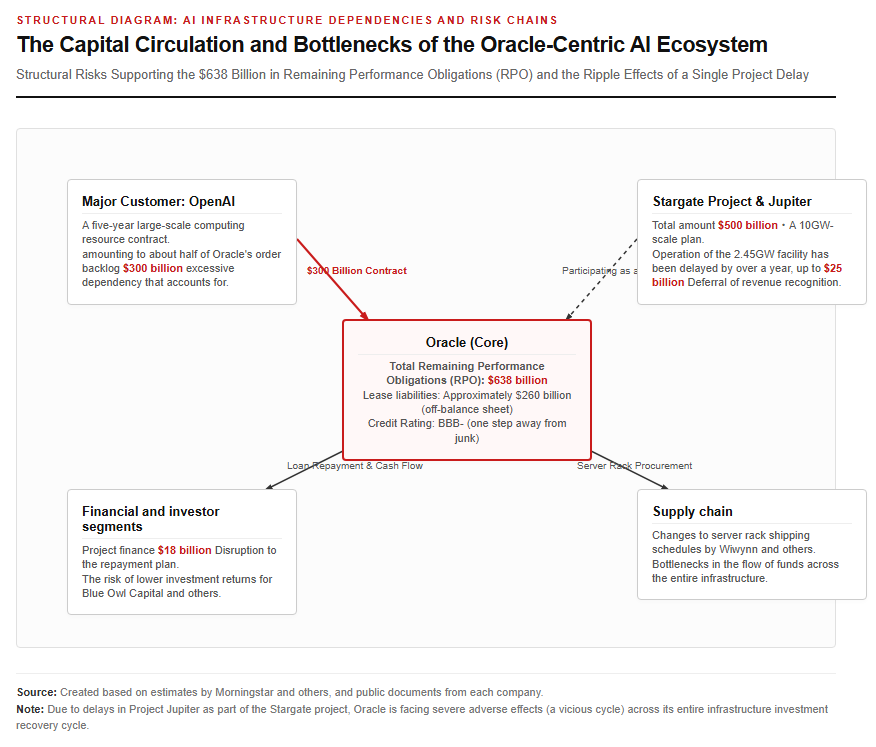
A structural weakness in Oracle’s AI infrastructure investment is its excessive concentration on a specific customer. Of the $638 billion in remaining performance obligations (RPO) presented by the company, it is estimated that roughly half—amounting to $300 billion—stems from a massive five-year computing resource contract with generative AI development giant OpenAI alone. Oracle plays a core role in “Stargate,” a $500 billion, 10-gigawatt nationwide AI infrastructure construction project jointly promoted by SoftBank Group, OpenAI, MGX, and others, and Project Jupiter was one of its most critical hubs.
However, because the operation of the 2.45-gigawatt facility is delayed by more than a year, Morningstar estimates that the timing for Oracle to record up to $25.5 billion in planned revenue is likely to be pushed back. This delay in revenue recovery not only disrupts the repayment plan for the $18 billion project financing, but also directly leads to changes in shipping schedules for Taiwanese contract manufacturers contracted to supply server racks (such as Wiwynn), and lower investment returns for investor Blue Owl Capital. The stagnation of a single massive project is causing bottlenecks throughout the entire AI capital cycle, spanning from infrastructure development to the semiconductor and server supply chains, and financial investors. The dependency structure among key stakeholders surrounding AI infrastructure is as follows.
Structural Shifts in AI Infrastructure Investment and Key Areas to Watch
Oracle’s financing struggles and development delays have served as a sobering reality check against the conventional market myth of low costs—the idea that “AI usage will expand while costs continue to fall.” Following this series of developments, financial institutions and private credit funds are beginning to incorporate grid accessibility, community consensus, and the certainty of obtaining environmental permits as stringent evaluation criteria for loan conditions, looking beyond mere high AI demand. The aggressive growth model fueled by massive debt has reached its limits, accelerating an industry-wide shift toward balance sheet (B/S) health and an emphasis on substantive cash flow.
The primary focus moving forward is the New Mexico Environment Department’s decision on the air quality permit, which has a deadline of November 23, 2026. If this permit is not granted, further operational delays and plan revisions will be inevitable. Secondly, there are financial market trends to watch, specifically whether the resyndication of the $18 billion construction loan will proceed or if the increased burden on the banking syndicate will trigger a credit crunch for other projects. Furthermore, intense attention is focused on the restructuring of the AI infrastructure market landscape, including the impact of Oracle’s planned $40 billion in additional fundraising and share dilution in fiscal year 2027, as well as the rising premium on operators holding existing, operational data centers.
Reference Page
- 【U.S. Securities and Exchange Commission – Oracle Corp. Form 10-K Annual Report】https://www.sec.gov/Archives/edgar/data/1341439/000119312526277521/orcl-20260531.htm
- Oracle Investor Relations – Record Q4 and FY 2026 Results Official Release
- 【Tennessee Chancery Court – City of Sterling Heights Police & Fire Retirement System v. Oracle Corp. Class Action Complaint】https://www.courthousenews.com/wp-content/uploads/2026/07/Sterling-Heights-v-Oracle-complaint.pdf
【#Oracle #AIDataCenter #ProjectJupiter #CreditConcerns #AIInfrastructureFinancing #Stargate】

コメント