Resonac has signed memorandums of understanding with startups and others to manufacture semiconductors in low Earth orbit. Behind this is a strategy to realize high-performance compound semiconductors that transcend physical constraints on Earth in the microgravity environment of outer space, thereby strengthening the foundation for next-generation industries.
- Building next-generation manufacturing platforms to support economic security
- Co-creation led by industry-academia collaboration and internal volunteers
- The Dramatic Evolution of Semiconductor Crystals Driven by Microgravity
- Expectations for the Explosively Expanding Compound Semiconductor Market
- Growth scenarios envisioned by a global leader in semiconductor materials
- Countdown from Utilizing Japanese Modules to Commercialization
Building next-generation manufacturing platforms to support economic security
On June 25, 2026, Resonac Corporation announced that it had signed a memorandum of understanding (MOU) with BEAM Technologies, a RIKEN-based venture, and Japan Low Earth Orbit Corporation, a company engaged in space infrastructure development, aiming to realize semiconductor manufacturing business in Low Earth Orbit (LEO). This initiative addresses the critical industrial and economic security issues of improving semiconductor performance and ensuring stable supply driven by the spread of IoT, AI, and the next-generation communication standard 6G. The core of this project is to create compound semiconductors with extremely high purity and efficiency, which cannot be achieved through conventional ground-based manufacturing processes, in the unique environment of “space.” While countries provide massive policy support to expand semiconductor manufacturing capacity and research and development, Japanese companies are joining forces to build a platform that delivers high-performance semiconductors to the market that are impossible on Earth. Through this “next-generation manufacturing platform utilizing microgravity,” Resonac aims to reestablish Japan’s technological dominance in the global market.
Co-creation led by industry-academia collaboration and internal volunteers
This project is not a solo effort by Resonac, but is being driven by strong collaboration with highly specialized startups and external organizations. Our joint partner, BEAM Technologies, is a RIKEN-born startup founded in March 2022 and possesses extensive expertise in the design and development of compound semiconductors. Additionally, Japan Low Orbit Corporation, established in July 2024, is responsible for developing commercial supply resupply ships and Japan’s own space modules, supporting infrastructure for low orbit utilization. Interestingly, this advanced project was born from REBLUC, a community of volunteers within Resonac. Under the company’s purpose (reason for being) to change society through the power of chemistry, employees have come together autonomously to contribute to society through space-related materials, and the results have culminated in this industrialization. Please refer to the diagram below.
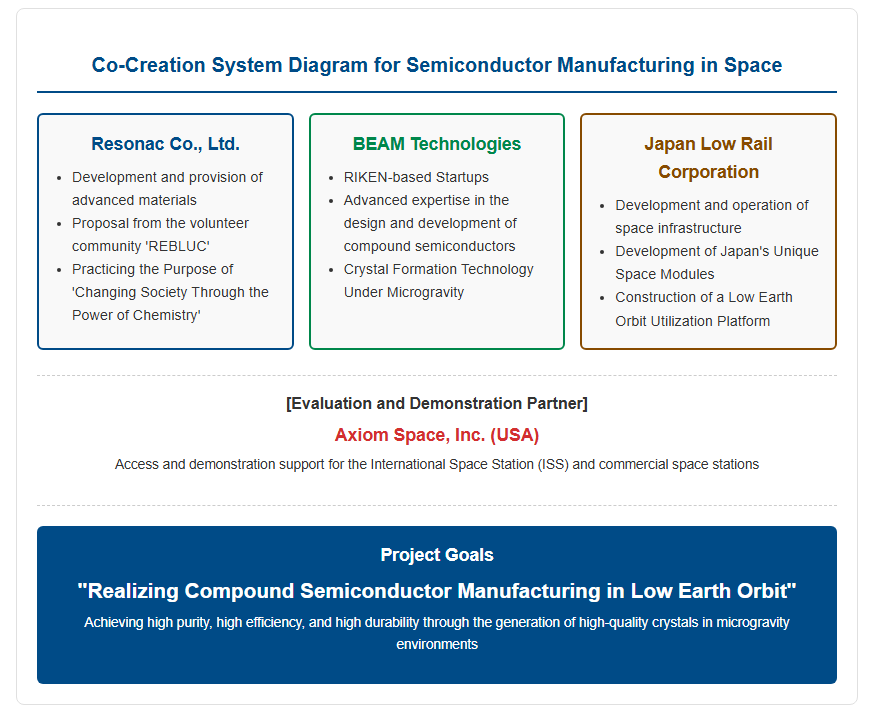
This approach of “co-creation,” where diverse human resources connect across boundaries, is the driving force behind pioneering the uncharted space business.
Manufacturing processes freed from gravity and their value
The Dramatic Evolution of Semiconductor Crystals Driven by Microgravity
Why invest enormous costs to manufacture semiconductors in space? The reason is that it eliminates the physical constraints caused by gravity unique to the Earth. In the ground-level crystal growth process, issues such as uneven compositions due to thermal convection, structural distortion due to hydrostatic pressure, and contamination from container walls are unavoidable. In contrast, in the microgravity environment of outer space, thermal convection is suppressed, allowing atoms to align uniformly and producing high-quality single crystals with extremely few defects. By leveraging this environment, Resonac aims to realize compound semiconductors that combine high purity, high efficiency, and excellent durability. This is key to achieving specifications that outperform ground products in fields requiring extreme performance, such as power control and high-speed communication. Manufacturing in space is not just an experiment; it is expected to dramatically improve the performance of existing space-use semiconductors and even represent a breakthrough that enables general-purpose semiconductors used on Earth to be applied to space specifications.
Expectations for the Explosively Expanding Compound Semiconductor Market
The compound semiconductor market targeted by the project is a promising area expected to see significant growth going forward. The global compound semiconductor market is projected to expand from approximately 18 trillion yen in 2024 to about 26 trillion yen by 2033. This is closely linked to the widespread adoption of electric vehicles (EVs), the power saving of AI data centers, and the construction of next-generation communication infrastructure, all of which are related to the overall social transformation (GX) and digital transformation (DX). Resonac already holds a world-class market share in SiC (silicon carbide) epitaxial wafers, next-generation power semiconductor materials, and by combining this existing strength with manufacturing technology in space, it aims to secure overwhelming competitiveness. Compound semiconductors are a field where Japan has a strong industrial base and can easily demonstrate technological advantages, so if successful manufacturing demonstrations in space are achieved, it holds the potential to develop into a new high value-added business that drives Japan’s entire chemical industry.
Long-term Strategy and Roadmap to 2030
Growth scenarios envisioned by a global leader in semiconductor materials
Since the merger of Showa Denko and Hitachi Chemical in 2023, Resonac has made the semiconductor and electronic materials business a pillar of its growth, concentrating management resources. In particular, it holds a world-class position in semiconductor back-end materials, specializing in integrated development that traces everything from material function design to raw materials. The company’s long-term vision aims to become “Japan’s world-class functional chemical manufacturer” by 2030, and the space business is one of the symbolic projects that embodies that vision. President and CEO Hidehito Takahashi defines his company as a startup with 26,000 employees, promoting non-continuous actions that break free from conventional wisdom. Please refer to the diagram below.
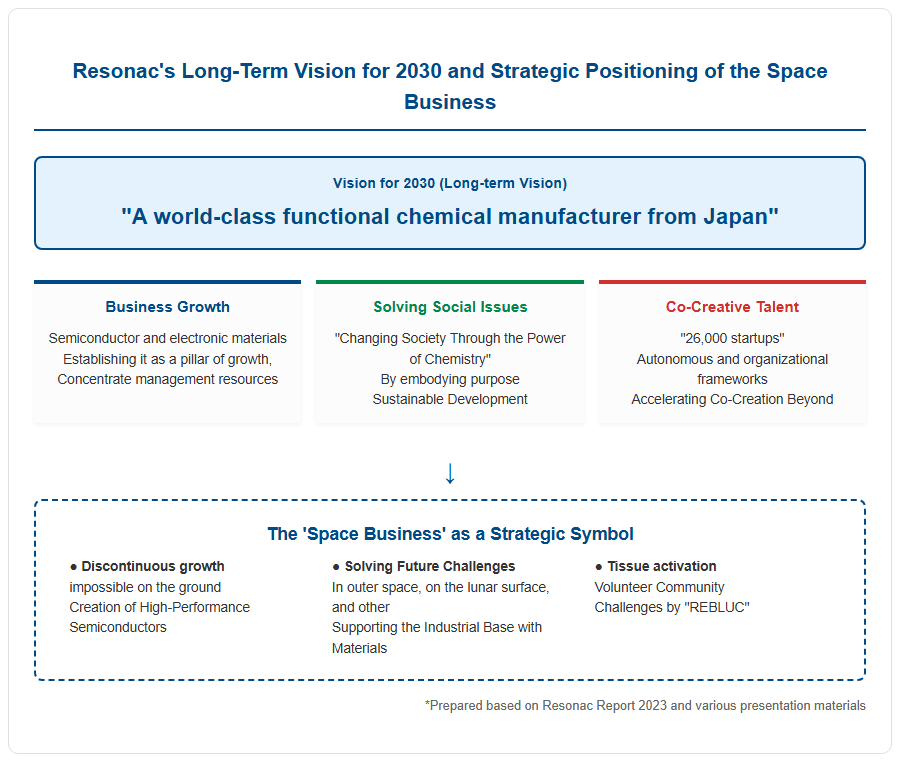
The space business is not merely an activity for branding, but a strategic investment aimed at balancing the advancement of a medium- to long-term revenue base with the purpose of solving social issues through the power of chemistry. By building a manufacturing platform in space ahead of competitors, Resonac aims to further solidify its leading position as a leading materials partner.
Countdown from Utilizing Japanese Modules to Commercialization
A concrete roadmap has already been drawn up for future developments. First, by autumn 2025, evaluation experiments for semiconductor encapsulation materials for space use under development are scheduled to begin on the International Space Station (ISS). This experiment aims to demonstrate the effect of a special resin that absorbs malfunctions (soft errors) in electronic devices caused by cosmic rays, aiming to enhance the space reliability of existing semiconductors. From 2030 onward, the plan is to connect the Japan module, which is being developed by Japan Low Earth Orbit Corporation, to the commercial space station, aiming to achieve full-scale compound semiconductor manufacturing there. In line with the progress of the national space technology strategy based on the “Master Space Plan,” Resonac will jointly advance everything from material development to building manufacturing platforms. As space development, once state-driven, now enters the “era of utilization” led by private sectors, Resonac’s challenge will become an essential technological foundation supporting grand visions such as future satellites, space data centers, and even lunar bases.
[#レゾナック #宇宙ビジネス #半導体 #化合物半導体 #経済安全保障 #共創 #スタートアップ #地球低軌道]
コメント