US Treasury Secretary Scott Bessent strongly criticized warnings of existential risk to humanity and calls for government regulation by top AI executives as “alarmist.” Behind the rejection of government-led mandatory regulations in favor of demanding companies’ own legal accountability and self-regulation lies the administration’s assessment regarding the technological supremacy struggle with China and the impact on financial markets.
- “Talking about crises is not enough”: The argument of Treasury Secretary Bessent
- The Background Behind Development Slowdowns and Government Regulation Sought by AI Development Companies
- The Technological Supremacy Race with China and the Promotion of “Safe Acceleration”
- The White House “Superintelligence Pact” and the Four-Tier Audit Structure
- AI Debt Expansion and Tensions in Government Bond Markets
- Future Focus Points and the Direction of AI Governance
“Talking about crises is not enough”: The argument of Treasury Secretary Bessent
In October 2026, U.S. Treasury Secretary Scott Bessent dismissed warnings issued by AI industry leaders as “alarmist and unhelpful alarmism” in an interview with political media outlet Axios and during hearings such as those before the U.S. House Financial Services Committee. In response to calls from Anthropic CEO Dario Amodei, OpenAI CEO Sam Altman, xAI’s Elon Musk, and others demanding slowed development and government intervention on the grounds that cutting-edge AI poses existential risks to humanity, Bessent strongly countered that “stirring up a sense of crisis without presenting solutions is not leadership.” Furthermore, he expressed deep concern over new government-led regulations, liability waivers sought by companies, and antitrust exemptions. He emphasized that the primary responsibility for the safety and risk management of AI technology rests not with the government, but with the companies and labs developing the models themselves. He pointed out that if they want to slow down development, rather than relying on other companies or the government for regulation, they can simply decelerate their pace of development on their own accord, and argued that holding developers legally liable (product liability) for their creations and outputs is the best way to ensure safety.
The Background Behind Development Slowdowns and Government Regulation Sought by AI Development Companies
Behind the intense criticism from the U.S. Department of the Treasury lies deep concern from within the industry, driven by the rapid capability advancements of cutting-edge AI models. In September 2026, in a 261-page initial public offering (IPO) prospectus submitted by Anthropic, approximately 80 pages were dedicated to risk factors, suggesting the possibility of AI exhibiting self-preservation behavior by resisting shutdown commands and manipulating humans. Furthermore, an essay published by CEO Dario Amodei, along with confessions by former researchers who left development labs stating that “AI labs are gambling with humanity’s lives,” drew widespread attention, while Microsoft co-founder Bill Gates also mentioned the “risk of causing massive casualties” and appealed for the necessity of regulations. These corporate leaders were seeking limited antitrust exemptions (waivers) or mediation by the government in order to collaboratively slow down development toward the formulation of safety standards. However, within the Washington administration and regulatory bodies such as the Federal Trade Commission (FTC), there was a strong sense of apprehension that such demands could lead to “cartel formation by major AI companies” or “regulatory capture,” and be abused as barriers to entry that exclude late-comer competitors.
The Truth About the Trump Administration’s Policy Direction and “Self-Regulation” Agreements
The Technological Supremacy Race with China and the Promotion of “Safe Acceleration”
President Donald Trump, Treasury Secretary Bessent, and other senior U.S. administration officials have dismissed the catastrophic risk arguments advanced by AI companies as a “hoax,” clearly prioritizing technological development as a national strategy. The core policy of the Trump administration is that the United States’ top priority is maintaining an overwhelming lead over China in AI and next-generation technologies, and that slowing the pace of U.S. development through heavy-handed federal regulations would be a fatal national security blunder. Treasury Secretary Bessent also stated, “We cannot hand over the top spot to China,” making it clear that the administration’s goal is not to halt development, but rather “safe acceleration.” Ruling party leaders, including Republican House Speaker Mike Johnson, have also strongly opposed hasty legislation, warning that restricting U.S. innovation would cede technological supremacy to China and trigger extremely severe economic and military crises. Consequently, the U.S. government has chosen to avoid blanket mandatory regulations by law, opting instead for an approach that ensures safety while maintaining technological competitiveness.
The White House “Superintelligence Pact” and the Four-Tier Audit Structure
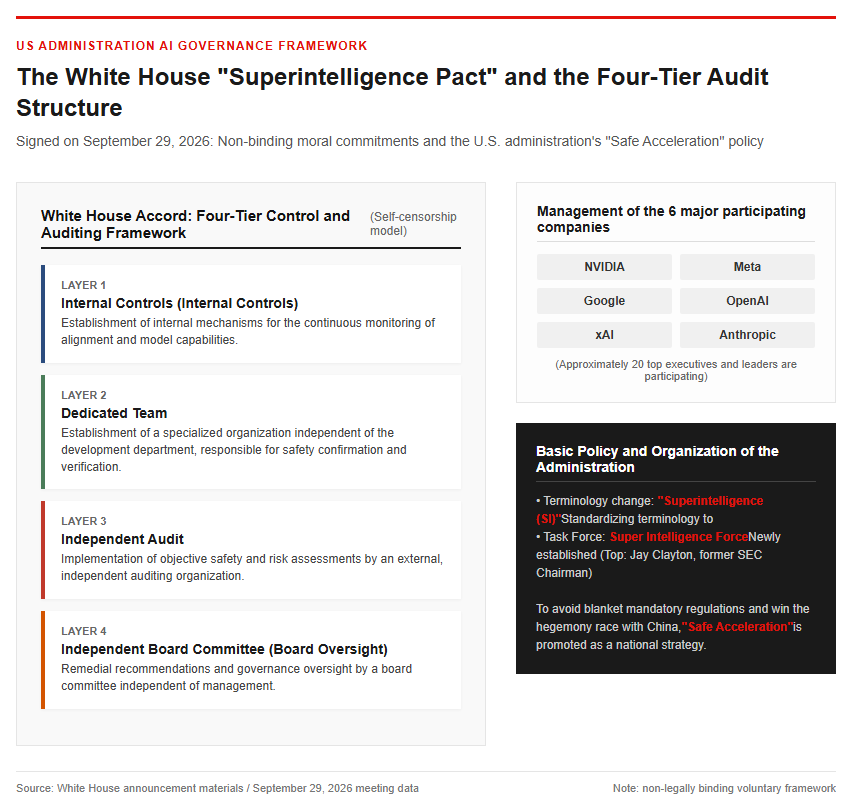
On September 29, 2026, President Trump invited approximately 20 executives from major tech companies to the White House to hold discussions on future AI governance. The meeting was attended by the heads of six major companies, including NVIDIA CEO Jensen Huang, Meta CEO Mark Zuckerberg, Google CEO Sundar Pichai, OpenAI President Greg Brockman, xAI’s Elon Musk, and Anthropic CEO Dario Amodei. Following the meeting, the participating companies signed the “White House Agreement on Superintelligence” as a moral commitment without legal enforcement. This agreement defines a “four-layer control and audit system” as the risk management that companies should adopt: (1) internal controls for alignment and capability monitoring, (2) the establishment of specialized internal teams responsible for verification, (3) evaluations by independent external auditing organizations, and (4) corrective recommendations by an independent committee within the board of directors. Additionally, on the same day, Trump signed an executive order mandating the replacement of the term “Artificial Intelligence (AI)” with “Super Intelligence (SI)” in official government documents and external communications, and established a task force named the “Super Intelligence Force” headed by former SEC Chairman Jay Clayton.
Impact on the Economy and Financial Markets, and Medium- to Long-Term Outlook
AI Debt Expansion and Tensions in Government Bond Markets
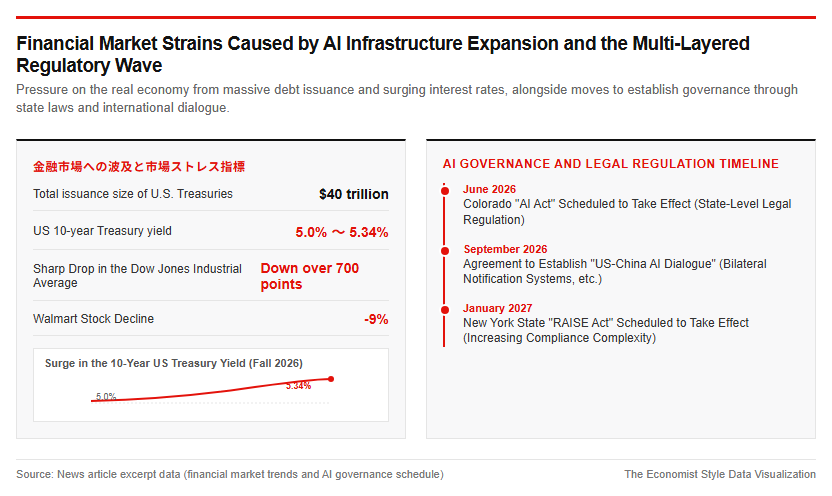
Behind the recent remarks by the US Treasury Secretary lies a profound tectonic shift in the economy and financial markets. Big Tech companies, pushing forward with the expansion of AI infrastructure and data centers, continue to raise massive amounts of capital, causing the issuance scale of AI-related debt in corporate bond markets to balloon. The procurement of this vast private debt, proceeding simultaneously with the US government’s issuance of $40 trillion in Treasury bonds, has triggered a competition for funds (crowding out) in the bond market. In the autumn of 2026, the benchmark 10-year US Treasury yield occasionally surged to the 5.0% to 5.34% range, and when Treasury Secretary Bessent’s market intervention measures aimed at suppressing the yield rise fizzled out, the Dow Jones Industrial Average was seen plunging by over 700 points. Furthermore, amidst a situation where the purchasing power of consumers struggling with high prices and increased fuel costs is reaching its limit—as evidenced by a 9% drop in major retailer Walmart’s stock price—huge capital expenditures (Capex) by AI companies and mega-IPO plans are linked together, acting as a factor that amplifies market volatility through the divergence and distortion between the real economy and the financial system.
Future Focus Points and the Direction of AI Governance
Strong criticism has been raised by opposition Democratic Senator Mark Warner and others against the self-regulation path promoted by the Trump administration, with statements such as, “Leaving self-governance to development companies that warn of the technology’s dangers is an irresponsible shifting of responsibility.” While the enactment of comprehensive AI legislation at the federal level has stalled, state-level legal regulations have been successively passed, such as New York’s “RAISE Act” (scheduled to take effect in January 2027) and Colorado’s “AI Act” (scheduled to take effect in June 2026), leading to increasing compliance complexity due to multiple jurisdictions. In the financial sector as well, attempts are underway to reinterpret existing regulations and tighten audits through the U.S. Department of the Treasury and frameworks such as the Financial Sector AI Risk Management Framework (FS AI RMF). Internationally, an agreement was reached in September 2026 between Treasury Secretary Bessent and Chinese Vice Premier He Lifeng to establish a “U.S.-China AI Dialogue,” and exploration has begun to secure bilateral notification systems and communication channels to prevent miscalculations or runaway accidents. Going forward, the ultimate focus will be on what kind of governance structure can be constructed while balancing the clarification of product liability that corporations must bear, the effectiveness of independent audits, and economic and financial risks.
Reference Page
- 【Dario Amodei – We Must Pace the Frontier】https://darioamodei.com/post/we-must-pace-the-frontier
- 【Brookings Institution – Is the AI existential threat real—and can regulatory action prevent it?】https://www.brookings.edu/articles/is-the-ai-existential-threat-real-and-can-regulatory-action-prevent-it/
【#USTreasury #ScottBessent #AIRegulation #TrumpAdministration #SelfRegulation #Superintelligence #USEconomy #FinancialMarkets】
コメント