NTT TechnoCross launched a new version of its visual regression testing tool, “AIspector,” starting October 1, 2026. This release aims to support test automation in development environments with strict security requirements by adding support for local LLMs that do not connect to external networks and screen comparison features close to visual inspection.
- New Version of AI Testing Tool “AIspector” Now Available
- Test Workload in Software Development Environments and the Expansion of “AI-Driven Development”
- NTTテクノクロス社内における70%上の工数削減実績
- “Smart Approximate Comparison Feature” that Replicates Human Visual Perception
- The Effectiveness of “Local LLM Support” for Keeping Confidential Information In-House
- Expansion of PDF Comparison Features and Deployment Toward a Comprehensive Platform for 2027 and Beyond
New Version of AI Testing Tool “AIspector” Now Available
NTT TechnoCross Corporation launched a new version of “AIspector”, a domestic visual regression testing tool that uses AI to automate screen difference detection and operation checks, on October 1, 2026. This tool automates VRT (Visual Regression Testing) using AI, which compares screen captures before and after web application modifications to detect unintended layout distortions and bugs. The new version incorporates several new features, including a smart approximate comparison function that enables judgments close to human visual perception, support for local LLMs that can be used in closed environments without external network connections, and a PDF document comparison function useful for checking manuals and specifications. As shown in the product image below, intuitive operability and advanced AI analysis technology are integrated.
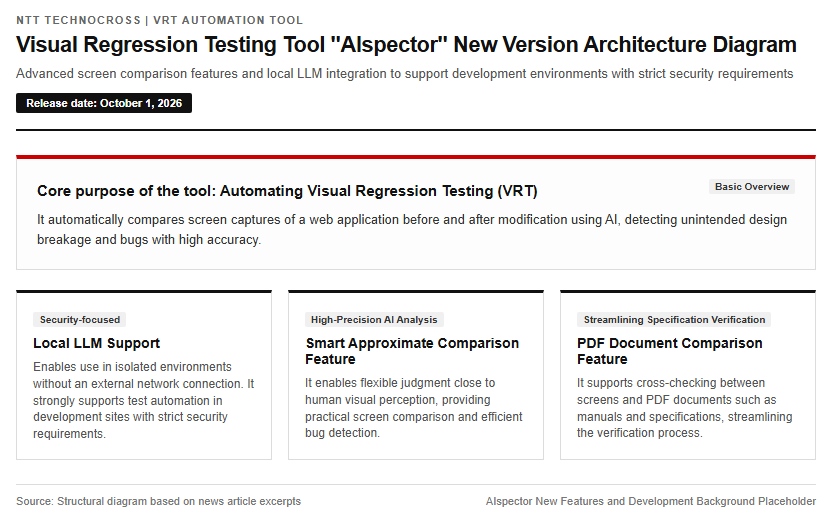
These enhancements are expected to simultaneously reduce the verification burden that has been a challenge in traditional UI testing and improve test accuracy.
Test Workload in Software Development Environments and the Expansion of “AI-Driven Development”
In recent years, “AI-driven development”—which leverages cutting-edge technologies such as generative AI to automate and streamline every phase from design to testing—has been rapidly gaining traction in software development. Particularly in web application modification and verification processes, visual inspection for display discrepancies and layout breakage is essential, and as release cycles have shortened, the workload on testers has become extremely heavy. With conventional automated comparison tools, even minute color variations and one-pixel positional shifts that do not affect display quality or user experience are detected as differences, posing a challenge where humans must manually check and evaluate a massive number of difference results one by one. Against this backdrop, there has been a strong demand for advanced AI automation solutions capable of reducing verification man-hours while maintaining the quality of the testing process.
NTTテクノクロス社内における70%上の工数削減実績
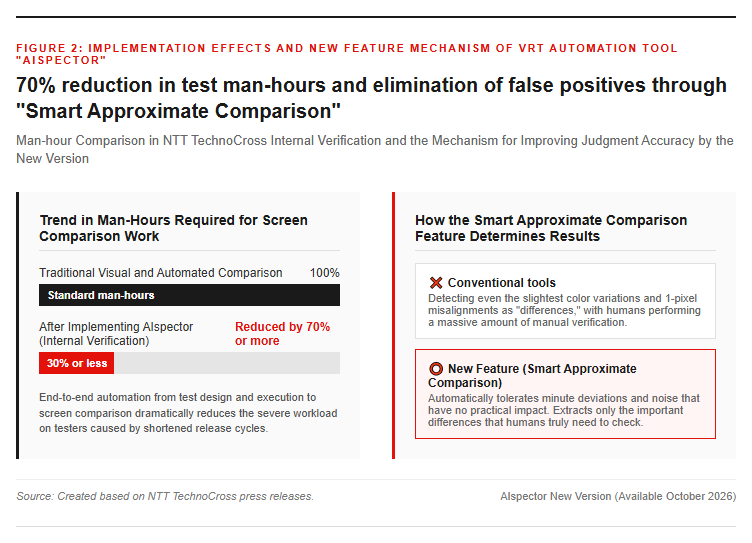
To resolve the heavy burden placed on the testing process, NTT TechnoCross has been offering “AIspector,” a visual regression test tool in which AI consistently automates everything from test design to test execution and screen comparison, since April 2026. In a demonstration where this tool was actually introduced to the testing process of a web application development within the company, it achieved extremely remarkable results, reducing the man-hours required for conventional screen comparison work by over 70%. On the other hand, diverse requests had been received from actual operational sites, such as wanting to relax or tighten the criteria for difference detection depending on system characteristics and testing stages. This new version release in October 2026 is the result of significantly evolving the functions by reflecting the detailed needs of the field while building upon the results achieved internally.
Technical Features and Advanced Security Measures of the New Feature
“Smart Approximate Comparison Feature” that Replicates Human Visual Perception
The “Smart Approximate Comparison” feature included in the new version automatically tolerates minute positional misalignments, image noise, and slight color changes that have no practical impact to the human eye, based on pre-configured judgment criteria. This eliminates excessive false positives caused by minor discrepancies that do not affect screen display quality, and extracts only the critical differences that humans truly need to review, thereby significantly reducing operational workload. Meanwhile, for critical verifications requiring strict design reproducibility or pixel-level consistency, users can also select the conventional “Exact Match Comparison”. As shown in the system comparison diagram below, by flexibly switching detection modes according to the testing purpose and development phase, it can support a wide range of scenarios from efficiency-focused primary testing to rigorous final quality checks.
The Effectiveness of “Local LLM Support” for Keeping Confidential Information In-House
In addition to major functional evolutions, support for “local LLMs”—which can be operated entirely within a company’s own environment—has been realized as a security governance measure. By making local LLMs selectable in addition to the conventional cloud LLM connection model, AI-driven test automation can now be run even in on-premise environments or internal closed networks where external network connections are strictly restricted. Since input data and screen information are not sent to external servers, a secure verification environment that thoroughly prevents leakage risks can be built even for development projects handling product specifications for unreleased features, highly confidential corporate data, and client information that cannot be shared externally. This is a technological milestone that will greatly encourage the adoption of AI in development sites subject to particularly strict security requirements, such as financial institutions and government systems.
Expansion of PDF Comparison Features and Deployment Toward a Comprehensive Platform for 2027 and Beyond
In addition to web screen comparisons, a new “PDF document comparison feature” has been added for operational manuals, system specifications, reports, and other documents. Because it can visualize changes between PDF files with high precision, it significantly reduces the man-hours required for peripheral tasks such as checking for broken report layouts due to web system modifications and verifying changes during manual revisions. NTT TechnoCross plans to exhibit this tool at the “Software Offshore & Development Support Expo,” part of the “Japan IT Week Autumn” held at Makuhari Messe from October 21 to 23, 2026, where it will conduct live demonstrations of the new feature. Furthermore, starting in 2027 and beyond, the company aims to expand its functionality beyond the scope of visual regression testing into other testing areas, evolving the tool into a comprehensive platform for AI-driven test automation.
Reference Page
- [NTT TechnoCross Press Release] https://www.ntt-tx.co.jp/whatsnew/2026/260929.html
- [AIspector Product Information] https://www.ntt-tx.co.jp/products/aispector/
【#NTTTechnoCross #AIspector #TestAutomation #LocalLLM #VisualRegressionTesting #AIDrivenDevelopment】

コメント