Revolver Inc. has revised the plan details for its cloud CMS “dino,” significantly expanding core features and the number of administrator accounts while keeping prices unchanged. Behind this move are the increasing difficulty of price revisions in the SaaS market and strong corporate demands for web security and operational efficiency.
- Key Points of the Service Refresh Unlocking Advanced Features for the Lite Plan
- Significant Expansion of Administrator and Article Creator Account Quotas and Its Impact
- The Limits of Blanket Price Hikes in the SaaS Market and the Shift in Pricing Strategies
- The Shift Away from Open Source and the Growing Demand for Cloud CMS (SaaS-based)
- Redefinition and Brand Expansion from “B2B” to a General-Purpose “Cloud CMS”
- Synergy and Prospects with the AI Multilingual Communication Platform “prism”
Key Points of the Service Refresh Unlocking Advanced Features for the Lite Plan
On October 1, 2026, Revolver Inc. revised the pricing plans for “dino,” the cloud CMS it develops and provides. The basic pricing structure and usage-based billing system—the Lite plan at 50,000 yen per month, the Standard plan at 100,000 yen per month, and the Professional plan at 200,000 yen per month—remain unchanged. While maintaining the basic rates for annual upfront payments, the company has implemented expansions in both features and usage limits. With this revision, key features previously offered only in the Standard plan and above have now been made available in the lowest-priced Lite plan as well. Specifically, features such as the edit history management function to record and restore content change history, administrator permission settings to assign detailed access rights to each user, test sub-accounts for safe verification, and stock content management functions have become available starting from the Lite plan. In addition, the creation of multilingual sub-accounts and RSS output functions for external distribution have been revised so that they can be added as paid options starting from the Lite plan. Even with the 50,000-yen-per-month entry plan, advanced management and operational features required in the enterprise domain are now available as standard, improving operational efficiency for small- and medium-sized corporate websites and newly launched owned media.
Significant Expansion of Administrator and Article Creator Account Quotas and Its Impact
In addition to the unlocking of features, the upper limits for administrator accounts and article creator accounts, which are directly linked to website organizational management, have also been raised across all plans. Under the new plans, the account limits for the Lite plan were expanded from the previous 3 site administrators and 3 article creators (3|3) to 5 site administrators and 10 article creators (5|10). Similarly, the Standard plan has been increased from the previous (5|10) to (10|20), and the Professional plan has been increased from the previous (10|20) to (20|50). Please refer to the figure below for the detailed breakdown of the account limits and PV limits under the new plans.
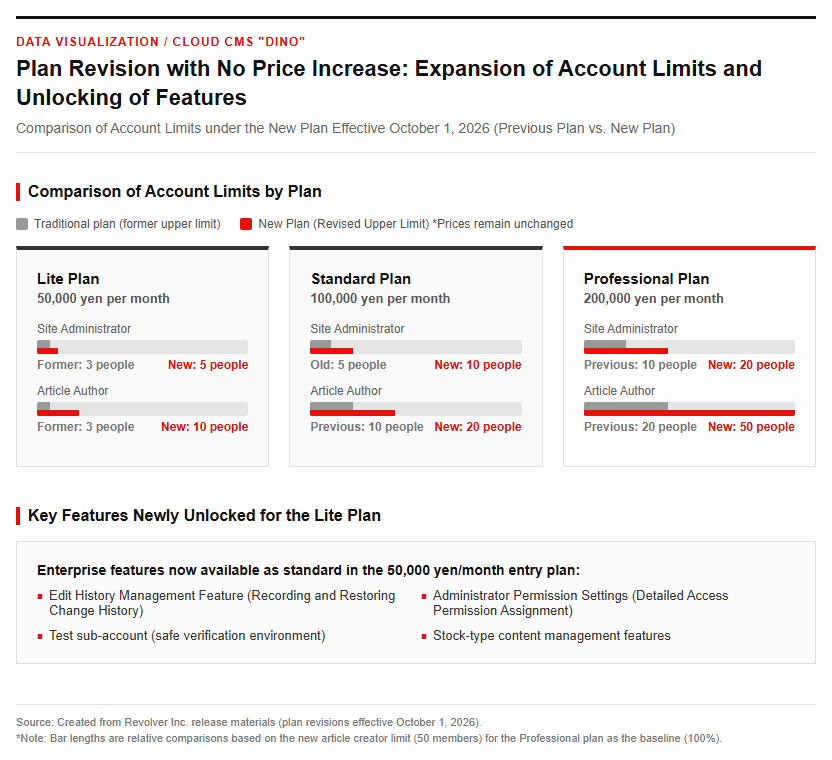
. In conventional systems, account limitations made it difficult to collaborate across multiple departments or coordinate with external writers and production partners, sometimes raising security concerns due to shared privileges. With this expansion in the number of accounts, it has become possible to form cross-departmental editorial teams and achieve governance-compliant privilege separation without incurring additional fees. In particular, the inclusion of up to 10 article creator accounts in the 50,000-yen-per-month Lite plan has established an environment where an increase in in-house writers and decentralized content production can be achieved at a low cost.
Changes in the SaaS Pricing Environment and the Market’s Structural Background
The Limits of Blanket Price Hikes in the SaaS Market and the Shift in Pricing Strategies
The domestic B2B SaaS market is entering its maturity phase, marked by the rise of competing services and the commoditization of features. The strategy of implementing uniform price hikes tied to feature enhancements—once the primary driver of growth—now carries a significant risk of increasing churn rates, driven by customers’ rigorous ROI evaluations and declining product-switching costs. Data analyzing pricing strategies increasingly show simulation results where customer churn completely offsets revenue gains if a blanket price increase is implemented under a single-price model. In this environment, Revolver’s expansion of features and usage limits while keeping prices unchanged can be described as a customer success strategy focused on delivering tangible value enhancement. In a market environment where raising prices is difficult, the approach of increasing the density of delivered value while keeping base fees flat serves as a rational pricing method that secures long-term retention while suppressing churn. For users as well, the ability to utilize advanced features and additional account slots without securing extra budget approval directly improves the return on investment (ROI) for adopting the tool.
The Shift Away from Open Source and the Growing Demand for Cloud CMS (SaaS-based)
For a long time, open-source CMSs, typified by WordPress, have held the mainstream position in website development in Japan. However, in recent years, cyberattacks exploiting plugin vulnerabilities, rising maintenance costs, and bugs occurring during version updates have emerged as pressing risk management challenges for companies. Since unauthorized external access and data tampering can severely damage a company’s corporate reputation, the migration to cloud-based CMSs (SaaS), which allow infrastructure maintenance and security measures to be centralized with the vendor, is accelerating. The cloud CMS “dino” provides standard features such as an auto-scaling function that automatically expands server capacity during traffic surges and a security framework based on ISMS certification. For companies struggling to allocate human resources to infrastructure management, the advantage of having system updates and server monitoring included as part of the service is immense. Amid tightening security policies, the market position of cloud-based CMSs—which ensure security while keeping implementation and operational burdens low—has become firmly established.
The Evolution and Future Outlook of Corporate Web Infrastructure
Redefinition and Brand Expansion from “B2B” to a General-Purpose “Cloud CMS”
Since launching the service in 2015, the cloud CMS “dino” has built a strong track record as a system specialized in building owned media. However, as the importance of corporate communication grows, the need for the high dissemination power and stable operability cultivated through owned media has expanded to corporate sites in general. In response to this, Revolver implemented its first major repackaging in 10 years in October 2025, redefining the product as a B2B cloud CMS that supports entire corporate sites. Furthermore, in conjunction with the revision on October 1, 2026, the service descriptor was renamed from “B2B cloud CMS” to the simple “cloud CMS.” This change demonstrates the company’s stance on deploying the service as a web infrastructure across all industries and scales, not limited to specific B2B markets, but including B2C companies, government agencies, educational institutions, and various organizations. Leveraging its strengths—such as an intuitive WYSIWYG editor and the complete separation of structure settings from article editing—functional enhancements are continuously being made to serve as a foundation that allows personnel without specialized technical knowledge to securely build and update websites.
Synergy and Prospects with the AI Multilingual Communication Platform “prism”
In September 2026, Revolver announced “prism”, an AI-powered multilingual publishing platform. prism is a system that uses AI technology to translate content posted in Japanese into up to 30 languages with high precision and automatically publishes it on the web. The robust system infrastructure and operational know-how cultivated over years of developing “dino” form the technical foundation of prism. Looking ahead to the future of web operations, the two products—the robust enterprise web platform “dino” and “prism”, which breaks down language barriers—will become the two major pillars of the company’s business. Please refer to the diagram below for the collaborative model between the future information dissemination infrastructure and multilingual expansion.
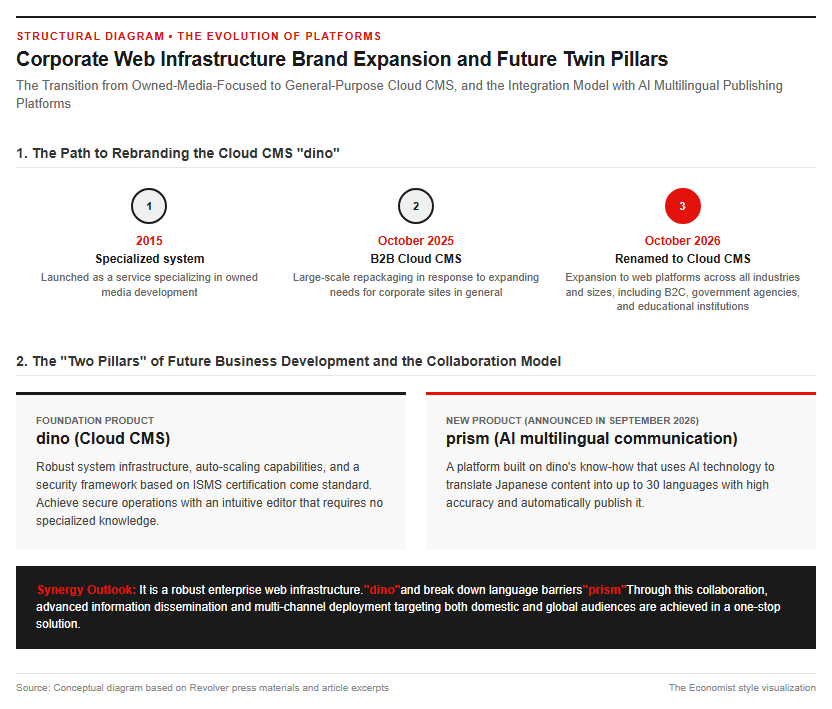
. For companies aiming to disseminate information overseas or capture inbound demand, an operational workflow is realized in which high-quality content managed by dino can be instantaneously deployed in multiple languages through prism. With the advancement of AI technology, automation and labor-saving in website operations are accelerating, ranging from content creation to translation, distribution, and operational maintenance. Having expanded its features while keeping prices unchanged, dino continues to evolve as a next-generation web infrastructure with an eye toward integration with evolving AI technologies.
Reference Page
- [Revolver Inc. Press Release] https://prtimes.jp/main/html/rd/p/000000037.000010629.html
【#CloudCMS #SaaSPricing #dino #WebsiteOperations #Security #Revolver】

コメント