
It has been revealed that Suzuki will adopt Chinese company Horizon Robotics’ “Journey 6” in-vehicle SoC for advanced driver-assistance systems (ADAS) in vehicles for India and other markets. Behind this decision lies fierce cost competition driven by the rise of Chinese EVs and smart cars, alongside a rapid geopolitical and technological shift in automotive semiconductor procurement.
- The Semiconductor Procurement Strategy Shift Undertaken by Suzuki and Toyota
- Suzuki’s Autonomous Driving and ADAS Strategy with an Eye on the Indian Market
- A product lineup spanning from entry-level to high-end models
- Open platform architecture that Denso and Bosch are also entering
- Software-Defined Vehicles and Cost Competition Accelerated by Western and Chinese Players
- Technological Innovations and Outlook of Japanese Companies Toward the Next-Generation Mobility Society
The Semiconductor Procurement Strategy Shift Undertaken by Suzuki and Toyota
It has been revealed that major Japanese automakers Suzuki and Toyota Motor are adopting Systems on Chip (SoCs) manufactured by Horizon Robotics, a leading Chinese automotive AI semiconductor giant, for their Advanced Driver Assistance Systems (ADAS). Conventionally, automakers in Japan, Europe, and the US have built supply chains reliant on traditional semiconductor heavyweights in the West and Japan. However, the full-scale adoption of chips from a Chinese startup for global deployment models outside the local Chinese market is an extremely unusual decision. The core product adopted this time is the “Journey 6” series, the latest automotive processor developed by Horizon. Suzuki plans to incorporate the chip as the main SoC for controlling advanced driver assistance functions in vehicles sold in India, its largest market. Meanwhile, Toyota is also proceeding with deployment in vehicles destined for the Chinese market and other regions, indicating a dramatic shift in the selection criteria for core components that influence product competitiveness in the global market. Behind this is the reality that, accompanying the global export expansion of Chinese EVs and smart cars, the cost-performance and implementation speed of automotive semiconductors have become decisive factors separating winners from losers.
Suzuki’s Autonomous Driving and ADAS Strategy with an Eye on the Indian Market
In its “Technology Strategy 2025” looking a decade ahead, Suzuki has introduced the unique concept of “SDV (Software Defined Vehicle) Light” alongside its environmental initiatives. This development philosophy aims to realize electrical systems that avoid excessive performance and high costs, striking a balance between “just right” features and pricing for customers in each market. Particularly in the Indian market, where Suzuki holds an overwhelming share, safety regulations are tightening amid population growth and economic development, creating a rapid demand for the standard inclusion of highly reliable advanced safety features even in entry-level models and compact cars. Directly introducing ultra-expensive autonomous driving SoCs designed for developed nations would drive up vehicle prices, directly resulting in the alienation of its core customer base. Therefore, by adopting Horizon’s Journey 6—which offers excellent cost performance along with sufficient AI computing power and energy efficiency—Suzuki aims to achieve practical Level 2-equivalent driver assistance while keeping vehicle prices down. The following diagram illustrates the direction of the electrical architecture in Suzuki’s next-generation mobility.
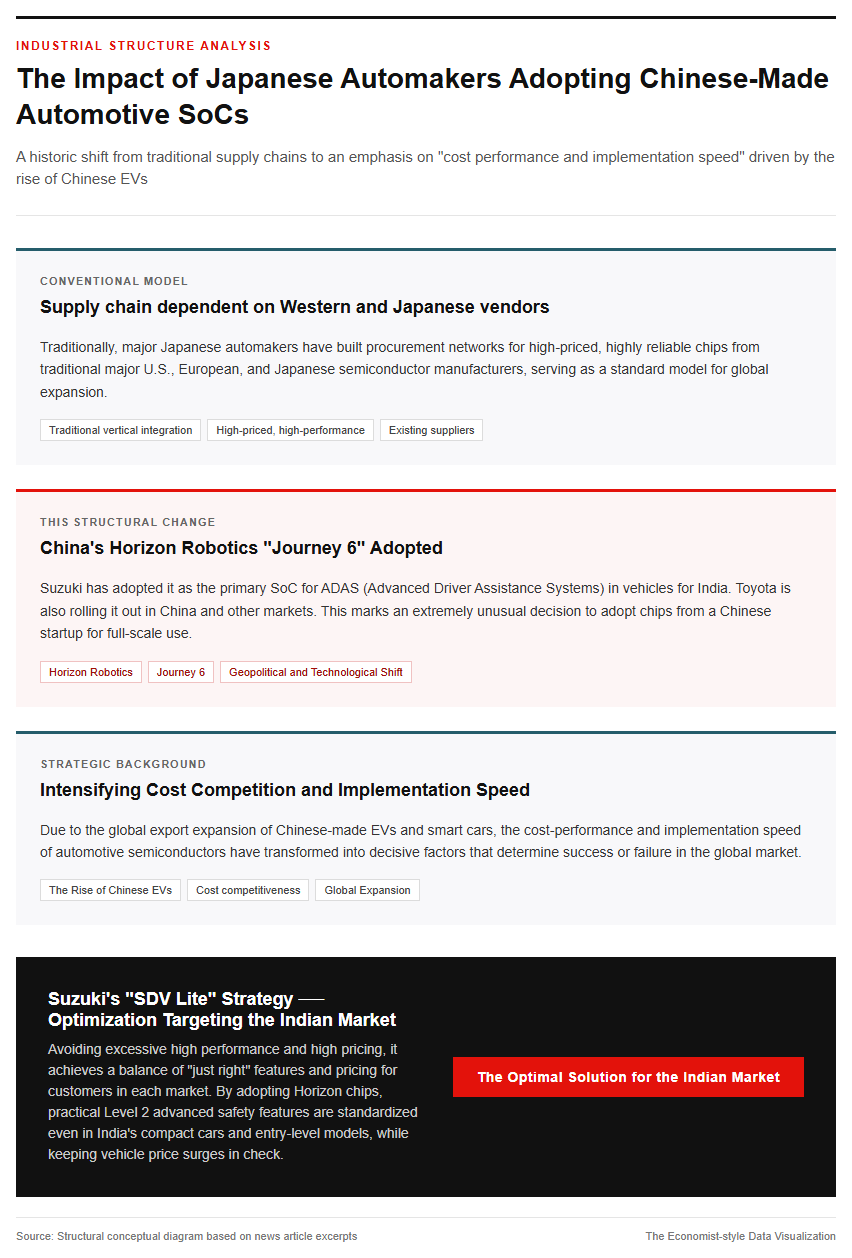
This decision can be said to be a highly rational strategic choice for simultaneously achieving the widespread adoption of safety features and maintaining profitability in emerging markets.
Technical Superiority of the Horizon Robotics “Journey 6” Series
A product lineup spanning from entry-level to high-end models
The “Journey 6” series developed by Horizon Robotics offers the flexibility to support a wide range of autonomous driving and ADAS applications under a single architecture, ranging from entry-level models with a computing power of over 10 TOPS to the top-tier model boasting 560 TOPS of processing capacity. Particularly for the “Journey 6B (J6B)”, which is increasingly being adopted in low- and mid-range models by Suzuki and Toyota, its design is optimal for replacing conventional monocular cameras and basic ADAS systems, achieving significant cost reductions and a smaller board footprint. A key feature is its focus on the high-speed processing of visual AI models, centered around its in-house developed neural processing unit (NPU) architecture, the “BPU (Brain Processing Unit)”. According to Horizon’s published data, design wins for the Journey 6B alone over its product lifecycle have already exceeded 20 million units, securing global economies of scale. The following figure illustrates the common infrastructure structure that supports different levels of driving assistance on a single semiconductor platform.
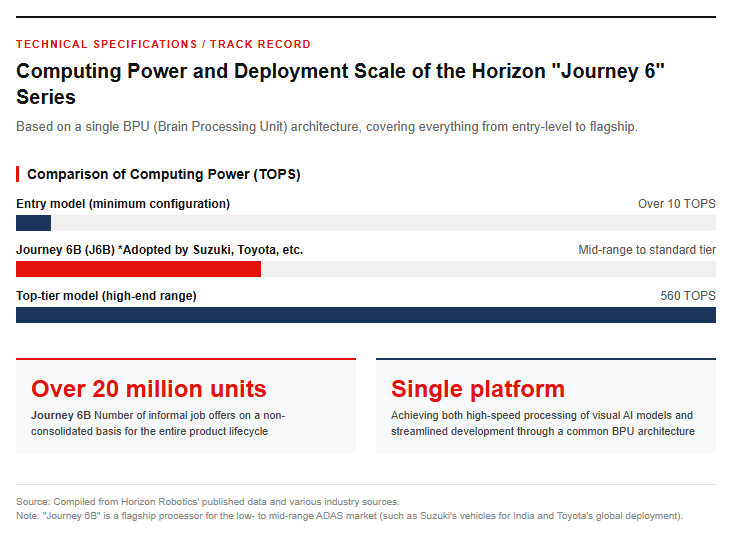
The ability to horizontally deploy the same development environment across a diverse lineup of vehicle models has become a major advantage for automakers in terms of shortening development time and reducing costs.
Open platform architecture that Denso and Bosch are also entering
Driving Horizon’s rapid growth is not merely standalone chip sales, but an open business model that externally provides software, intellectual property (IP), and a development toolchain. The company positions this approach as the semiconductor industry’s “ARM + Android model,” establishing an environment where automakers and major Tier 1 suppliers can freely build their own proprietary autonomous driving algorithms. Consequently, major global automotive electrical suppliers such as Japan’s DENSO and Germany’s Bosch have successively adopted the Journey 6B as a development platform for next-generation front cameras and driving assistance domain controllers. By combining it with highly reliable integrated ECUs and sensing technology, DENSO is advancing system development that achieves both the minimization of unwanted activation rates and improved safety. Additionally, Germany’s Volkswagen Group, through its software subsidiary CARIAD, has invested approximately 2.4 billion euros to establish a joint venture named “Carizon” with Horizon, fully ramping up its integration into next-generation EVs for the Chinese market. Rather than just selling standalone chips, building a platform that engages the entire ecosystem is paying off.
Changes in the Competitive Landscape of the Automotive Semiconductor Market and the Future of Japan’s Automotive Industry
Software-Defined Vehicles and Cost Competition Accelerated by Western and Chinese Players
The automotive semiconductor market is undergoing a dramatic shift from traditional microcontroller-centric architectures to the era of Software-Defined Vehicles (SDVs), which center on large-scale SoCs integrating Central Processing Units (CPUs), GPUs, and NPUs onto a single chip. While U.S. semiconductor giants NVIDIA and Qualcomm lead the high-performance, high-priced high-end market, emerging semiconductor companies such as Horizon in the Chinese market are rapidly expanding their market share, armed with overwhelming cost performance and rapid development speeds. In the first half of 2026, Horizon’s revenue reached approximately 2.055 billion yuan, a 32.9% increase year-over-year, maintaining a top-tier market share in China’s ADAS market for domestically produced passenger cars. Through an upfront investment strategy that allocates approximately 2.755 billion yuan—exceeding its revenue—to research and development, the company is intensifying its stance of prioritizing market share expansion and ecosystem building above all else, despite running a deficit. The following figure shows the market share structure of automotive SoCs in the global market and the trends in cost-reduction pressure.
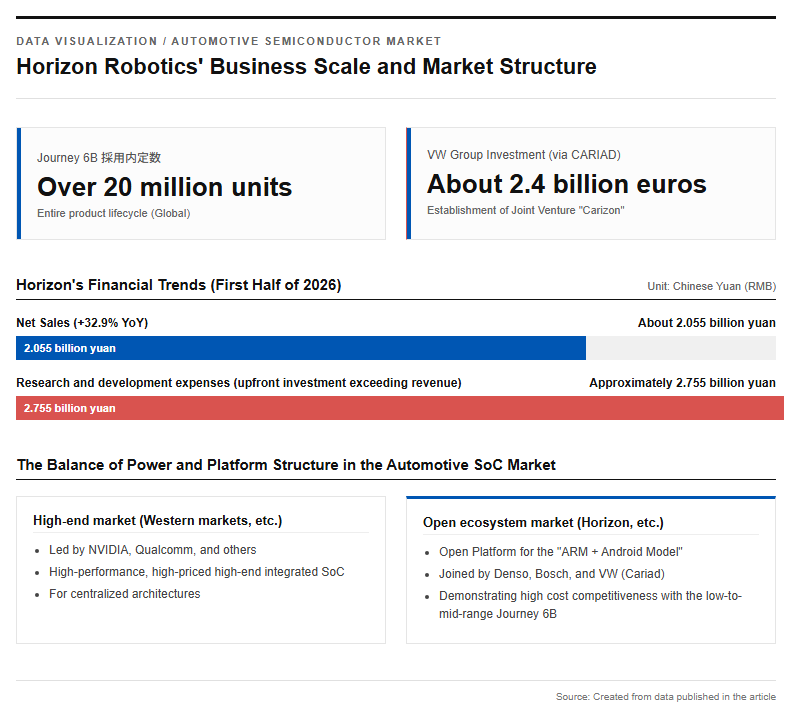
Automakers in Japan, Europe, and the US are growing increasingly concerned that if they fail to adopt these overwhelmingly low-priced and high-performance Chinese SoCs, they will be placed at a competitive disadvantage in terms of pricing within emerging markets and the new energy vehicle sector.
Technological Innovations and Outlook of Japanese Companies Toward the Next-Generation Mobility Society
The rise of Chinese in-vehicle SoCs is forcing a major strategic review on Japan’s domestic automotive and semiconductor industries as well. Domestically, 12 major companies, including Toyota Motor, Nissan Motor, Honda Motor, DENSO, and Renesas Electronics, have banded together to establish the Advanced SoC Research for Automotive (ASRA) research association, advancing the joint development of domestically produced in-vehicle SoCs using chiplet technology. While ASRA’s initiative aiming for mass-produced vehicle deployment from 2030 onward is important from a long-term perspective, immediate cost reduction and speed to market are essential in the current global competition. Suzuki’s adoption of Horizon’s SoC can be described as the embodiment of a “multi-pathway strategy”—the joint development of domestic technology in pre-competitive areas and the flexible utilization of cutting-edge overseas parts in competitive areas. Moving forward, the construction of a two-tiered procurement network tailored to each market is expected to progress: advanced automated driving Level 3 and above for developed countries, and practical Level 2 and below for emerging countries. A new winning formula for Japan’s mobility industry, which fuses reliability and cost-efficiency at a high level, is being put to the test.
Reference Page
- [Suzuki Press Release] https://www.suzuki.co.jp/release/d/2025/0909/pdf/0909.pdf
- [Horizon Robotics Official Announcement] https://en.horizon.auto/press-releases/
- [Volkswagen Group CARIAD Press Release] https://www.volkswagen-group.com/en/press-releases/volkswagen-to-strengthen-regional-development-competence-for-autonomous-driving-in-china-through-joint-venture-between-cariad-and-horizon-robotics-16562
【#Suzuki #AutomotiveSoC #HorizonRobotics #AutonomousDriving #ADAS #DigitalTransformation】

コメント