On September 2, 2026, NEC Corporation announced a new security service that utilizes AI to autonomously handle everything from vulnerability detection to remediation for IT assets. As cyberattacks accelerate due to the misuse of frontier AI, the company aims to break away from the traditional operational model in which humans chase threats.
- Key Points of the New Service Where AI Autonomously Addresses Vulnerabilities
- The Acceleration of Cyberattacks by Frontier AI and Corporate Challenges
- cotomi Security for Industry Analyzes Undisclosed Vulnerabilities
- Automatic Generation of Virtual Patches and Code Diagnosis Using High-Performance AI
- 10-phase implementation models classified based on industry standards
- Realizing an Autonomously Protected IT Infrastructure and Future Outlook
Key Points of the New Service Where AI Autonomously Addresses Vulnerabilities
On September 2, 2026, NEC Corporation announced the “BluStellar Intelligent Managed Service,” an autonomous managed service that provides one-stop support from the detection of vulnerabilities in IT assets and networks to their remediation, utilizing frontier AI. The service will begin rolling out at the end of September of the same year, primarily targeting financial institutions, manufacturers, and distribution and retail service providers, with the goal of achieving 30 billion yen in sales over the next three years. The AI comprehensively analyzes complex IT asset information possessed by customers and clearly identifies risks that require prioritized remediation in a manner optimized for each organization. This makes it possible to build cyber resilience to proactively prepare against the threats of cyberattacks. A conceptual diagram of the service is shown below.
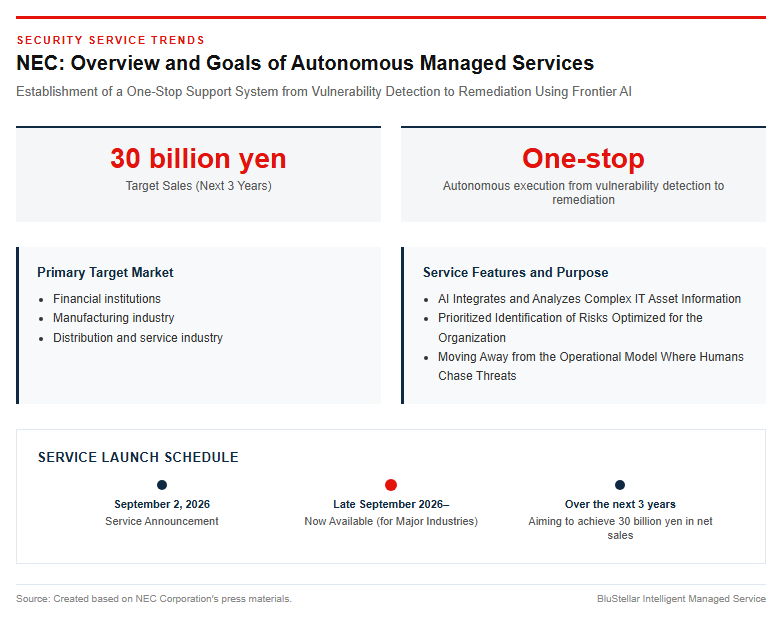
The greatest feature of this service is that it not only visualizes risks, but also goes so far as to automate the actual risk response process.
The Acceleration of Cyberattacks by Frontier AI and Corporate Challenges
Behind the launch of this new service lies the harsh reality that the emergence of frontier AI—an advanced AI technology—has dramatically increased the speed and comprehensiveness of cyberattacks. Previously, there was a certain grace period from the discovery of a vulnerability to the execution of an actual attack, but now that entire process is being automated, leaving virtually no time to respond. Furthermore, multiple management challenges are surfacing, including the explosive growth in the scale of attacks, the burden on specialized personnel reaching its breaking point, and the risk of data breaches associated with the use of external AI. In fact, in May 2026, the Financial Services Agency and the Bank of Japan strongly urged financial institutions to implement short-term measures accounting for the shifting threats posed by frontier AI. Thus, the conventional operational method of humans constantly chasing threats has reached its limit, making the establishment of an autonomous and continuous defense system an urgent priority for all industries.
AI Technology for Security and Operational Automation
cotomi Security for Industry Analyzes Undisclosed Vulnerabilities
In conjunction with this service announcement, NEC also unveiled cotomi Security for Industry, a proprietary technology designed to address previously undisclosed vulnerabilities newly discovered by high-performance AI. While widely known vulnerabilities are organized with Common Vulnerabilities and Exposures (CVE) identifiers, Pre-CVEs—vulnerabilities prior to public disclosure—lack sufficient information such as attack vectors. This technology ingests Pre-CVEs, has AI automatically classify attack vectors and privilege escalation risks, and automatically appends detailed information to determine response priorities. The priority determination is based on BOD26-04, a standard established by the U.S. Cybersecurity and Infrastructure Security Agency. Furthermore, it comprehensively analyzes whether devices are exposed to the internet and the existence of actual exploitation cases, as well as whether an attack path leading to critical assets can be established by combining multiple vulnerabilities.
Automatic Generation of Virtual Patches and Code Diagnosis Using High-Performance AI
Another innovative technology is an automatic virtual patch generation feature for emergencies when formal patches cannot be applied immediately to a system. In running systems, there are often cases where it is difficult to fix the source code immediately even if a vulnerability is discovered. With this technology, AI estimates attack methods and attack packets based on vulnerability information, and autonomously generates virtual patch rules to detect and block attacks at the network level. By applying this to devices such as web application firewalls, risks can be minimized until permanent measures are completed. Furthermore, starting from the end of September 2026, NEC will successively roll out services such as Threat-Driven Security Assessment, which conducts detailed source code diagnostics using high-performance AI. This will achieve a multi-layered security framework combining reviews by in-house experts with advanced automated diagnostics.
Phased implementation process and future practical application roadmap
10-phase implementation models classified based on industry standards
This autonomous managed service is designed to be implemented incrementally according to the maturity level of the customer’s security measures. Specifically, based on industry-standard frameworks such as U.S. security standards NIST SP 800 and CIS Controls, the processes required for vulnerability response are categorized into 10 phases. These processes consist of asset discovery, configuration management, vulnerability information collection, vulnerability detection, cross-referencing with the configuration management database, prioritization and defense planning, ticketing and assignment, remediation, application verification, and reporting and improvement. These are divided into three specific service menus: IT/network asset management, vulnerability management, and vulnerability remediation, making it possible to select and implement only the necessary parts according to a company’s own requirements. In its development, operational know-how accumulated over approximately 30 years from more than 6,000 companies through the “Client Zero” initiative—with NEC itself as the first customer—has been incorporated.
Realizing an Autonomously Protected IT Infrastructure and Future Outlook
What NEC ultimately envisions is the realization of a self-protecting IT infrastructure where AI autonomously analyzes impacts and priorities to continuously drive automated remediation in a controlled manner. As part of its future development roadmap, the company plans to expand the scope of vulnerability countermeasures and further accelerate the entire process from detection to response in the second half of 2026. Furthermore, in fiscal 2027, it plans to fully automate the execution process of defense measures themselves and further advance its managed services. By transitioning from conventional periodic diagnostics and manual individual remediation work to an autonomous operational model centered on continuous situational awareness and AI-driven automated remediation, a foundation will be built to protect corporate business continuity from rapidly intensifying cyber threats. Whether enterprises can stay ahead of threats driven by frontier AI and build IT systems with autonomous defense capabilities will be a critical key for businesses surviving in the digital society of the future.
Reference Page
- 【NEC Launches Security Services Leveraging Generative AI and Agentic AI】https://jpn.nec.com/press/202504/20250415_01.html
- [NEC Launches Intelligence-Driven Next-Generation Cybersecurity Service to Comprehensively Protect Domestic and Overseas Bases from Cyber Attacks] https://jpn.nec.com/press/202511/20251117_01.html
- [AI × Cybersecurity Strategy and Initiatives at NEC] https://jpn.nec.com/techrep/journal/g25/n01/250110.html
[#NEC #Cybersecurity #GenerativeAI #VulnerabilityMitigation #AutonomousDefense #ITInfrastructure]

コメント