In September 2026, the Gates Foundation announced it will commit at least \$1 billion over the next two years to prevent AI technology from widening global inequality. The funding aims to counteract market forces that prioritize the wealthy, directing priority investments toward healthcare, education, agriculture, and the expansion of underrepresented language datasets.
- Background Behind the $1 Billion Investment to Expand AI Access for Low-Income Populations
- Specific Allocation Across Healthcare, Education, Agriculture, and Language Data
- Linguistic Bias in Early LLMs and Operational Risks in Developing Nations
- The U.S.–China “Super Competition” and Proposed Compute Resource Sharing
- Labor Market Disruption Risks and the Proposal for “Human Reserved” Roles
- The Token Tax Concept and Key Watchpoints Leading to the Foundation’s 2045 Sunset
Background Behind the $1 Billion Investment to Expand AI Access for Low-Income Populations
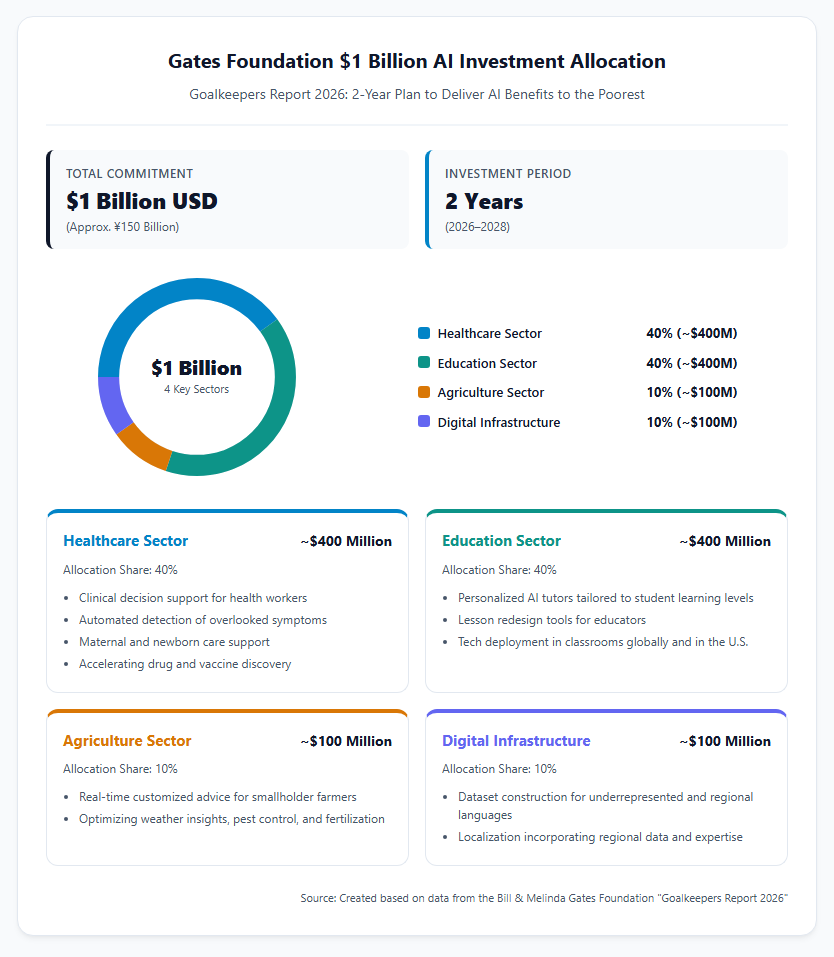
On September 15, 2026, alongside the release of its annual Goalkeepers Report 2026, the Gates Foundation announced plans to spend at least \$1 billion over the next two years. The primary objective of this investment is to equitably deliver the benefits of AI technology—which have historically been concentrated in developed nations and wealthy demographics—to the world’s poorest populations and low-income countries. Co-chair Bill Gates warned that leaving AI development purely to market mechanisms risks a classic market failure, where tools are built primarily for wealthy individuals and large corporations with the highest ability to pay. As with past technological revolutions, if developing nations and vulnerable communities are left behind, global disparities will only deepen. This commitment is framed as an urgent intervention to bridge that gap, leveraging AI to reduce inequality rather than exacerbate it. Mark Suzman, CEO of the Gates Foundation, emphasized that while \$1 billion may seem modest compared to the astronomical sums reported daily in corporate AI investments, it represents a transformative commitment within the context of humanitarian aid and global tech equity. Please refer to the conceptual diagram below.
Specific Allocation Across Healthcare, Education, Agriculture, and Language Data
The \$1 billion fund will be distributed across four key sectors based on clear strategic priorities. Forty percent of the total, or approximately \$400 million, will be directed toward healthcare. This allocation will support clinical decision-making tools for health workers in developing countries, automated detection of overlooked symptoms, maternal and newborn care, and the acceleration of drug and vaccine discovery. Another 40% (\$400 million) is designated for education, funding AI tutors tailored to individual student learning levels and assisting teachers in redesigning effective lesson plans. Ten percent, or about \$100 million, will go toward agriculture, providing smallholder farmers with real-time, customized advice on weather conditions, pest control, and fertilizer application. The remaining 10% (\$100 million) will be invested in digital infrastructure to build dataset resources for regional and underrepresented languages currently underserved by mainstream AI models.
The Limits of Market Forces and Structural Challenges Facing AI
Linguistic Bias in Early LLMs and Operational Risks in Developing Nations
One of the major structural challenges in current AI development is the linguistic bias present in training data. Over 90% of the data used to train early large language models (LLMs) originated from English-language sources, leaving the languages and cultural contexts of many global communities underrepresented. For instance, while state-of-the-art voice recognition systems achieve error rates below 6% for English, error rates can exceed 60% for languages like Yoruba spoken in Nigeria. In healthcare settings, such disparities pose critical risks: if a pregnant woman in Malawi mentions in Chichewa that her “water broke,” existing AI tools risk literal mistranslations such as “dumped water,” which could dangerously impair urgent clinical decisions. Because linguistic inequality directly translates into disparities in information access and medical accuracy, localizing datasets and establishing locally led evaluation frameworks have become urgent imperatives.
The U.S.–China “Super Competition” and Proposed Compute Resource Sharing
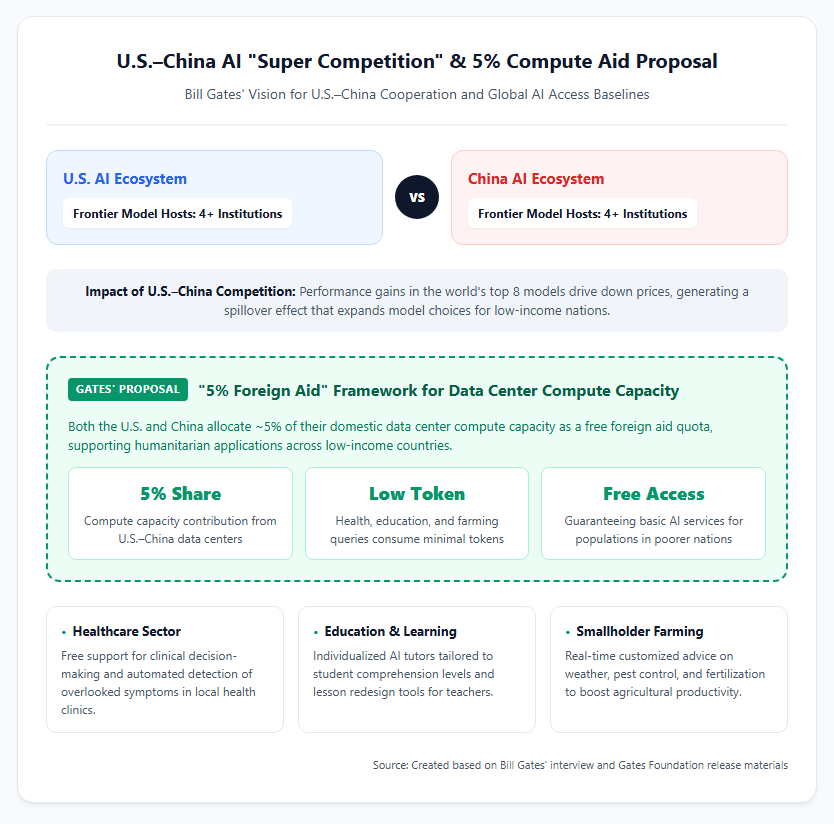
The AI landscape is currently defined by an intense “super competition” between the United States and China. According to Bill Gates’ analysis, both nations host at least four organizations capable of maintaining frontier-level models, driving a fierce rivalry for talent and computational power. However, Gates views this U.S.–China competition as potentially advantageous for developing nations, as it drives down model costs and expands available choices. Building on this dynamic, Gates proposes that both the U.S. and China allocate approximately 5% of their domestic data center compute capacity as a form of foreign aid, making it freely available for humanitarian applications in healthcare, education, and agriculture across low-income countries. Because processing health or agricultural inquiries consumes relatively few tokens, coordinated compute sharing between the two superpowers could help establish a global baseline ensuring that everyone on Earth has access to essential AI services. Please refer to the structural diagram below.
Concerns Over Social Disruption and Future Outlook
Labor Market Disruption Risks and the Proposal for “Human Reserved” Roles
The rapid advance of AI is expected to trigger unprecedented structural shifts in the global labor market. In white-collar fields such as administration, software programming, and data analysis, employment impacts are expected to manifest within the next few years. Furthermore, as humanoid robotics technology matures, blue-collar sectors like construction and hospitality face major transformations within four years. In response to this swift automation, Gates advocates for deliberately designing “Human Reserved” domains that restrict AI entry to prioritize human touch, empathy, and ethical judgment. By establishing protected sanctuaries for roles where human warmth and dignity are indispensable—such as delivering end-of-life medical diagnoses, emotional caregiving, and early childhood education—society can build an essential safeguard to preserve human connection and dignity.
The Token Tax Concept and Key Watchpoints Leading to the Foundation’s 2045 Sunset
Addressing the risks of employment disruption and technology misuse requires robust institutional policy and international governance. Under current tax systems, hiring human workers incurs payroll taxes, whereas acquiring AI systems or robots can be written off as capital expenses—a structure that inadvertently incentivizes aggressive corporate automation. To counteract this imbalance, Gates proposes implementing a “token tax” or “robot tax” tied to AI compute consumption and robotic deployment, using the generated tax revenues to fund worker retraining and social support programs. As the Gates Foundation approaches its scheduled sunset in 2045—when it plans to spend down its entire endowment of approximately \$200 billion to mark its 50th anniversary—the next 12 to 18 months represent a critical window for establishing equitable AI distribution and governance rules. Public-private collaboration that ensures the world’s poorest are not left behind remains the most vital imperative for the future.
Reference Pages
- 【Goalkeepers Report 2026 – Bill & Melinda Gates Foundation】https://goalkeepers.gatesfoundation.org/report/2026-report/
- 【Bill & Melinda Gates Foundation Official Site】https://www.gatesfoundation.org/
【#BillGates #GatesFoundation #GenerativeAI #AIEquity #Goalkeepers2026 #AIEthics】
コメント