Nerima Ward, Tokyo, introduced the “Unpaid Tax Countermeasures Support AI,” co-developed with Fujitsu Japan Limited, into actual operations on April 1, 2024, reducing the time required to select asset investigation destinations for delinquency management by approximately 90%. This was driven by common municipal challenges: approximately 35,000 unpaid cases and a shortage of veteran staff.
- Overview and Key Points of the AI-Powered Support System for Addressing Unpaid Taxes Introduced by Nerima Ward
- The Background Behind Conventional Delinquency Management and Common Challenges Shared by Local Governments
- 90% Time Reduction and Improved Investigation Accuracy Through Asset Investigation Target Optimization AI
- Optimization of Staff Allocation through AI Matching of Difficulty and Proficiency Levels
- Utilizing it for livelihood rehabilitation that balances strengthened collection with support for those in need
- Ripple effects on local governments nationwide, future developments, and points to watch
Overview and Key Points of the AI-Powered Support System for Addressing Unpaid Taxes Introduced by Nerima Ward
Nerima Ward, Tokyo, has begun full-scale operations of the “delinquency countermeasure support AI,” jointly developed with Fujitsu Japan Limited, in actual delinquency countermeasure operations starting April 1, 2024. This is the first initiative in Japan to directly utilize AI for selecting property investigation targets and assigning cases to staff in local government tax and National Health Insurance premium collection operations.
This system consists of the following two main systems.
- Asset Investigation Target Candidate Optimization System (Automatic Suggestion of Optimal Investigation Targets)
- Project Difficulty and Staff Proficiency Matching System (Optimal Allocation)
The following figure shows the overview and key functions of AI implementation in Nerima Ward.
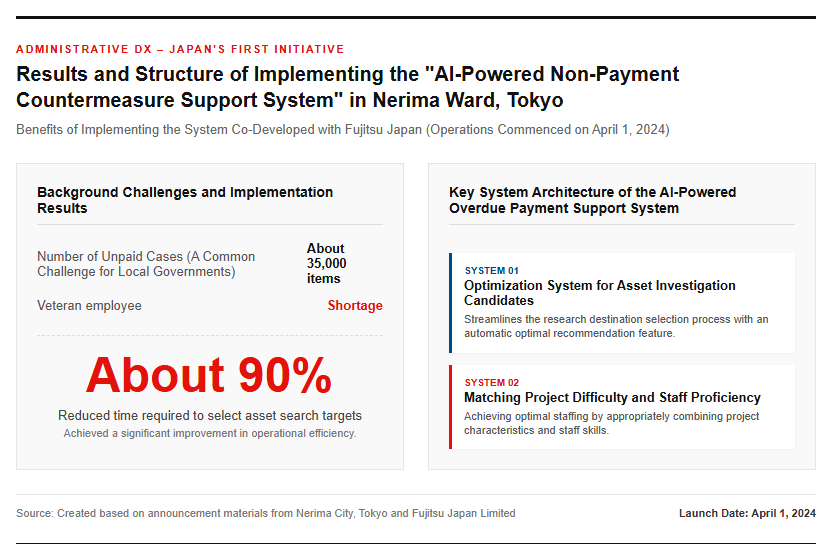
Prior to full-scale practical implementation, a joint demonstration experiment conducted from March 27, 2023, to the end of December of the same year confirmed remarkable effects in reducing staff workloads and improving investigation accuracy. Through the operation of this system, Nerima Ward expects to improve the collection rates of resident taxes and national health insurance premiums, yielding an annual collection effect of over 400 million yen. As an advanced model of municipal DX that simultaneously achieves the digitalization of administrative operations and work efficiency, it is also drawing significant interest from local governments across the country.
The Background Behind Conventional Delinquency Management and Common Challenges Shared by Local Governments
In the collection of delinquent resident taxes and national health insurance premiums by local governments, property investigations into inappropriate delinquent taxpayers based on the Local Tax Act are essential to achieve fair taxation. However, on the front lines, many structural issues have hindered the progress of delinquency management.
The main background and challenges in Nerima Ward are as follows.
- The existence of approximately 35,000 unpaid cases, making it extremely difficult to address all of them
- the chronic shortage of veteran staff resulting from personnel reassignments taking place on a 3- to 4-year cycle
- the time required to organize information such as the income and family structure of delinquent payers, which caused disparities in results depending on the proficiency level of the staff
In traditional manual asset investigations, narrowing down inquiry targets such as financial institutions and insurance companies required the intuition and experience of veteran staff. For newly assigned employees to select investigation targets for a single case, they had to meticulously examine a massive volume of past tax delinquency histories, family information, and taxation documents, which consumed significant effort and time. Additionally, because annual caseloads were assigned uniformly, a vicious cycle occurred where inexperienced staff were unable to handle complex cases, causing processing bottlenecks. These challenges have been a longstanding headache not only for Nerima Ward, but for tax administration offices in local governments across Japan.
90% Time Reduction and Improved Investigation Accuracy Through Asset Investigation Target Optimization AI
Developed by Nerima Ward and Fujitsu Japan Limited, the “Property Search Destination Candidate Optimization System” is an innovative mechanism that trains AI on the thought processes and investigation know-how of experienced officials. The AI analyzes several years of resident registry information, income information, past delinquency histories, and disposition records to instantly extract candidate financial institutions and other search locations with a high probability of holding accounts, ranked in order of priority.
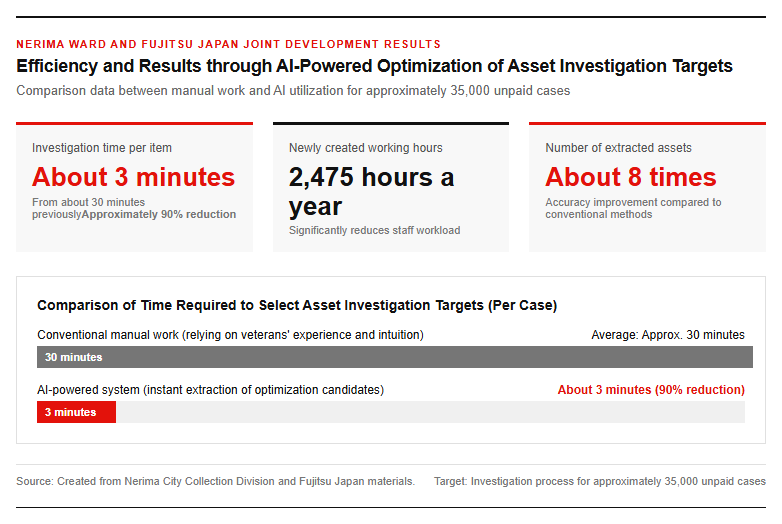
The specific results achieved through the implementation are as follows.
- Time spent selecting research targets per case reduced from the previous average of about 30 minutes to about 3 minutes (approx. 90% reduction in work time)
- Newly created approximately 2,475 hours of working time per year
- Asset extraction volume for financial institutions and others has dramatically increased to approximately 8 times that of conventional methods.
The following data visualizes the reduction in research time.
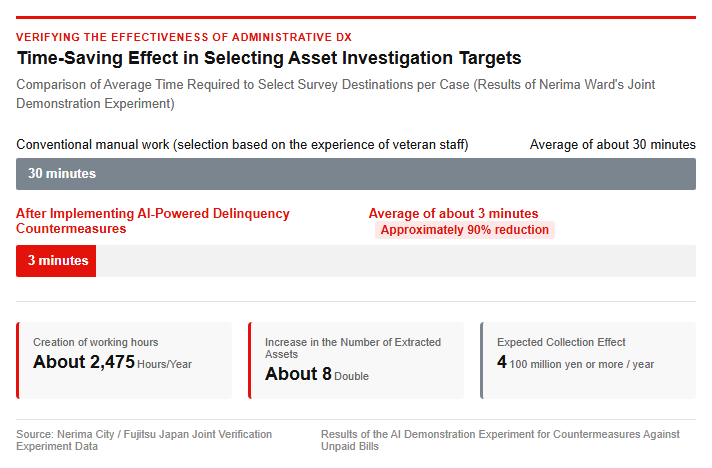
Traditional methods required an average of about 30 minutes per case for the selection process, but the use of AI suggestions has dramatically reduced this to about 3 minutes. This cut the time required for selection by 90%, freeing up a massive amount of working time—approximately 2,475 hours annually. Furthermore, in comparative experiments between conventional investigations without AI and those utilizing AI, the accuracy of tracking down delinquent taxpayers’ bank accounts and other assets soared to about 8 times higher. Even inexperienced staff members are now able to conduct asset investigations with an accuracy equal to or greater than that of veterans, achieving operational leveling and remarkable efficiency.
AI-Driven Organizational Reform and Its Ripple Effect on Local Governments Nationwide
Optimization of Staff Allocation through AI Matching of Difficulty and Proficiency Levels
Another key pillar of the unpaid-tax countermeasure support AI is the “matching system between case difficulty and staff proficiency level.” In Nerima Ward’s Tax Collection Division, personnel changes take place every year during the April personnel shuffle, but previously, both complex and simple cases were uniformly assigned to each staff member. As a result, a problem arose where operations would stall when high-difficulty cases were concentrated among newly appointed staff.
This system optimizes staff operations through the following methods.
- Evaluating proficiency on a 4-level scale based on employee asset investigation history and work man-hours
- Classified into three difficulty levels based on factors such as the complexity of unpaid cases and the amount in arrears.
- Automatic creation of optimal assignment tables matched to employee skills using matching algorithms
The concept of optimal project matching by AI is shown in the following figure.
By analyzing past work logs and processing speeds, the AI objectively classifies staff members into four tiers and cases into three tiers, and proposes the appropriate combinations. The introduction of this matching system has successfully reduced the total time required for investigative work by approximately 7%. By enabling step-by-step case assignments tailored to individual skill levels, it has become easier to provide appropriate guidance and advice to new staff members, thereby achieving sustainable human resource development and boosting overall workplace performance.
Utilizing it for livelihood rehabilitation that balances strengthened collection with support for those in need
Nerima Ward’s use of AI to support measures against unpaid taxes goes beyond simply strengthening tax collection or reducing administrative workload. By leveraging AI to quickly organize and analyze multifaceted data, it has become possible to grasp the detailed living conditions of each individual with unpaid taxes more meticulously than ever before.
Specifically, we strictly distinguish and use the following two-pronged approach:
- Strengthening collection efforts through thorough asset investigations for delinquent payers with the ability to pay or assets.
- For non-payers showing signs of financial hardship due to low income or heavy debt, early livelihood reconstruction support will be provided.
By rapidly understanding actual living conditions through AI, we will advance “strengthened collection” efforts, such as strict property seizures, against individuals who neglect to pay taxes despite owning assets. Meanwhile, for delinquent taxpayers who are genuinely struggling to make ends meet due to unemployment, illness, or heavy debt, we will promptly connect them with welfare divisions such as welfare offices and life support centers. By initiating administrative support from an early stage, we provide comprehensive assistance toward rebuilding their lives. This initiative, which achieves a high-level balance between “proper tax collection” and “support for those in financial difficulty,” has been praised as a sustainable collection model that enhances administrative credibility.
Ripple effects on local governments nationwide, future developments, and points to watch
The “Nerima Ward Model,” built by Nerima Ward and Fujitsu Japan Limited, has received high praise as an advanced case study of a local government taking the lead in developing AI based on challenges in the field. In addition to being presented at the “Gyokaku Koshien 2024” hosted by Ehime Prefecture, it has been featured in training sessions for tax collection officials nationwide and in specialized journals, drawing intense attention from local governments across the country.
Future developments and key focus areas for AI supporting measures against unpaid payments are as follows:
- Promotion of further automation through integration with electronic inquiry systems for financial institutions and RPA
- Data accumulation through the expansion of participating local governments and continuous improvement of AI algorithm accuracy
- Rollout of the general-purpose “Nerima Ward model” compatible with standardized systems to local governments nationwide
Due to the nature of AI, the more it is adopted and utilized by local governments, the greater the volume of accumulated data, which further accelerates accuracy improvements through machine learning. In addition, following the acceleration of property investigations, Nerima Ward is preparing to introduce RPA to automate obtaining responses from financial institutions and importing data. Local governments across Japan also face major challenges such as staff shortages due to population decline and the need to streamline tax delinquency management, and the proliferation and evolution of general-purpose AI systems aligned with the standardization of core systems are drawing attention as a development that will drastically transform future tax administration.
Reference page
- [Nerima City Official Website: Press Release] https://www.city.nerima.tokyo.jp/kusei/koho/hodo/r6/r603/20240327.html
- [Fujitsu Limited Press Release] https://prtimes.jp/main/html/rd/p/000000278.000093942.html
[#OverdueTaxMeasureAI #NerimaWard #FujitsuJapan #GovernmentDX #TaxAdministration #DelinquencyManagement #AdministrativeEfficiency]

コメント