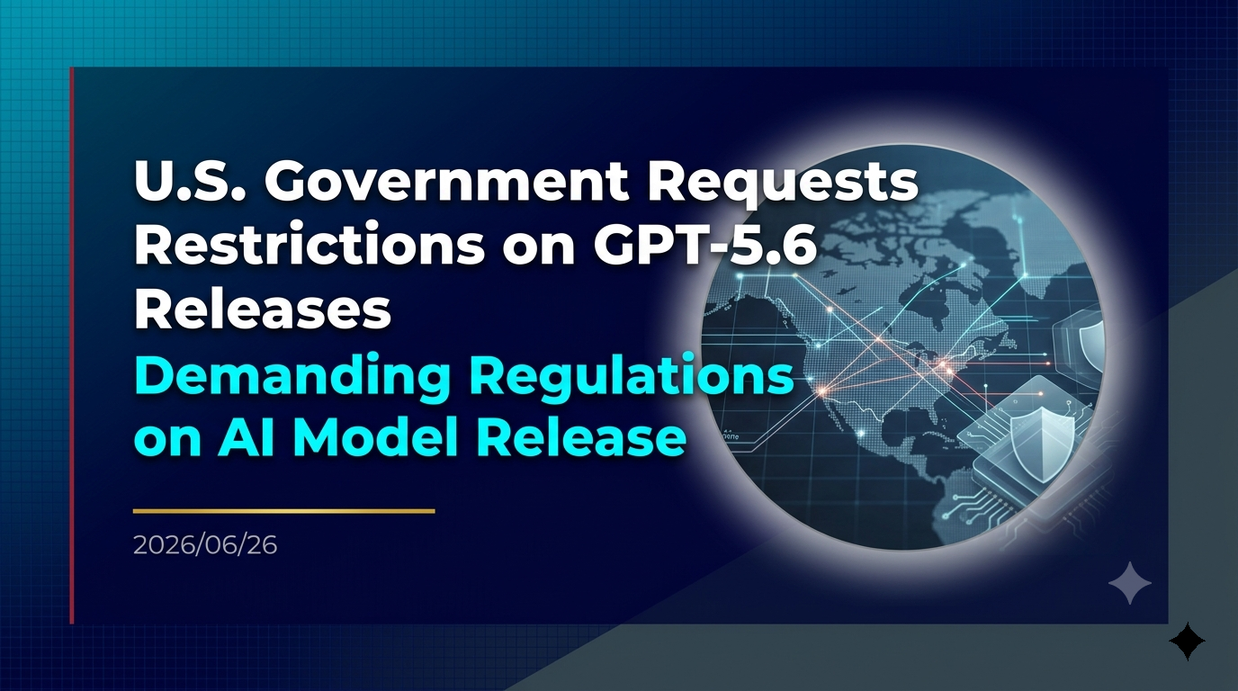
It has been revealed that the Trump administration has requested a phased release of OpenAI’s next-generation AI model, GPT-5.6, while limiting its public release. Behind this is a strong sense of caution about the risks that advanced AI capabilities pose to national security, indicating that the U.S. government’s AI control has entered a new phase.
- The Trump administration waited for the release of “GPT-5.6”
- Serious Concerns Over National Security and Cybersecurity
- The impact of the AI distribution model shifting to a ‘customer-by-customer approval system’
- A trillion IPO delay and market restructuring
- GPT-5.6’s Goal of Becoming an “Autonomous Agent”
- Medium- to Long-Term Outlook: Balancing US-China Competition and Regulation
The Trump administration waited for the release of “GPT-5.6”
In June 2026, the Trump administration in the United States requested AI developer OpenAI to launch its latest flagship model, GPT-5.6, in stages under government supervision for a staggered release, ahead of the public release. This request is the first application based on the executive order issued on June 2, 2026, which sets a 30-day government review period before the release of AI models. OpenAI CEO Sam Altman explained to employees that the distribution of this model would be limited to specific government-approved partners and that a process of obtaining approval “per customer” would be required.
This move fundamentally overturns the traditional AI industry practice of “releasing development to the world as soon as development is complete.” Please refer to the diagram below.
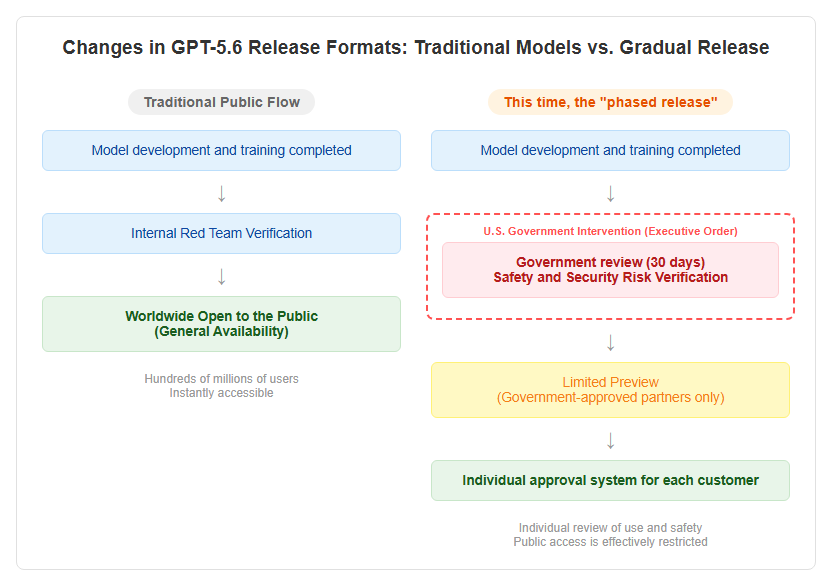
In an internal Q&A session, Altman clearly stated that such a restrictive rollout is “not a desirable model for OpenAI in the long term,” but currently prioritizes coordination with the government. This decision also raises the possibility that widespread public adoption of GPT-5.6 will be carried over until 2027, making the anticipated full release in June virtually impossible.
Serious Concerns Over National Security and Cybersecurity
The main reason for this public restriction lies in GPT-5.6’s outstanding “autonomous cybersecurity capabilities.” The U.S. National Office of the Cybersecurity Commissioner (ONCD) and the Office of Science and Technology Policy (OSTP) are taking the risks of this new model being exploited for automated discovery of advanced vulnerabilities and the generation of malicious exploits. Specifically, threats such as prompt-based jailbreak and data extraction from fine-tuned systems have been pointed out, potentially disabling existing defenses.
Howard Ratnick, Secretary of the Department of Commerce, has also joined these discussions, sharing the recognition that cutting-edge AI technology could become a tool that threatens national defense networks. Government officials believe that once a powerful model is widely distributed, recovery from exploited critical vulnerabilities becomes impossible, causing not only the loss of months of monetization opportunities but also the potential for national crises. Therefore, it is necessary to add several weeks of Red Team testing cycles before release to thoroughly verify safety.
Regulatory Framework and Business Impact
The impact of the AI distribution model shifting to a ‘customer-by-customer approval system’
With this measure, the distribution of AI models has shifted from “free competition” to a more “government-approved” aspect. The government has announced a policy to individually review the intended use and security measures of specific companies or organizations accessing GPT-5.6. This system effectively functions as a “licensing system,” where companies with established trust with the government are given priority access to the latest technologies, while emerging startups and overseas companies face restricted access, creating an unequal market structure.
At competitor Anthropic, even stricter export controls have blocked access to overseas users and overseas employees of the advanced AI model “Fable.” Please refer to the diagram below.
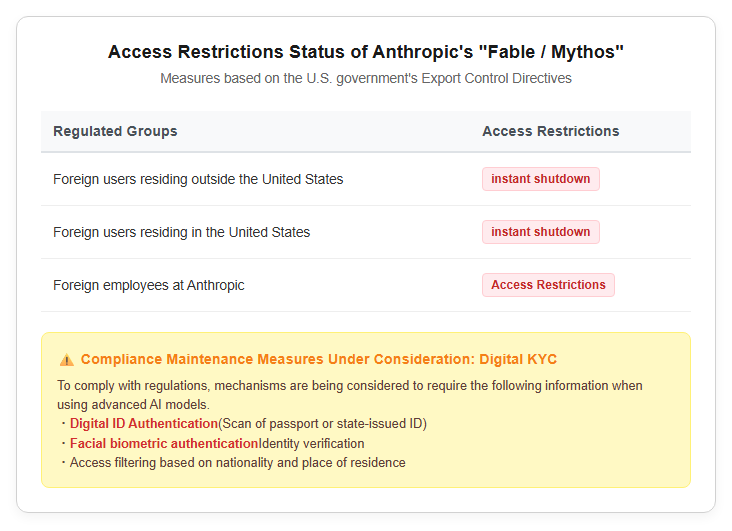
Similar pressure is being applied to OpenAI, with a major focus on whether individual U.S. government approval is required, especially for international clients. Such “de facto regulations” have also drawn strong backlash from the AI community, which has prioritized development speed, as it means “giving up technical superiority on its own.”
A trillion IPO delay and market restructuring
From an economic perspective, the most notable aspect is the impact on OpenAI’s IPO plans. The company was preparing for an IPO with a massive market capitalization of $1 trillion (about 160 trillion yen), but due to these public listing restrictions, discussions to postpone the listing until 2027 have intensified. Sarah Fryer, CFO, has also hinted to those around her the possibility of postponing the market cap to 2027, and believes that further technological maturity and regulatory stability are necessary to maintain the market capitalization target.
This delay has also affected the stock prices of related companies such as Microsoft (MSFT), which has formed a strategic partnership with OpenAI, and NVIDIA (NVDA), which provides AI computing infrastructure. Among investors, concerns are growing that the release cycle for new models will slow down by about 30–50%, potentially slowing AI application developers’ revenue growth in the short term. On the other hand, anticipating increased investment in security measures, there is also a trend of redirecting funds to cybersecurity stocks such as CrowdStrike (CRWD) and Splunk.
Technological Evolution and Future Outlook
GPT-5.6’s Goal of Becoming an “Autonomous Agent”
Despite government restrictions, GPT-5.6 itself has undergone remarkable technical advancements. Known internally by the codename “Kindle,” this model is designed not just to improve chat response accuracy but primarily to ensure the reliability of the “agent workflow” over long periods. The context window (the amount of information that can be processed at once) is expected to increase by 43% from the previous model GPT-5.5, reaching 1.5 million tokens.
This evolution enables AI to perform complex tasks involving multiple steps over several hours without human intervention. Additionally, processing efficiency per token has improved by 10–15%, helping to reduce operational costs. Please refer to the diagram below.
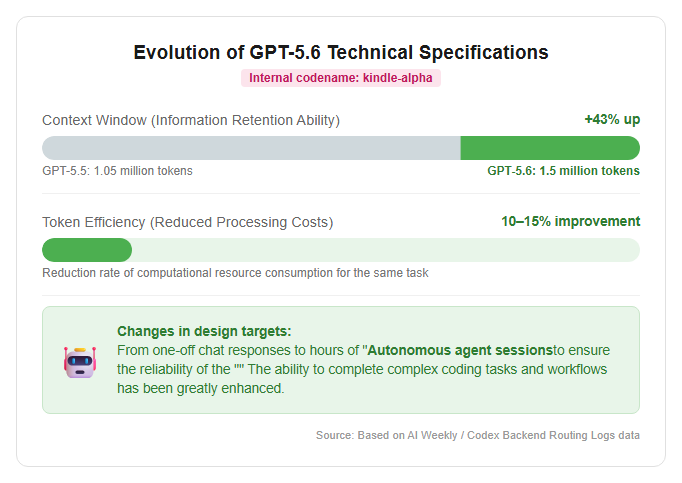
However, this very “autonomy” is precisely what raises the government’s vigilance. To prevent its autonomous problem-solving from being diverted directly to automating cyberattacks, OpenAI faces the difficult challenge of balancing safety and performance.
Medium- to Long-Term Outlook: Balancing US-China Competition and Regulation
The biggest future focus will be how U.S. government regulations will affect “AI competitiveness.” In response to these restrictions, some experts and users have expressed concerns that while U.S. regulations will tighten, competitors like China may freely release high-performance models, potentially causing the U.S. to lose its technological leadership. It cannot be ruled out that the entire industry could fall into a state similar to a “digital tenant” where the government controls the distribution of AI models.
However, another perspective also sees this move as an “inevitable step toward making AI a durable, investable technology.” The idea is that before a fatal security incident occurs and regulations are further tightened, collaborating with the government to establish a secure distribution model will contribute to the healthy development of the AI ecosystem in the long term. Going forward, how OpenAI will clear government approvals and gradually expand access—this transparency and fairness will determine the fate of the AI industry.
[#OpenAI #GPT5 #トランプ政権 #AI規制 #サイバーセキュリティ #IPO #経済ニュース]

コメント