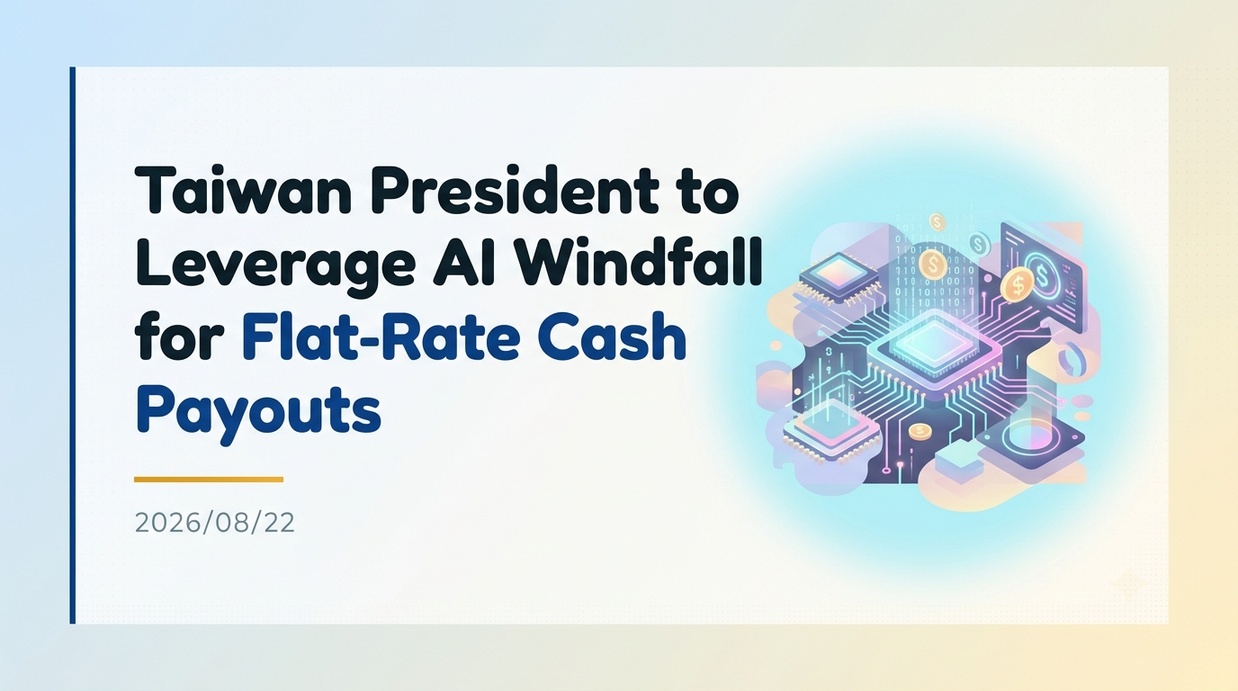
Taiwanese President Lai Ching-te has announced a plan to distribute a flat cash payment of 10,000 New Taiwan Dollars to all citizens in 2027, against the backdrop of tax revenue windfalls driven by the historic boom in the semiconductor and artificial intelligence (AI) industries. While this cash payout, also dubbed the “AI dividend,” is hailed as a means to equitably distribute the fruits of economic growth, it is also drawing criticism as a populist policy aimed at masking severe domestic income inequality and the expansion of the defense budget.
- Decision on Flat-Rate Cash Payouts and Implementation Schedule
- Explosive economic growth and higher-than-expected tax revenues
- “M-Shaped Economy” and Consideration for Inequality
- The Populism Debate Ahead of Local Elections and Taipei City’s Backlash
- Defense Budget Surpasses NT Trillion and Avoidance of Security Criticism
- Future Outlook and the Global Impact of the “AI Dividend”
Decision on Flat-Rate Cash Payouts and Implementation Schedule
In the central government’s general budget proposal for fiscal year 2027, the Taiwan government has decided on a policy to provide a flat-rate cash handout of 10,000 New Taiwan dollars (approx. 50,000 yen) per person to all citizens, as well as qualified spouses and foreign residents holding permanent residency. On August 17, 2026, after receiving a report on budget compilation from the Executive Yuan, President Lai Ching-te announced the allocation of 235.7 billion New Taiwan dollars (approx. 1.2 trillion yen) for this supplementary budget. Within the government, this payout is positioned as an “AI dividend,” marking a pioneering initiative to directly return the unprecedented growth of the AI industry to the public. The budget proposal will be deliberated at a meeting on August 20, 2026, with the goal of review and passage by the Legislative Yuan by the end of the year. If approved, actual distribution procedures are expected to begin ahead of the Lunar New Year in February 2027, a period when consumer spending appetite among citizens is at its peak. The government also issued a similar 10,000 New Taiwan dollar payment in 2025, and with this latest distribution decision, the precedent of directly returning tax revenue windfalls to the citizens is becoming firmly established in Taiwanese society.
Explosive economic growth and higher-than-expected tax revenues
Making this large-scale cash handout possible is the phenomenal economic growth driven by Taiwan’s robust semiconductor and information and communications technology (ICT) supply chains, led by TSMC. Massive investments are pouring into Taiwan due to the explosive surge in global demand for artificial intelligence (AI), high-performance computing, and cloud services. Taiwan’s statistical authorities have significantly revised upward their forecast for the 2026 annual economic growth rate to 11.05%, marking a 39-year high. In the first half of 2026 alone, an extremely high growth rate of 14.15% was achieved, which is the highest level in half a century. Driven by this robust economic climate, the central government’s total revenue forecast for fiscal year 2027 has been revised upward to 3.9266 trillion New Taiwan dollars (approximately 19.7 trillion yen). President Lai and Premier Cho Jung-tai have emphasized that this cash handout will be funded solely by the increase in tax revenues without issuing new government bonds, executed in accordance with a “virtually zero-borrowing” fiscal discipline that maintains a balanced budget.
“M-Shaped Economy” and Consideration for Inequality
While the economic growth figures are impressive, beneath the surface the country is facing a severe polarization of income—the progression of the so-called M-shaped economy. While workers in the high-tech export sector, represented by TSMC, reap massive benefits, those working in the service industry, traditional industries, and small and medium-sized local enterprises are completely left behind by the wave of growth. As housing prices in Taipei skyrocket and inflation of daily necessities hits low-income brackets hard, a tangible sense of being left behind has been growing among citizens. According to economic analysis, Taiwan’s GDP per capita is expected to exceed $40,000, yet the reality is that middle-class wages are significantly lower compared to countries with a similar GDP level. President Lai stated that the government should not rest on its laurels regarding the rise in averages, but instead turn its attention to the front lines of people struggling to get by below the average, thus asserting the justification for universal cash handouts. As shown in the following photo, cutting-edge AI technology is rapidly being implemented into society in Taiwan.
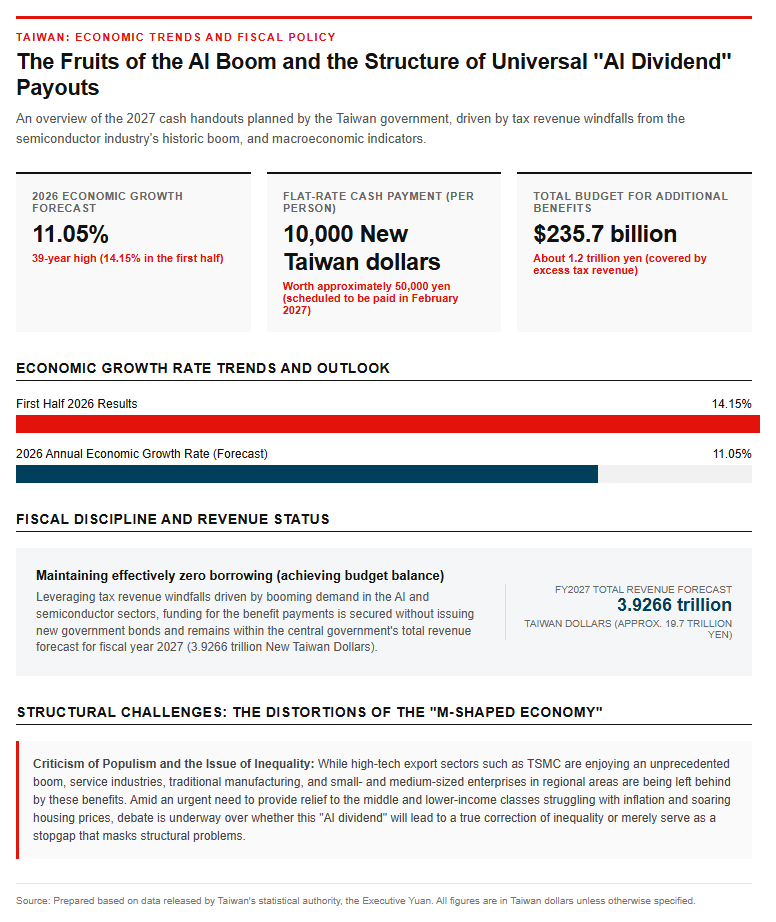
The cash obtained is expected to be allocated to educational expenses, elderly care, and the purchase of daily necessities, directly alleviating the burden on low-income households.
Political Confrontation Over Policy and Geopolitical Risks
The Populism Debate Ahead of Local Elections and Taipei City’s Backlash
This cash handout plan has triggered fierce political battles within Taiwan’s political arena. With the local elections approaching on November 28, 2026, and the presidential election in 2028, opposition parties such as the Kuomintang (KMT) have fiercely criticized the decision to distribute funds as a populist “cash-splurging” policy aimed at securing voter support. In particular, Taipei Mayor Chiang Wan-an, a member of the KMT, demanded that the central government increase the payout amount to 20,000 New Taiwan Dollars (approximately 100,000 Japanese yen) per person, citing the central government’s abundant tax revenues. In response, the ruling Democratic Progressive Party (DPP) countered that Taipei City should fund the additional payouts from its own fiscal surplus, leading to a bogged-down debate. The Taipei City Department of Finance explained that while the city’s fiscal surplus for fiscal year 2027 stands at 33.2 billion New Taiwan Dollars (approximately 170 billion Japanese yen), its existing debts reach 35.3 billion New Taiwan Dollars (approximately 180 billion Japanese yen), meaning the financial situation is effectively in the negative. Arguing that debates ignoring the differences in tax revenue structures between local and central governments are unjust, the conflict surrounding the cash handouts has evolved into a dispute over central-versus-local fiscal logic.
Defense Budget Surpasses NT Trillion and Avoidance of Security Criticism
It has been pointed out that behind the major announcement of cash handouts at this particular timing lies the existence of another extremely important national budget. In the draft budget for fiscal year 2027, Taiwan’s national defense budget is set to increase from the previous year, reaching 1.1225 trillion New Taiwan dollars (approximately 5.6 trillion yen) and breaking the 1 trillion New Taiwan dollar mark for the first time in the combined total of the annual and special budgets. This represents the largest-scale security investment in history, exceeding 3% of GDP, and President Lai has consistently emphasized the importance of strengthening defense capabilities, stating that “investment in national defense is investment in peace.” However, it is inevitable that public and opposition criticism will mount regarding the heavy burden of military spending, the resulting fiscal pressure, and the intensification of geopolitical tensions. Some political analysts point out that the crowd-pleasing policy of cash handouts may have been announced as a packaged, preemptive appeasement measure designed to preemptively curb public dissatisfaction and concerns over the record-breaking security budget and to ensure the smooth passage of the budget bill through the Legislative Yuan.
Future Outlook and the Global Impact of the “AI Dividend”
This Taiwanese cash handout program goes beyond a mere temporary economic stimulus measure, making a profound impact on global welfare policies and economic models. While conventional universal basic income (UBI) social experiments in Europe and North America have primarily aimed at poverty alleviation and the restructuring of social security, Taiwan’s initiative closely resembles the “Alaska Model,” which distributes dividends derived from natural resource export profits. In Taiwan’s case, rather than oil, it can be described as a new wealth distribution model unique to the AI era, using “silicon”—world-dominating semiconductors—as its resource. On the other hand, this system also harbors the risk of becoming a medium- to long-term fiscal trap. The semiconductor industry is inherently cyclical, and should the AI demand boom cool down, the Taiwanese government’s tax revenues would drop significantly. Once a precedent is established of distributing the “AI dividend” annually as a matter of citizens’ inherent rights, scaling back these payments during future economic downturns would become exceedingly difficult, potentially imposing a severe fiscal burden on future generations. The world is closely watching the trajectory of this “AI dividend”.
Reference page
- 【Basic Income Earth Network (BIEN)】https://basicincome.org/
- 【UBI Taiwan】https://ubitaiwan.org/en/about/
[#TaiwanEconomy #AIDividend #CashHandout #SemiconductorIndustry #LaiChingte #MShapedEconomy #NationalDefenseBudget #Populism]

コメント