Prime Minister Sanae Takaichi emphasized balancing a “strong economy” with “fiscal sustainability” in her October 2026 policy speech. Behind this is the aim to break away from the long-standing contraction-equilibrium economy through “responsible proactive fiscal policy” and attract large-scale domestic investment.
- Basic policy centered on economic priorities with statecraft and public welfare as its core
- The Mechanism of “Responsible Proactive Fiscal Policy” That Induces Large-Scale Investment
- The “Virtuous Cycle of Growth” Brought by Wage Increases and Capital Investment
- 17 Strategic Sectors and Their Impact on the Stock Market (Sanaenomics)
- Restructuring of fiscal management targets centered on the debt-to-GDP ratio
- Medium- to Long-Term Challenges Posed by Surging Interest Rates and Persistent Inflation
Basic policy centered on economic priorities with statecraft and public welfare as its core
In her policy speech on October 5, 2026, Prime Minister Sanae Takaichi positioned “the economy” as her highest priority, expressing her determination to fulfill the spirit of “keisei saimin” (governing the nation and relieving the suffering of its people). Addressing the current reality in which Japan has suffered from low interest rates and a deflationary structure for nearly 30 years, leading to a deeply ingrained “defensive mindset” among businesses and households, she strongly called for a departure from a contraction-equilibrium economic structure. In her speech, she emphasized achievements such as wage increases in the 5% range for the third consecutive year in the spring labor-management negotiations and private-sector domestic capital investment reaching a record-high 128 trillion yen in fiscal 2025. Building on this, she appealed to the importance of a new framework for economic and fiscal management that simultaneously achieves a “strong economy” and “fiscal sustainability.” Rather than simply expanding government expenditures, she outlined a path to raise the potential growth rate, increase citizens’ take-home pay, and achieve a natural increase in tax revenue. Through this resolve and execution, the aim is to set the Japanese economy back on a trajectory of autonomous expansion amidst intensifying international competition.
The Mechanism of “Responsible Proactive Fiscal Policy” That Induces Large-Scale Investment
At the core of the speech were concrete measures for a “responsible proactive fiscal policy,” outlining the government’s direction to implement planned fiscal stimulus as a catalyst for domestic investment. Breaking away from the conventional reliance on supplementary budgets, a principle was established to record ongoing, essential initiatives in the initial budget. In budget compilation, the existing expenditure cap known as the “ceiling” will not be applied, and a “‘Strong and Prosperous Japan’ Investment Framework” will be created to back growth investments based on multi-year plans. Furthermore, for fields of critical importance to economic security, “separate framework management” utilizing special accounts will be introduced to establish a mechanism that stably secures medium- to long-term financial resources. Meanwhile, to thoroughly prune wasteful spending, a comprehensive review of subsidies and special tax measures will be promoted through the “Japanese-version DOGE” established in the Cabinet Secretariat. By combining sound revenue securing that does not rely on exceptional government bonds with targeted investment, the aim is to achieve both improved market confidence and economic growth.
Economic Structural Transformation and Spillover Effects on Markets and Industries
The “Virtuous Cycle of Growth” Brought by Wage Increases and Capital Investment
The structural reform targeted by the Takaichi administration is the establishment of a “virtuous cycle of growth” in which corporate investment, wage increases, and the growth of personal consumption are mutually linked. As countries around the world deploy industrial policies by injecting massive national funds, stagnation in domestic investment has been a factor leading to the overseas outflow of technology and employment. Moving beyond mere generous subsidies, the administration is preparing to abolish the provisional tax rates on gasoline and diesel, cut the consumption tax rate on food by 1% for a limited two-year period, and introduce income-linked benefits. This aims to securely anchor the turnaround of real wages into positive territory and shore up household purchasing power. It seeks to launch a cycle where companies regain the pricing power lost during the deflationary era, and improved business earnings are translated into further wage hikes and new investments. The following image visualizes this ripple structure of economic growth.
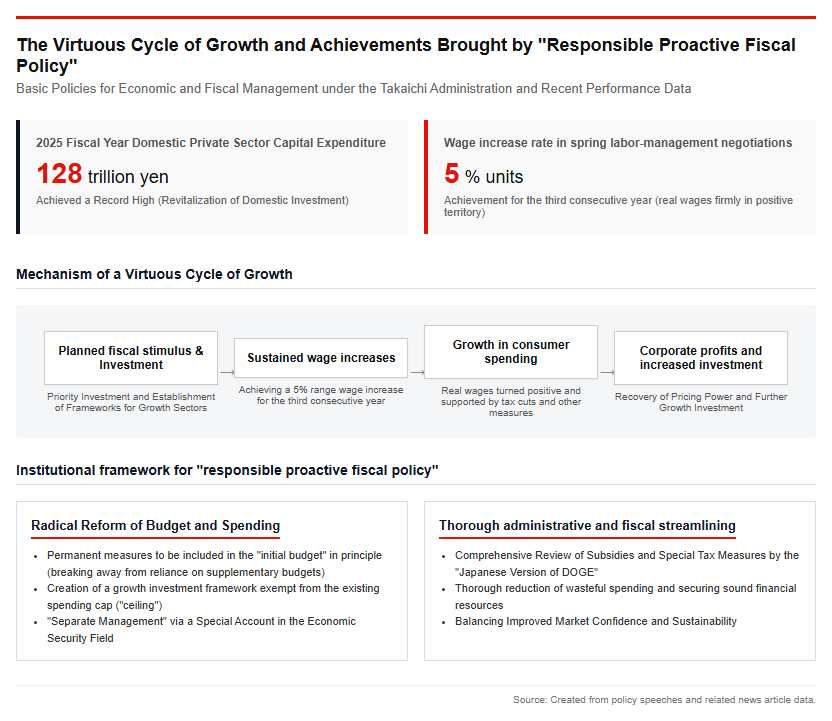
Through the integration of such comprehensive measures against rising prices and growth policies, an overall boost to domestic demand is expected.
17 Strategic Sectors and Their Impact on the Stock Market (Sanaenomics)
Positioned as the pillars of the administration’s growth strategy are 17 strategic fields centered on “crisis management investment” and “growth investment.” Specifically, these include AI and semiconductors, quantum technology, biotechnology, the defense industry, aerospace, cybersecurity, next-generation energy (such as fusion energy), and disaster prevention. Particularly in the defense sector, plans are underway to achieve the target of increasing defense spending to 2% of GDP ahead of schedule within the current fiscal year. For these strategic fields directly tied to national policy, the government plans to formulate a five-year “public-private investment roadmap” to guide the influx of private capital. In the stock market, these are positioned as “Sanaenomics” or “national policy theme stocks,” and valuations for related sectors are rising. The government’s clear commitment and budgetary measures enhance predictability, serving as a crucial factor supporting a new revaluation scenario for Japanese stocks as a whole.
Ensuring Fiscal Sustainability and the Risks of Spiking Interest Rates and Inflation
Restructuring of fiscal management targets centered on the debt-to-GDP ratio
Regarding fiscal sustainability, the Takaichi administration is significantly reorganizing conventional fiscal discipline targets. Moving away from the conventional single-year primary balance (PB) surplus target, the administration has now placed “the stable decline in the ratio of total national and local debt to GDP” at the core of its fiscal management objectives. The PB has been repositioned as a confirmation indicator to be managed over multiple years, demonstrating a flexible stance that tolerates “temporary deficit expansion” in response to economic fluctuations and the necessity of growth investments. According to Cabinet Office estimates, under “Growth Strategy Realization Case 1,” which entails additional fiscal spending on the scale of 10 trillion yen in real terms annually, the achievement of real GDP growth in the high 1% range and a reduction in the public debt-to-GDP ratio are projected simultaneously. However, for this scenario to hold, extremely stringent preconditions are required, such as an increase in total factor productivity (TFP) surpassing the United States and the realization of over 370 trillion yen in cumulative public-private investment, leaving the ensuring of its effectiveness as a challenge for the future. The following figure illustrates the overall picture of the structural change.
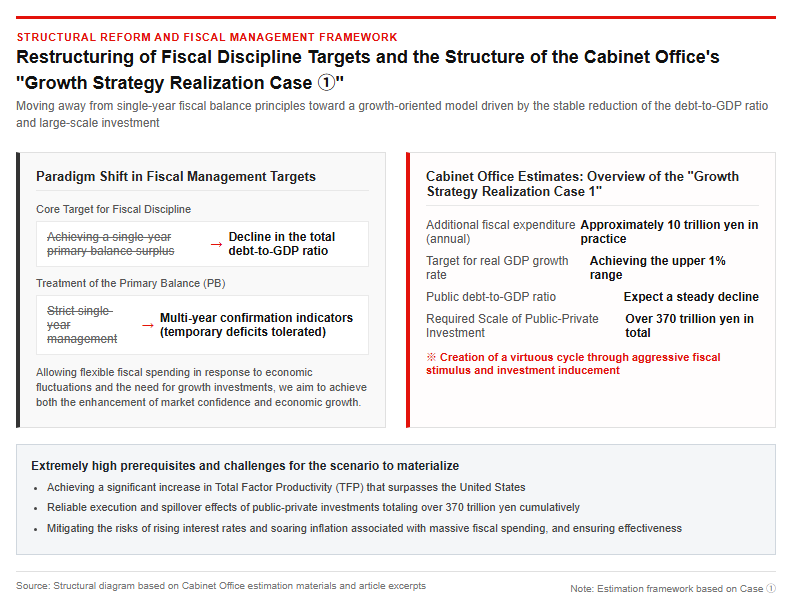
Medium- to Long-Term Challenges Posed by Surging Interest Rates and Persistent Inflation
Concerns over aggressive fiscal policy are primarily manifesting in the form of rising long-term interest rates and inflationary pressures in financial markets. Risks have been pointed out that structural fiscal deficits will expand due to an annual scale of 10 trillion yen in investments across 17 strategic fields and an increase in annual expenditures exceeding 5 trillion yen resulting from a reduction in the consumption tax on food. Entering 2026, Japan’s 10-year government bond yields surged to nearly 3%, a high not seen in about 30 years, and the rise in the risk premium associated with increased government bond issuance became pronounced. Estimates have also been released indicating that, accompanied by the normalization of monetary policy by the Bank of Japan, the policy interest rate will rise to around 2% and long-term interest rates to around 3.6% to 4% by the end of fiscal 2027. Rising interest rates will sharply increase the nation’s government bond interest payments in the future, with a high possibility that interest payments in fiscal 2040 will reach more than four times those of fiscal 2025. To achieve sustainable growth, a balance is essential between raising the potential growth rate through growth investment and curbing sharp interest rate spikes through strict expenditure control.
Reference Page
- [Basic Policies on Economic and Fiscal Management and Reform]https://www5.cao.go.jp/keizai-shimon/kaigi/cabinet/honebuto/2026/decision0721.html
- [Basic Policy for Introducing a Refundable Tax Credit System] https://www.cas.go.jp/jp/seisaku/kokuminkaigi/contents/20260805/01_siryou1.pdf
【#TakaichiAdministration #PolicySpeech #ResponsibleProactiveFiscalPolicy #JapanGrowthStrategy #JapaneseEconomy #InterestRateTrends #FiscalSustainability】
コメント