On October 2, 2026, Internet Initiative Japan Inc. announced the addition of approximately 10Gbps connectivity to its enterprise SD-WAN service, the “IIJ Omnibus Service.” This move is driven by an increase in branch office traffic due to the expanding use of cloud services and the migration to zero trust.
- Key Points of the News and Announcement Details
- Background of the Announcement: Rapidly Increasing Traffic and Facility Challenges
- The Role of the In-House Developed “SEIL CA10” Adapter
- Introduction of IPv6 IPoE Connection Utilizing Flets Hikari Cross
- Local Breakout and SASE/SSE Integration
- Impact on Enterprise Network Operations
- Future Outlook and Key Points to Watch
Key Points of the News and Announcement Details
On October 2, 2026, Internet Initiative Japan Inc. (IIJ) began offering new features for its enterprise SD-WAN service, the IIJ Omnibus service, supporting high-speed connectivity of approximately the 10Gbps class. In this functional expansion, the company newly added the SEIL appliance series CA10—an in-house developed service adapter equipped with 10GbE ports—to its lineup, and also added support for branch connections via the IPv6 IPoE method utilizing Flets Hikari Cross lines provided by NTT East and NTT West. This makes it possible to build wide-area network environments incorporating ultra-high-speed access lines of the 10Gbps class across corporate locations nationwide. By increasing the capacity of branch WAN lines, which were traditionally centered around 1Gbps bandwidth, and having IIJ comprehensively handle configuration, monitoring, and operational maintenance processes, enterprises can now achieve faster branch communications without the burden of complex equipment management.
Background of the Announcement: Rapidly Increasing Traffic and Facility Challenges
In recent years, many companies and government agencies have been rapidly adopting integrated security models such as SASE and SSE, which are based on a Zero Trust mindset to maintain secure access regardless of location or device. In addition to this, with the expanding use of SaaS such as Microsoft 365, the normalization of web conferencing, and the massive growth of business data, internet traffic across entire enterprises continues to trend toward a significant year-over-year increase. Along with these changes in the communication environment, WAN lines used by individual locations to connect to the cloud have become bottlenecks, making communication delays and bandwidth congestion significant issues. The conventional 1Gbps bandwidth could no longer handle large-volume communications from multiple devices, resulting in adverse effects on business operations, such as interruptions in web conferencing and delays in file transfers. The recent implementation of 10Gbps connection support was carried out with the aim of directly responding to the high-speed, large-volume communication needs of the cloud era and fundamentally resolving bandwidth shortages in branch and office networks.
Technical Specifications and Feature Enhancements Supporting 10Gbps Connectivity
The Role of the In-House Developed “SEIL CA10” Adapter
To accommodate 10Gbps-class access lines, IIJ has introduced the SEIL Appliance Series CA10, an in-house developed network device. This device comes standard with 10GbE ports and boasts high throughput performance capable of withstanding large-volume traffic processing. By installing it at the WAN edge of corporate locations, it enables communication control that maximizes the bandwidth of 10Gbps lines and inter-site encrypted communication. Furthermore, this appliance supports zero-touch provisioning utilizing IIJ’s proprietary patented technology, the SEIL Management Framework (SMF). Since on-site workers can complete the configuration automatically simply by connecting a LAN cable and turning on the power, rapid site deployment is possible without dispatching specialized engineers to the location. The configuration diagram is shown below.
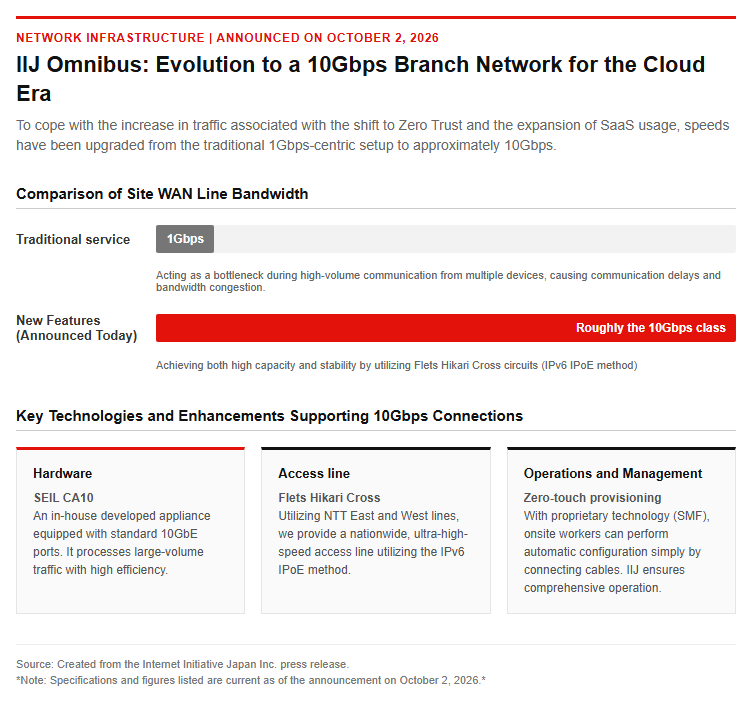
.Device configuration management, status monitoring, and emergency troubleshooting are all managed remotely by IIJ’s expert engineers via the management portal, significantly reducing the management man-hours required by the IT department.
Introduction of IPv6 IPoE Connection Utilizing Flets Hikari Cross
Another pillar of this feature enhancement is the support for approximately 10Gbps IPv6 IPoE connection methods utilizing Flets Hikari Cross provided by NTT East and NTT West. With the conventional PPPoE connection method, session congestion at network termination units frequently became a bottleneck, preventing users from achieving their original line speeds in many cases. Meanwhile, by adopting the IPv6 IPoE method—a next-generation network technology—stable communication with high bandwidth, avoiding congestion, becomes possible. By accommodating Flets Hikari Cross through the IIJ Omnibus service, SD-WAN communications from sites and local breakouts connecting directly to the cloud from each site’s internet line are dramatically accelerated. Capitalizing on IIJ’s strengths as an independent telecommunications carrier, it is also possible to achieve a multi-carrier redundant configuration that freely combines not only Flets Hikari but also mobile lines, leased lines, and more as access circuits.
Local Breakout and SASE/SSE Integration
The IIJ Omnibus service is designed to flexibly integrate with SASE—which combines SD-WAN functionality for network control with cloud-based security functions—and SSE architecture specialized for security. A particularly crucial feature is the local breakout function, which connects communications destined for specific cloud services directly to the internet from branch locations. Typically, destination information such as IP addresses and FQDNs for cloud services changes frequently and without notice, posing the challenge that manual operation makes maintaining settings difficult. IIJ Omnibus provides the “IIJ Cloud Navigation Database,” which automatically updates communication destination settings, constantly and automatically distributing the latest routing information without placing an operational burden on administrators. By routing high-load web conferencing and video streaming traffic directly via local breakout and processing it in a distributed manner over a high-bandwidth 10Gbps connection, network latency across the entire company is completely eliminated.
Significance of Implementation and Future Market Outlook
Impact on Enterprise Network Operations
Adopting the IIJ Omnibus service, which supports 10Gbps connections, has a tremendous impact on stabilizing corporate IT infrastructure and improving operational efficiency in IT departments. Traditionally, when enterprises sought to accelerate site communication speeds, they had to individually contract expensive wide-area Ethernet or MPLS dedicated lines, making steep line costs and long deployment times major bottlenecks. However, by combining affordable 10Gbps-class fiber-optic lines with SD-WAN, it is possible to deploy a high-quality, high-bandwidth WAN environment comparable to dedicated lines to all offices in a short period, all at a low cost. In addition, a graphical management portal is provided that eliminates the need for direct command operations on devices, enabling anyone to centrally visualize communications and modify settings. By preventing operations from becoming a black box while ensuring redundancy through automatic failover during outages, companies can achieve enhanced business continuity and a dramatic reduction in maintenance and operational workload.
Future Outlook and Key Points to Watch
Looking ahead, it is certain that traffic generated at branch offices will further increase with the promotion of corporate DX, the business utilization of generative AI technologies, and the explosive growth of IoT devices. IIJ has clearly stated its policy to rapidly respond to changing market environments surrounding networks and to continue accelerating the functional enhancement of the IIJ Omnibus service and the expansion of peripheral security services. In particular, the adoption of SASE configurations combining SSE products—such as the cloud-based zero-trust access service “IIJ Flex Mobility Service/ZTNA”—with IIJ Omnibus is rapidly increasing. Whether network infrastructure can be upgraded to higher bandwidths and advanced security controls can be seamlessly integrated will be the key to determining future corporate growth. SD-WAN supporting 10Gbps connections is expected to go beyond simply speeding up lines and further increase its presence as an indispensable social infrastructure supporting the next-generation IT foundation of enterprises.
Reference Page
- [IIJ Press Release (Announced on October 2, 2026)] https://www.iij.ad.jp/news/pressrelease/2026/1002.html
- [IIJ Omnibus Service Official Page] https://www.iij.ad.jp/biz/omnibus/
- [SEIL Appliance Series CA10 Product Information] https://www.seil.jp/product/ca10.html
【#IIJ #SDWAN #10Gbps #SASE #SSE #FletsHikariCross #ZeroTrust】

コメント