Unitika has developed the low-dielectric bismaleimide resin “UMI-0” for advanced semiconductor package substrates and established a mass-production system. This development is driven by market needs for faster data processing, accompanying the rapid spread of generative AI and 5G communications, as well as the reduction of transmission loss in high-frequency substrates.
- 【Key Points】Low-dielectric bismaleimide resin “UMI-0” developed by Unitika
- [Technical Background] Signal Attenuation Associated with Higher Frequencies and Challenges of Conventional Resins
- 【Development Methods and Features】Proprietary technology achieving an acid value of less than 1.0 and liquid characteristics
- 【Performance Data】Excellent dielectric properties and high heat resistance in the 20GHz band
- [Practical Application and Significance to Society] The Evolution of Generative AI Servers and High-Frequency Communication Boards
- [Future Outlook and Key Points] Global Strategy Aiming for 1 Billion Yen in Sales by 2030
- U-Imide (BMI)
【Key Points】Low-dielectric bismaleimide resin “UMI-0” developed by Unitika
On September 30, 2026, Unitika Ltd. announced the development of “UMI-0,” a new product grade of its low-dielectric bismaleimide resin “U-Imide,” which can be applied as a material for advanced semiconductor package substrates. The company has already established a mass-production system capable of stable year-round production, and has begun full-scale marketing activities for customers both in Japan and overseas. This product is expected to serve as a material that solves the structural issues caused by thermal stress and characteristic degradation originating from impurities, which have been challenges for conventional semiconductor substrate resins. Starting with its adoption in advanced package substrates and flexible copper-clad laminates (FCCL), it is being deployed in a wide range of electronic material applications, including conductive pastes and high-heat-resistant adhesives. An overview of the development background, key technical specifications, and product appearance is provided in the image below.
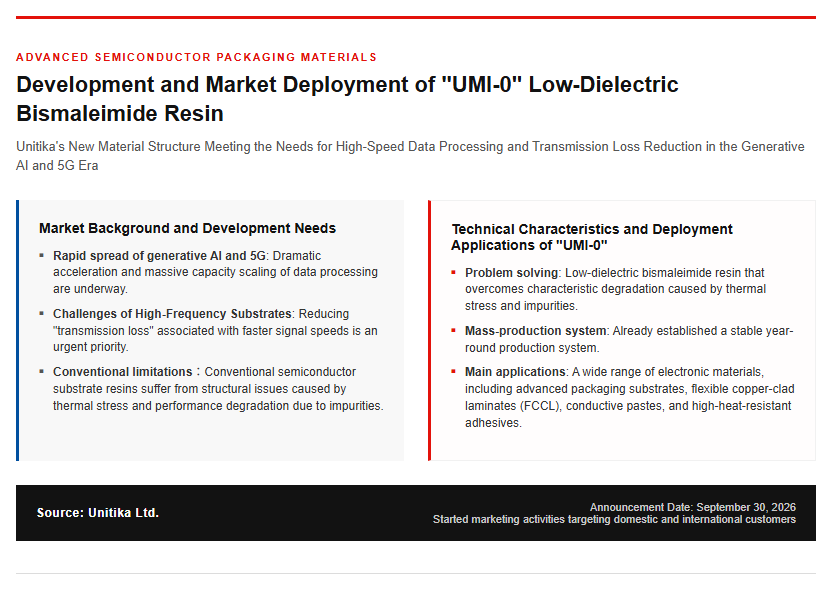
Unitika has already filed about 30 patents for this newly developed product both in Japan and overseas, securing strong competitiveness in building its intellectual property network. The company has set a plan to achieve 1 billion yen in sales by 2030 for the group centered around this product.
[Technical Background] Signal Attenuation Associated with Higher Frequencies and Challenges of Conventional Resins
With the rapid expansion of generative AI and cloud services in recent years, as well as the advancement of communication technologies such as 5G and 6G, the amount of data processed across society has increased dramatically. In semiconductor devices installed in AI servers and data centers, operating frequencies are rapidly shifting to higher frequencies in order to process and transmit large volumes of data at high speeds. However, there is a physical challenge: the higher the signal frequency, the greater the transmission loss (dielectric loss), where electrical energy is converted into heat and lost along the substrate’s transmission path. To suppress transmission loss, it is essential to lower the dissipation factor (Df) of the resin used for the insulating substrate. However, in conventional low-dielectric resins, rigid aromatic skeletons have been widely used to achieve low-dielectric properties and high heat resistance. As a result, the cured resin lacked sufficient flexibility and could not fully absorb the thermal stress caused by temperature changes occurring during semiconductor manufacturing processes and operating environments, presenting a serious problem in which cracks and interfacial delamination easily occurred inside the substrate.
Innovative Features Brought by Molecular Design and High Purification
【Development Methods and Features】Proprietary technology achieving an acid value of less than 1.0 and liquid characteristics
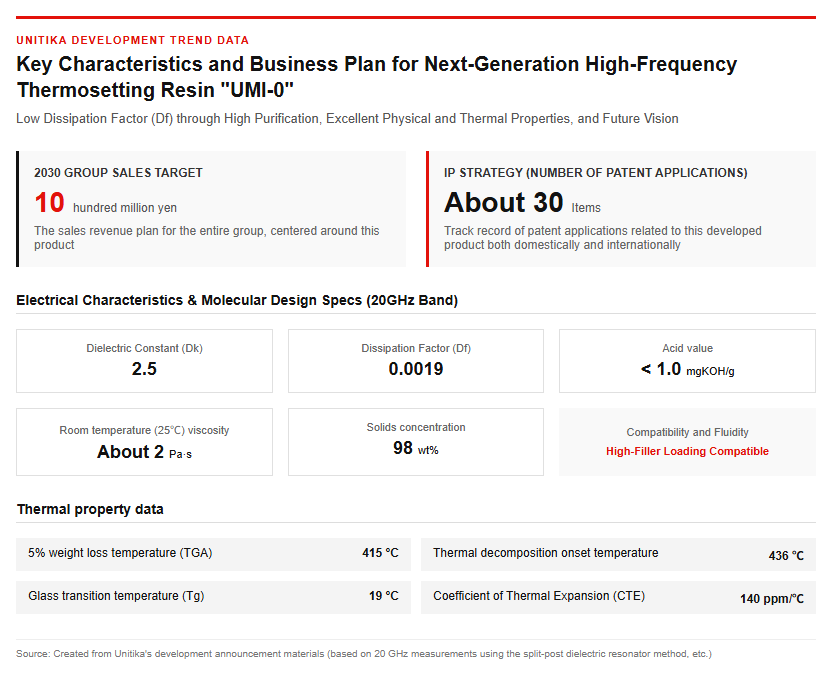
Developed by Unitika, “UMI-0” is a thermosetting bismaleimide resin that combines a proprietary molecular design incorporating a flexible aliphatic backbone with high-purification technology to purify and remove residual impurities. Conventionally manufactured bismaleimide resins retain acid components derived from the manufacturing process, which not only hinders the achievement of a low dielectric dissipation factor but also causes reduced compatibility with other resins and increased viscosity. In contrast, “UMI-0” achieves extreme purity with an acid value of less than 1.0 mgKOH/g through its proprietary high-purification technology. This ensures excellent electrical properties while significantly improving compatibility with other thermosetting resins (such as epoxy resins and phenolic resins) and photocurable resins. Furthermore, “UMI-0” features excellent liquid fluidity with a viscosity of approximately 2 Pa·s at room temperature (25°C), along with a high solid content concentration of 98 wt%. The ease of viscosity adjustment enables high loading of fillers (inorganic fillers) during substrate manufacturing, greatly expanding the flexibility of material design.
【Performance Data】Excellent dielectric properties and high heat resistance in the 20GHz band
The excellent physical properties of “UMI-0” are backed by objective measurement data. Measurement results using the split-post dielectric resonator method in the high-frequency range of 20GHz show that the cured product records extremely low values of 2.5 for dielectric constant (Dk) and 0.0019 for dissipation factor (Df). This is a level that can significantly reduce dielectric loss in high-frequency circuits. It also demonstrates excellent robustness in thermal properties, with the 5% weight loss temperature by thermogravimetric analysis (TGA) reaching 415°C and the thermal decomposition onset temperature reaching 436°C. The glass transition temperature (Tg) is 19°C, and the coefficient of thermal expansion (CTE) by thermomechanical analysis (TMA) is 140 ppm/°C. The introduction of a flexible aliphatic skeleton imparts appropriate flexibility without being excessively rigid, exhibiting good adhesion to substrates and metal thin films as well as stress relaxation capabilities. Structural analysis and property comparison data can be found in the figure below.
Furthermore, this resin can be arbitrarily diluted in general-purpose organic solvents such as toluene, methyl ethyl ketone (MEK), and cyclohexanone.
Developments Meeting Market Demands and Future Potential
[Practical Application and Significance to Society] The Evolution of Generative AI Servers and High-Frequency Communication Boards
According to a trend survey by Fuji Chimera Research Institute, a market research organization specializing in electronic materials, investments in AI servers by global IT companies including GAFAM are intensifying alongside the rapid adoption of generative AI. Consequently, in the market for low-dielectric materials such as printed wiring boards and buildup films, the required specifications—which were at the Df 0.0020 level in 2024—are set to advance to Df 0.0012 in 2025, with products reaching Df 0.0007 expected to emerge in 2026. Furthermore, the practical application of co-packaged optics (CPO) technology is anticipated between 2028 and 2032, showing that the demand for new materials is relentless. “UMI-0” is expected to serve as a key material that balances high-speed transmission with the maintenance of reliability in advanced semiconductor packaging substrate fields, including CCLs for multilayer main boards, CCLs for antenna boards, and interlayer insulation films. In addition, it will work in conjunction with products such as the millimeter-wave compatible “special PPS film” co-developed by Unitika and DIC, contributing to the reduction of transmission loss across the entire high-frequency communication infrastructure.
[Future Outlook and Key Points] Global Strategy Aiming for 1 Billion Yen in Sales by 2030
Unitika is fully launching mass production and shipments of “UMI-0” as well as customer acquisition, accelerating its global sales expansion not only in the domestic market but also to overseas semiconductor package and substrate manufacturers. Using a portfolio of approximately 30 patent applications filed domestically and internationally as its protective foundation, the company aims to achieve 1 billion yen in sales related to this product by 2030. Furthermore, starting from “UMI-0,” the company is advancing the development of different grades of bismaleimide resins optimized for various applications in terms of low dielectric properties, flexibility, heat resistance, and adhesion parameters. Through structural reforms, Unitika is breaking away from its traditional reliance on the textile business and concentrating its resources on the polymer and functional materials fields, such as low-dielectric glass fibers and imide-based epoxy resins. In response to the demands of increasingly sophisticated next-generation electronic devices, the company’s future business expansion is drawing significant attention as an entity that supports innovation in the electronics industry from the ground up through the creation of new materials.
Reference Page
- [UNITIKA News Release] Development of Low-Dielectric Bismaleimide Resin U-IMIDE® (Model Name: “UMI-0”)
 ユニチカ | ニュース一覧 | 高分子事業高分子・機能資材・繊維事業の最新ニュースや広報など各種情報を発信しています。ユニチカはコア技術である高分子・繊維・無機材料技術を核として、ハイクオリティかつ先進性のある機能素材の開発を実現していきます。www.unitika.co.jp
 - [Unitika Product Introduction] U-Imide UMI-0 | Product Information
U-Imide (BMI)
Plastics > Products > U-Imide > BMI
U-Imide (BMI)
U-Imide is a bismaleimide (BMI) type thermosetting polyimide resin developed by Unitika. It offers exceptional heat resistance, high dimensional stability, and superior electrical properties, making it widely used in cutting-edge industrial applications.
Features
- Outstanding Heat Resistance: Maintains high mechanical strength, rigidity, and reliability even under high-temperature environments.
- Superior Electrical Properties: Exhibits low dielectric constant and dielectric dissipation factor, making it ideal for high-frequency applications.
- High Dimensional Stability: Features low linear expansion and excellent dimensional accuracy.
- Good Processability: Demonstrates excellent moldability and workability compared to conventional condensation-type polyimides.
Applications
- Electrical and Electronic Components: Semiconductor testing sockets, burn-in sockets, connectors, and insulating parts.
- Industrial Machinery: Parts requiring high heat resistance, wear resistance, and load-bearing capacity.
- Aerospace & Advanced Materials: Matrix resins for composites and high-performance structural adhesives.
Product Lineup and Typical Properties
Please contact us for detailed grade specifications, characteristic data, and availability.
[#Semiconductor #LowDielectricResin #Unitika #5G #GenerativeAI #ElectronicMaterials]

コメント