Honda R&D Co., Ltd., Taisei Corporation, and Taisei Rotec Corporation have jointly developed foundational technology for a “magnetic-field-coupling wireless power transfer road system” that supplies high power wirelessly to electric vehicles while in motion. This initiative is driven by the goal of promoting decarbonization in the transportation sector by simultaneously achieving extended cruising ranges and shorter charging times for the electrification of large commercial vehicles.
- Key Points of the In-Motion EV Charging System Initiative by Honda and Taisei Corporation Group
- A magnetic field coupling method that breaks through the barriers of conventional technology and the world’s first integrated unit structure
- GX Promotion in the Transportation Sector and the Challenges Facing the Electrification of 20-Ton Heavy-Duty Vehicles
- The Evolution of Civil Engineering and Pavement Technologies Balancing Constructability and Durability for Existing Roads
- From the 1-million-wheel test in Fukushima to the FY2027 Tateyama Expressway public road demonstration
- Logistics Innovation Enabled by Dynamic Wireless Power Transfer and Key Considerations for Future Regulatory Frameworks and Standardization
Key Points of the In-Motion EV Charging System Initiative by Honda and Taisei Corporation Group
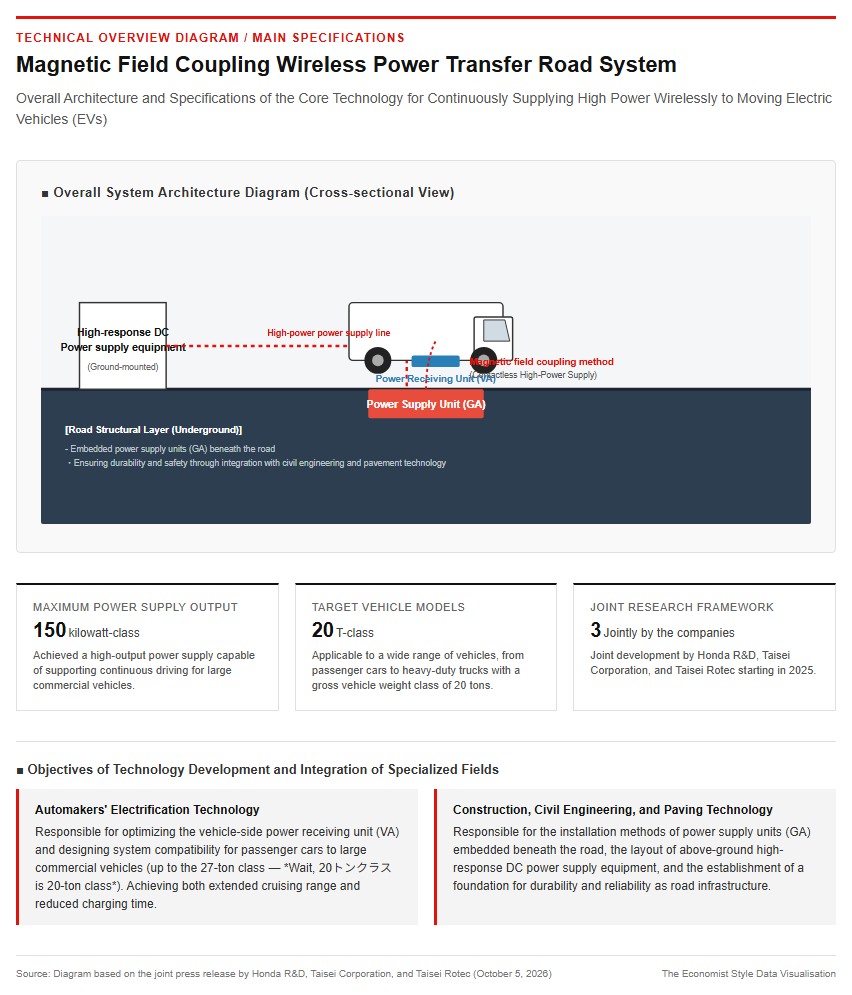
On October 5, 2026, Honda R&D Co., Ltd., Taisei Corporation, and Taisei Rotec Corporation announced that they have jointly developed the foundational technology for a “magnetic field coupling wireless power transfer road system” that continuously supplies high power contactlessly to electric vehicles (EVs) while in motion. This system is designed to be applicable to a wide range of vehicle types, from passenger cars to large commercial trucks with a gross vehicle weight of the 20-ton class. The system consists of power-transmitting units (GAs) embedded beneath the road, vehicle-side power-receiving units (VAs), and above-ground high-response DC power supply equipment, and is structured to support high-output power transfer of up to the 150 kW class. The three companies began joint research in 2025, and by combining the automaker’s electrification technology with the construction companies’ civil engineering and paving technologies, they established the technological foundation necessary for wireless power transfer to large vehicles while in motion, which had previously been considered difficult. Please refer to the overall configuration diagram below.
This technology is also scheduled to be widely showcased at exhibitions such as the “Japan Mobility Show Bizweek 2026,” which opens on October 13, 2026.
A magnetic field coupling method that breaks through the barriers of conventional technology and the world’s first integrated unit structure
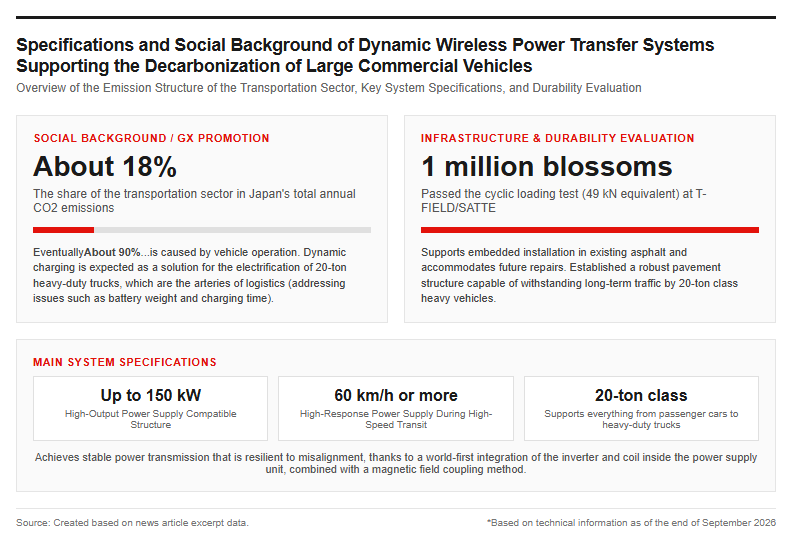
The greatest technical achievement in this joint development is the internal structural optimization of the power supply unit and the adoption of a DC power distribution system. Integrating the inverter and the power supply coil inside the power supply unit and connecting them via DC power distribution is an innovative technology that is a world first for an in-motion wireless power supply unit (as of the end of September 2026, according to Honda research). By combining it with a highly responsive ground-based DC power supply, it has become possible to supply a stable, large amount of power with a high response time of a few milliseconds to vehicles passing through the power supply section at high speeds of 60 km/h or more. The power supply method adopts a magnetic coupling method that utilizes magnetic field resonance, which has the feature of being less susceptible to lateral misalignment or differences in vehicle height, thereby maintaining high power transmission efficiency. It can be said that the foundation for a new mobility infrastructure has been established, eliminating waiting times at stationary rapid chargers and replenishing energy while driving.
Technological Innovations and Societal Context Supporting the Decarbonization of Heavy-Duty Trucks
GX Promotion in the Transportation Sector and the Challenges Facing the Electrification of 20-Ton Heavy-Duty Vehicles
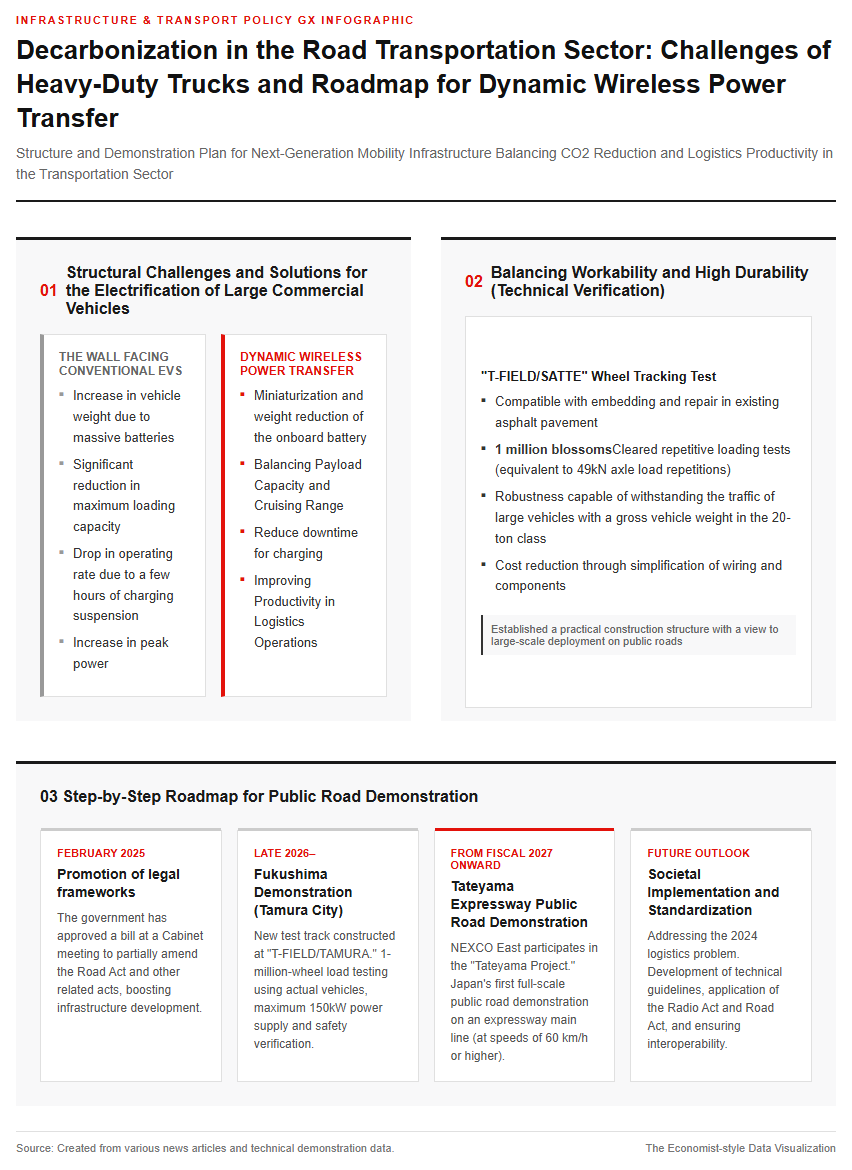
The transportation sector accounts for approximately 18% of Japan’s total annual CO2 emissions, with about 90% of that originating from automobile operations. In February 2025, the government also cabinet-approved the “Bill for Partial Revision of the Road Act and Other Related Acts,” strongly backing infrastructure development aimed at decarbonization (GX) in the road transport sector. While the electrification of passenger cars is progressing, structural barriers have hindered the EV adoption of heavy-duty trucks, which form the backbone of logistics. Ensuring a long cruising range in large commercial vehicles requires massive batteries, and the resulting increase in vehicle weight significantly cuts into the maximum cargo load capacity. Furthermore, charging large-capacity batteries requires several hours of downtime, leading to lower logistics operating rates and increased peak power demand. Dynamic wireless power transfer can extend cruising ranges while allowing onboard batteries to be smaller and lighter, making it a revolutionary solution that balances productivity and environmental compatibility in logistics operations.
The Evolution of Civil Engineering and Pavement Technologies Balancing Constructability and Durability for Existing Roads
Major barriers to the social implementation of dynamic power transfer roads were their load-bearing capacity and maintainability under harsh road environments. Taisei Corporation and Taisei Rotec have developed a practical construction structure that can be embedded by cutting into existing asphalt pavement, and established a construction method that can flexibly accommodate future repairs and pavement renewals. Furthermore, they conducted durability evaluations using a wheel-tracking tester at “T-FIELD/SATTE” (Satte City, Saitama Prefecture), the Taisei Corporation Group’s technology demonstration base. Assuming traffic conditions with frequent heavy vehicle traffic, they passed a repeated loading test of 1 million wheel loads (converted to a 49 kN equivalent wheel load), thereby achieving a robust pavement structure that does not break down even under long-term travel by large vehicles in the 20-ton gross weight class. Please refer to the following image of the experimental road’s pavement structure.
By simplifying wiring and components, installation costs and work hours have been reduced, ensuring the practicality required for large-scale deployment on public roads.
Roadmap to Public Road Testing and Outlook for Next-Generation Mobility Infrastructure
From the 1-million-wheel test in Fukushima to the FY2027 Tateyama Expressway public road demonstration
The three companies have outlined a concrete, phased roadmap aimed at future societal implementation. Starting in late 2026, they will construct a new test track at the “T-FIELD/TAMURA” demonstration facility located in Tamura City, Fukushima Prefecture, and begin a 1-million-wheel-load running test using actual vehicles. Here, in addition to the final confirmation of long-term durability, safety verifications will be conducted, including continuous power supply experiments at a maximum output of 150 kW and countermeasures against electromagnetic field leakage to the surroundings. Armed with the results of these experiments, the three companies will participate in the “Tateyama Project,” which will be conducted by East Nippon Expressway Company (NEXCO East) on the Tateyama Expressway in Chiba Prefecture from fiscal 2027 onward. This will be the first full-scale public road demonstration of dynamic wireless power transfer on a Japanese expressway main line, serving as an important milestone to prove the reliability of high-output power transfer and the control accuracy of the entire system in actual driving environments at speeds of 60 km/h or higher.
Logistics Innovation Enabled by Dynamic Wireless Power Transfer and Key Considerations for Future Regulatory Frameworks and Standardization
The practical application of dynamic wireless power transfer roads goes beyond simply changing the means of charging, holding the potential to fundamentally transform the entire automotive industry, infrastructure, and logistics systems. If dynamic charging infrastructure is put in place, it will improve truck operation rates and reduce battery costs, potentially serving as a savior for a transportation industry shaken by challenges such as the 2024 logistics problem. Meanwhile, the future focus for full-scale adoption lies in legal positioning and international standardization. It will be essential to develop technical guidelines for embedding coils beneath the road surface, apply the Radio Act and Road Act, and ensure interoperability so that EVs from any manufacturer can receive power seamlessly. Please refer to the following image for a vision of future infrastructure utilization.
By advancing institutional design—including communications, authentication, and billing systems—through public-private collaboration, a next-generation mobility society that balances decarbonization and economic growth will be opened up.
Reference Page
- 【Development of a Magnetic Field Coupling Wireless Power Transfer Road System for Contactless High-Power Supply to EVs in Motion】https://www.taisei.co.jp/about_us/wn/2026/261005_11194.html
- 【Participating Companies Selected for Demonstration Experiment of Wireless Power Transfer While Driving on the Tateyama Expressway Mainline】https://www.e-nexco.co.jp/pressroom/head_office/2026/0526/00016228.html
- 【Cabinet Approves “Bill for the Partial Amendment of the Road Act and Other Acts”】https://www.mlit.go.jp/report/press/content/001860876.pdf
【#DynamicEVCharging #Honda #TaiseiCorporation #WirelessCharging #DecarbonizedSociety #GX #HeavyDutyTrucks #MobilityInfrastructure】

コメント