The Kanto Regional Development Bureau of the Ministry of Land, Infrastructure, Transport and Tourism (MLIT) has launched a trial project to numerically evaluate outdoor labor reduction rates as extreme heat countermeasures in public works bidding. This initiative is driven by rising global temperatures and an increasing incidence of heat-related illnesses at construction sites.
- Scoring Criteria for Reducing Outdoor Workers During Peak Summer Months
- Eligible Technical Proposals and Excluded Operational Tweaks
- Intensifying Summer Heat and Growing Heatstroke Casualties
- Stricter Regulations and Proactive Support from Project Owners
- Shifting Bidding Strategies and Accelerated DX Investment
- Implementation Challenges and Building Sustainable Worksites
Scoring Criteria for Reducing Outdoor Workers During Peak Summer Months
On August 17, 2026, the Kanto Regional Development Bureau announced a public tender for the “FY2026 Edogawa Right Bank Shinozaki High-Standard Levee Related Improvement Project” in Edogawa Ward, Tokyo. This marks the bureau’s first trial project under the Technical Proposal Evaluation Type S model to evaluate heat mitigation strategies. The work involves cast-in-place box culvert construction, with a contract period running from the day following contract execution through February 28, 2029. Bids are scheduled to be opened on November 20, 2026. The defining feature of this trial is its evaluation period: a total of four months covering July and August in both 2027 and 2028. The scoring directly assesses the percentage reduction of outdoor workers specified in the construction plan. A maximum of 30 technical evaluation points is allocated for this category, requiring bidders to specify their reduction percentage relative to standard staffing levels. A proposal achieving the maximum reduction receives the full 30 points, while a proposal meeting the minimum threshold of a 5% reduction receives 8 points, with intermediate reductions scored proportionally. Proposals failing to meet the 5% threshold receive zero points.
Eligible Technical Proposals and Excluded Operational Tweaks
Constructing approximately 250 meters of box culverts requires extensive cast-in-place work, making worker relief during harsh summer conditions a central challenge. Eligible proposals are strictly limited to physical labor-saving techniques and process efficiencies. Examples include using precast concrete components, pre-assembling rebar off-site, introducing sliding formwork, and deploying teleoperated machinery or concrete-pouring robots. Conversely, administrative and scheduling adjustments are explicitly excluded from evaluation, such as adopting daylight saving time (shifting work hours earlier), adjusting shift schedules under variable working-hour systems, instituting mandatory summer shut-downs, or distributing personal cooling garments. As shown in the diagram below, project owners are prioritizing structural labor reduction driven by technical innovation over simple time management adjustments
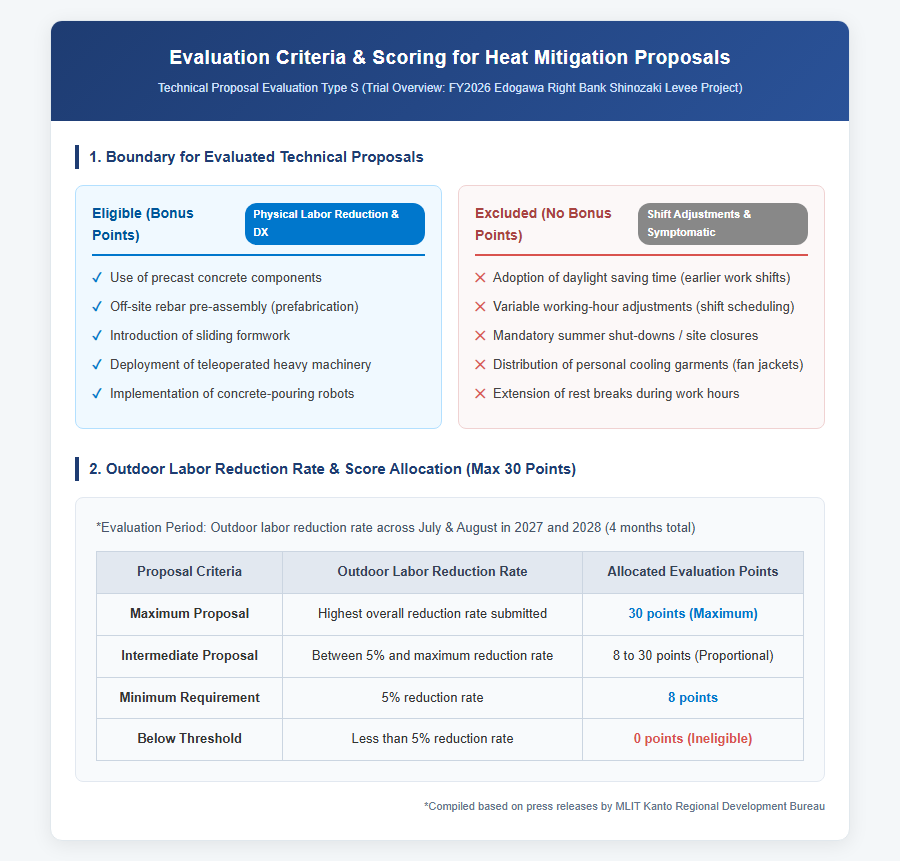
. Winning bidders are required to fully execute their submitted technical proposals during construction, and vague proposals lacking computational backing will not be credited. Public procurement is transitioning from traditional pricing- and noise-focused bids to an era where technical capability to create safe working environments directly dictates contract wins.
Background to Incorporating Heat Mitigation into Bidding Systems
Intensifying Summer Heat and Growing Heatstroke Casualties
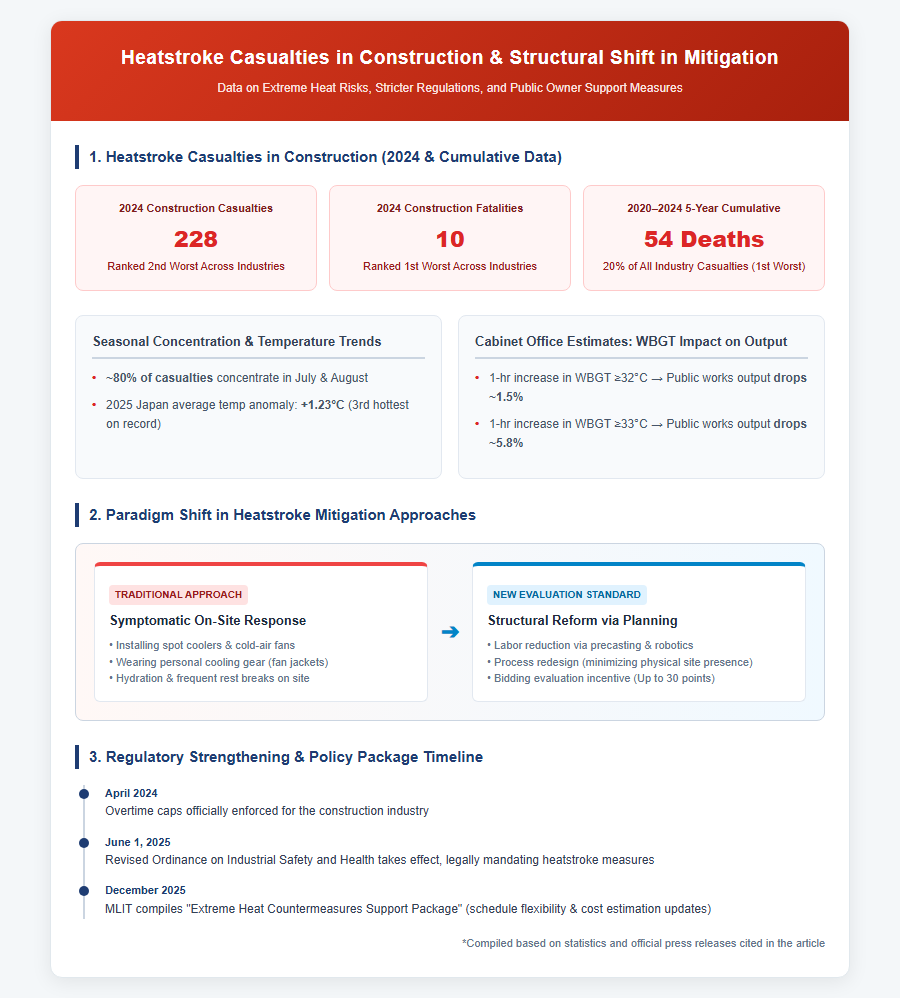
The integration of heat mitigation into bid evaluation is driven by recent sharp temperature increases and the growing severity of heatstroke casualties in the construction industry. According to a Cabinet Office report, Japan’s average temperature anomaly reached +1.23°C in 2025, making it the third hottest year on record. Days with peak temperatures exceeding 35°C have rapidly increased, underscoring a nationwide trend toward extreme heat. Reflecting this environmental shift, nationwide occupational heatstroke casualties reached 1,257 in 2024, the highest on record. By industry, construction accounted for 228 casualties, ranking second worst behind manufacturing, and recorded 10 fatalities, the highest among all sectors. Over the five-year period from 2020 to 2024, construction accounted for 20% of all occupational heatstroke casualties and 54 fatalities, ranking worst in both metrics. Approximately 80% of these incidents occurred during July and August. Cabinet Office estimates indicate that every additional hour where the Wet Bulb Globe Temperature (WBGT) exceeds 32°C reduces public works completion volume by approximately 1.5%, rising to a 5.8% drop at 33°C or above. Extreme heat thus poses both a fatal risk to worker safety and a severe bottleneck to project productivity.
Stricter Regulations and Proactive Support from Project Owners
Recognizing the gravity of the situation, government bodies have introduced tighter regulations and support measures. Following the April 2024 implementation of overtime caps in the construction industry, amendments to the Ordinance on Industrial Safety and Health took effect on June 1, 2025, legally mandating employers to establish comprehensive heatstroke countermeasures. In December 2025, MLIT compiled an Extreme Heat Countermeasures Support Package, promoting temperature-adjusted schedule planning and revised cost estimates for safety measures. Regional initiatives have also taken shape: the Utsunomiya National Highway Office piloted summer construction avoidance for paving work during July and August in FY2023, expanding the scheme to eight projects in 2025. Similarly, the Kinki Regional Development Bureau introduced bonus points for heat mitigation in its comprehensive evaluation system starting in FY2026. As illustrated in the diagram below, project owners are shifting from symptomatic on-site remedies—such as setting up spot coolers or wearing air-conditioned clothing—toward structural reforms that minimize physical human presence on site through redesigned construction plans
.
Impact on the Construction Industry and Future Outlook
Shifting Bidding Strategies and Accelerated DX Investment
The numerical evaluation of heat mitigation is fundamentally altering contractors’ bidding strategies and technology development. With up to 30 evaluation points assigned—an exceptionally high weighting in comprehensive evaluation bidding—the outdoor labor reduction rate has become a critical determinant of winning contracts. Consequently, general contractors are rapidly accelerating investments in large-scale precast components, rebar modularization, and teleoperation technologies. Beyond mitigating heatstroke risks, this technological wave shifts workers from hazardous outdoor environments to climate-controlled factories and remote control rooms. Eliminating harsh site conditions also promises to improve the industry’s image, attracting younger workers and female technicians to secure a sustainable workforce. Labor-saving methods and digital transformation (DX) are evolving from internal cost-reduction tools into direct competitive assets required to secure public works contracts.
Implementation Challenges and Building Sustainable Worksites
This trial by the Kanto Regional Development Bureau represents a pivotal milestone toward nationwide adoption. Under MLIT’s i-Construction 2.0 framework, which targets a 30% reduction in site labor by FY2040, this policy is expected to act as a major catalyst. Expanding the system from box culverts to bridges, tunnels, and local government procurement is widely anticipated. However, practical challenges remain. Surveys conducted by the Utsunomiya National Highway Office revealed concerns among contractors, including increased mobilization costs for heavy machinery due to schedule shifts, as well as reduced income for daily-wage workers during summer downtime. Addressing these hurdles will require project owners to set appropriate contract periods, establish compensation mechanisms, and build broader industry alignment. To establish climate-resilient, sustainable construction sites, public and private stakeholders must continue working together to overcome these operational challenges.
References
- [MLIT Press Release: “Trial Construction Evaluation for Heat Mitigation Strategies Launched”] https://www.mlit.go.jp/report/press/kanbo08_hh_001323.html
- [Kanto Regional Development Bureau: “Trial Implementation of Heat Mitigation Evaluation in Comprehensive Bidding”] https://www.mlit.go.jp/page/content/001999044.pdf
- [Kanto Regional Development Bureau Press Release] https://www.ktr.mlit.go.jp/kisha/kisha_03617.pdf
【#MLIT #KantoRegionalDevelopmentBureau #ComprehensiveEvaluation #HeatstrokePrevention #ExtremeHeatCountermeasures #ConstructionDX #iConstruction】


コメント