The priority flood control projects that Utsunomiya City has been advancing following the lessons of the 2019 East Japan Typhoon have reached a major milestone. The background is a fundamental shift toward “basin flood control,” which stores and suppresses rainwater throughout the entire basin, rather than relying solely on river maintenance.
- The devastating damage caused by the largest downpour on record
- Formulation of Basic Policy for Comprehensive Flood Control and Stormwater Countermeasures
- Expansion of rainwater storage by rice field dams and public facilities
- Promotion of Measures to Suppress Runoff on Private Land
- Reduction of flooded area and reduction of flood depth
- Significant shortening of the response period and future goals
- Introduction of Efficient Maintenance with Water PPP
- Key Points for Improving Flood Resilience
The devastating damage caused by the largest downpour on record
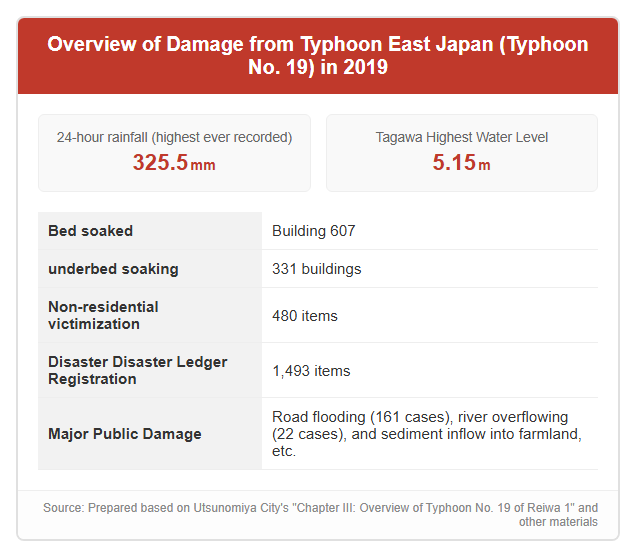
The biggest turning point that made flood control urgent in Utsunomiya City was the Reiwa 1st Year East Japan Typhoon that occurred in October 2019. This typhoon caused the city to record the highest daily rainfall on record, 325.5 mm. As a result of this record-breaking heavy rain, the first-class rivers Tagawa and Sugata River overflowed, causing extensive flooding damage across large areas of the city. Looking specifically at the situation of residential damage, there were 607 houses flooded above floor level and 331 houses flooded below floor level, with a total of 1,493 cases registered in the disaster relief ledger. Furthermore, significant damage occurred in infrastructure and industry, such as damage to riverbank revetments and sediment inflow into farmland, seriously affecting citizens’ lives. Please refer to the diagram below.
Formulation of Basic Policy for Comprehensive Flood Control and Stormwater Countermeasures
In response to this unprecedented disaster, Utsunomiya City formulated the “Utsunomiya City Comprehensive Flood Control and Rainwater Countermeasures Basic Policy” in February 2020. This policy sets forth three pillars: the traditional “flushing” initiative to drain rainwater early through river and sewer development, the new “storage” initiative to temporarily store and infiltrate rainwater, and the “preparation” efforts to reduce damage. The greatest feature of this policy is that it incorporates not only ‘public assistance’ by the administration, but also the concept of ‘self-help,’ where citizens protect themselves, and ‘mutual aid,’ where the government and citizens collaborate. By launching preliminary projects that can deliver results in a short period, we aimed to build a system that can quickly mitigate damage even from heavy rain on the scale of the Eastern Japan typhoon.
Achievements of ‘Storage’ Measures Implemented Across the Basin
Expansion of rainwater storage by rice field dams and public facilities
A major achievement at the core of our ‘storage’ initiative was the ‘rice field dam’ that utilizes farmland. Utsunomiya City, in collaboration with the Land Improvement District, promoted an initiative to temporarily store rainwater in rice paddies by installing adjustment devices on drainage trouts on field surfaces, gaining farmers’ understanding and cooperation. Please refer to the diagram below.
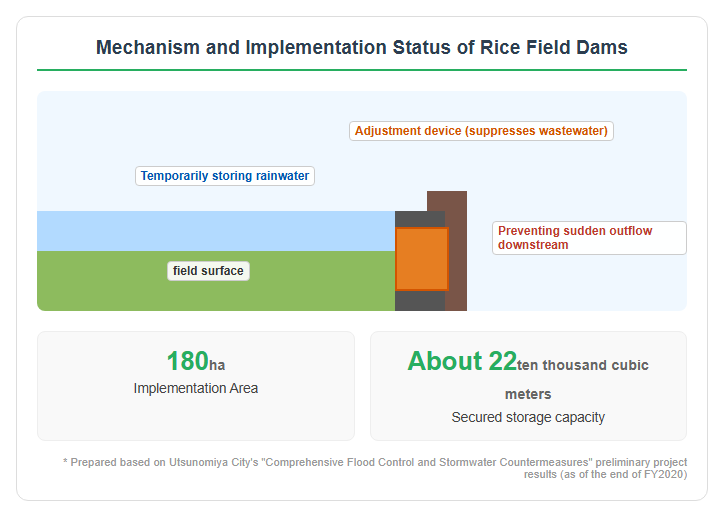
The implementation area covers 180 hectares, securing a storage capacity of approximately 220,000 cubic meters. Additionally, in public facilities such as parks and elementary and junior high schools, storage and infiltration facilities have been installed beneath the grounds, securing a capacity of approximately 8,700 cubic meters. As a result of these efforts combined, we have achieved a storage capacity of approximately 330,000 cubic meters, far exceeding the initial target of 200,000 cubic meters.
Promotion of Measures to Suppress Runoff on Private Land
Measures have been strengthened not only for public facilities but also for privately owned land within urbanized areas. Utsunomiya City has expanded its installation subsidy program to promote the installation of rainwater storage tanks, rainwater infiltration, and infiltration trenches in private businesses, apartment complexes, and general housing. This has improved water retention and infiltration capacity in parking lots and building premises, establishing a system to suppress sudden rainwater runoff into sewers and rivers. Additionally, by utilizing the urban planning system, considerations to relax floor area ratios for rainwater storage and infiltration facilities in redevelopment projects are being considered, encouraging developers to consider flood prevention measures. This steady accumulation through public-private partnerships has greatly contributed to reducing flood risks in urban areas.
Effects of Project Completion and Achievement of Development Goals
Reduction of flooded area and reduction of flood depth
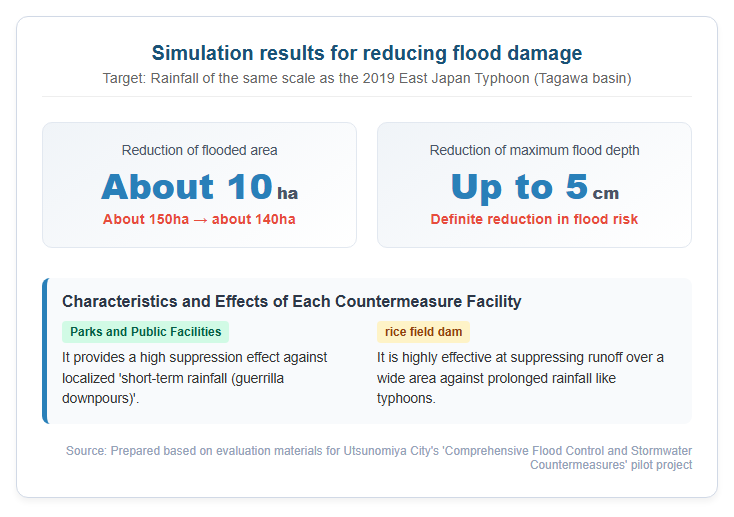
A series of flood prevention projects have confirmed concrete damage reduction effects. According to simulation analysis by Utsunomiya City, if rainfall of the same scale as the 2019 East Japan Typhoon occurs in the Tagawa basin, the flooded area can be reduced by about 10 hectares compared to before the countermeasures, and the flood depth can be lowered by up to 5 cm. Storage and infiltration facilities in parks demonstrate high suppression effects against localized short-term rainfall, and rice paddy dams have been proven particularly effective against prolonged rainfall such as typhoons. Please refer to the diagram below.
In areas that have repeatedly suffered severe damage, being able to secure a certain level of safety without waiting for river development completion has given local residents a sense of security.
Significant shortening of the response period and future goals
Thanks to this preliminary project and collaborative measures, we have achieved a significant shortening of the originally anticipated maintenance period. The initial basic policy stated that it would take 30 years to resolve above-floor flooding, but by combining Tochigi Prefecture’s river improvement efforts with the city’s “storage” initiatives, it is now expected that the issue will be resolved in an extremely short period: 5 years in the Tagawa basin and 10 years in the Sugata River basin. Going forward, Utsunomiya City will integrate these hardware measures with software measures utilizing digital technologies to realize a “Super Smart City” with an eye toward around 2030. Specifically, by providing real-time water level observation information and enhancing evacuation guidance systems, we plan to build resilient cities that maintain zero human casualties.
Sustainable Management System and Future Outlook
Introduction of Efficient Maintenance with Water PPP
After completing the flood control facilities, the next focus is on responding to the increasing maintenance and facility renewals. Utsunomiya City’s sewer facilities are expected to see the peak of renewal demand at treatment plants, and renewal costs for pipelines are expected to surge from the 2040s onward. In response to these challenges, the city decided to introduce the “Water PPP (Public-Private Partnership).” This approach outsources the management of the entire facility, which had previously been handled by the government, to private companies. Starting in fiscal year 2026 (Reiwa 8), it will launch as a Level 3.5 “renewal support type” targeting the Kawachi and Kamikawachi treatment areas. By introducing the know-how and new technologies of private companies, we aim to manage facilities efficiently within limited personnel and budgets, ensuring a sustainable sewer business for the future.
Key Points for Improving Flood Resilience
The key focus going forward is maintaining hard measures and enhancing resilience on the soft side of citizens’ disaster preparedness awareness. Utsunomiya City is promoting the distribution of hazard maps to all households and the spread of registration-based disaster prevention emails, but it is important to continue fostering awareness among citizens themselves to work on controlling the outflow. Additionally, trends in new fiscal methods that utilize private funds for disaster prevention projects, such as the ‘Flood Resilience Bonds’ issued by Yokohama City, are also being closely watched as common issues for local governments. The sustainability of the integrated model of ‘flushing, storing, and preparing’ developed by Utsunomiya City is being questioned to what extent it can remain effective against the intensification of heavy rains caused by climate change.
[#宇都宮市 #浸水対策 #流域治水 #田んぼダム #ウォーターPPP #防災 #令和元年東日本台風]

コメント