_en.png)
On June 24, 2026, record-breaking heavy rain caused by a linear rainband occurred mainly in the Kyushu region. With the approach of a double typhoon and the intensification of the rainy season front, the government is prioritizing rapid responses to protect lives through the application of the Disaster Relief Act and large-scale evacuation orders.
- Breaking News: Record heavy rainfall and linear rainbands occurring across various parts of Kyushu
- Status of the Application of the Disaster Relief Act and Wide-Area Evacuation Orders
- Severe damage to infrastructure and transportation and suspension of operations
- Corporate Legal Liability: Duty of Safety Consideration for Foreseeable Disasters
- The Worsening Water Disasters Caused by Climate Change and Data Trends
- Shift to ‘Basin-wide Flood Management’: A New Public-Private Approach to Water Disasters
- Future Outlook: The Future of Disaster Prevention Opened by Society 5.0 and DX
Breaking News: Record heavy rainfall and linear rainbands occurring across various parts of Kyushu
On June 24, 2026, the Kyushu region was hit by extremely dangerous weather conditions. The main reason is that Typhoons No. 7 (Meikara) and Haegos (No. 8), both of which are extremely powerful, formed one after another and were approaching the Japanese archipelago, which stimulated the rainy season front. In particular, a linear rainband formed in the Satsuma region of Kagoshima Prefecture, and in Satsumasendai City, 133.5 millimeters of torrential rain was observed over three hours until 10:20.
The Japan Meteorological Agency is issuing a strict warning as warm, moist air flows toward a stagnant front near Kyushu, making atmospheric conditions extremely unstable. In the analysis of rainfall, some places have exceeded 300 millimeters in 24 hours, rapidly increasing the risk of river flooding and landslides. The following diagram shows the occurrence of rainfall areas and linear rainbands at that time.
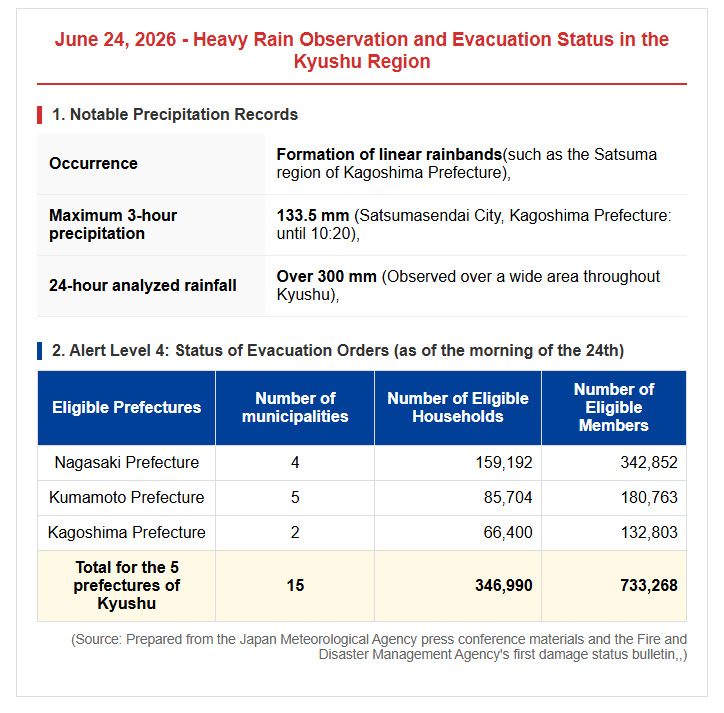
In response to this situation, the Japan Meteorological Agency has issued Level 4 “Heavy Rain Danger Warning Warnings” and other alerts based on the “New Disaster Prevention Weather Information,” which began operation in 2026. This system organizes traditional information to help residents intuitively understand the actions they should take, strongly urging everyone to evacuate from dangerous areas.
Status of the Application of the Disaster Relief Act and Wide-Area Evacuation Orders
In response to the expanding damage caused by the heavy rain, the Cabinet Office and local governments have initiated swift legal procedures. On June 24, Kagoshima Prefecture decided to apply the Disaster Relief Law to Satsumasendai City, citing the risk of harm to the lives and bodies of many people. As a result, a system was established where the national and prefectural governments would cover costs for supporting disaster victims, such as setting up shelters and providing food.
According to the first report from the Fire and Disaster Management Agency, as of the morning of the 24th, evacuation orders have been issued for a total of 11 cities and 4 towns and villages across five prefectures: Saga, Nagasaki, Kumamoto, Oita, and Kagoshima. The evacuation targets reached 346,990 households and 733,268 people, with large-scale evacuation operations underway over a wide area.
Support efforts are also spreading in the private sector. Nomura Securities and others have announced that they will take convenience measures for customers residing in areas covered by the Disaster Relief Act, such as responding to loss of registered seals and early payment of proceeds from the sale of securities. Government and private sectors are working together to provide multifaceted support to protect the living infrastructure of disaster victims.
Social infrastructure and corporate safety obligations
Severe damage to infrastructure and transportation and suspension of operations
This heavy rain has cast a serious shadow over logistics and transportation infrastructure. In particular, on the railway network, a landslide occurred again on the JR Hisatsu Line in Kagoshima Prefecture (Yoshimatsu–Hayabusane), which had recovered from the heavy rains in August 2025 and was about to resume operations after 10 months. Damage such as tracks being lifted has been confirmed in multiple locations, forcing the resumption of operations to be postponed indefinitely. This highlights the vulnerability of infrastructure under climate change: “Even after recovering from disasters, another disaster will come.”
In the logistics industry as well, delivery delays and route changes due to heavy rain are occurring one after another. According to the Japan Weather Association, heavy rain during the rainy season maximizes the impact on operations because it coincides with delivery times and the location of the base. In particular, short-term heavy rains causing road flooding and poor visibility have become challenges not only to halted deliveries but also to ensuring employee safety.
Each company utilizes weather risk information such as the “GoStop Management System,” which can detect transportation impact risks up to six days ahead, and is taking measures such as advancing shipments and considering alternative routes. However, disruptions in transportation networks are increasing delivery delays and the burden of customer service, making the overall impact on economic activity unavoidable.
Corporate Legal Liability: Duty of Safety Consideration for Foreseeable Disasters
In today’s world, where natural disasters are becoming more severe, companies are facing unprecedented levels of legal responsibility. Under Article 5 of the Labor Contract Act, the “duty of care for safety” means that companies, regardless of size, have a duty to protect their employees from disasters. Even record-breaking heavy rains like this are now regarded not as “force majeure” but as “foreseeable events” in today’s advanced weather information.
Past case law has also harshly pointed out deficiencies in pre-disaster prevention measures and manuals. For example, in a case of a kindergarten during the Great East Japan Earthquake, the principal’s misjudgment when departing the bus from the elevated kindergarten to the lowlands by the sea was criticized, and the formal disaster prevention manual was criticized, resulting in a large compensation order. On the other hand, in cases where financial institutions appropriately instructed evacuation to rooftops according to established disaster prevention plans, even for unexpected tsunami damage, it was not recognized as a violation of safety care obligations.
As part of their internal control systems, companies need to develop effective BCPs (Business Continuity Plans) and business continuity enhancement plans. Constantly checking the Japan Meteorological Agency’s hazard maps and real-time hazard distribution (Kikikuru), and making decisions to suspend business or instruct people to return home at an early stage when safe evacuation is possible, is key to fulfilling your legal responsibilities as a business owner.
Climate Change and ‘Watershed Flood Management’ for the Future
The Worsening Water Disasters Caused by Climate Change and Data Trends
Behind the extreme heavy rains like this is the strong reflection of the impacts of climate change caused by global warming. According to a report by the United Nations Intergovernmental Panel on Climate Change (IPCC), the global average temperature continues to rise, and the rate of increase in sea surface temperatures near Japan’s waters exceeds the global average. As temperatures rise, the amount of water vapor in the atmosphere increases, leading to a greater frequency of short-term heavy rainfall.
According to observational data from the Japan Meteorological Agency, compared to about 30 years ago, the frequency of short-term heavy rain with hourly precipitation of 50 mm or more has increased by about 1.4 times, and for 80 mm or more, it has increased by about 1.7 times. Furthermore, as a future projection, in a scenario where the world’s average ground temperature rises by 2 degrees compared to pre-industrial levels, Japan’s rainfall is estimated to be about 1.1 times higher, and the frequency of floods to about twice as high.
In this way, the risk of water disasters is steadily increasing, and we have entered an era where past rules alone cannot protect lives. The following diagram illustrates the need to review flood control plans that take into account the impacts of climate change.
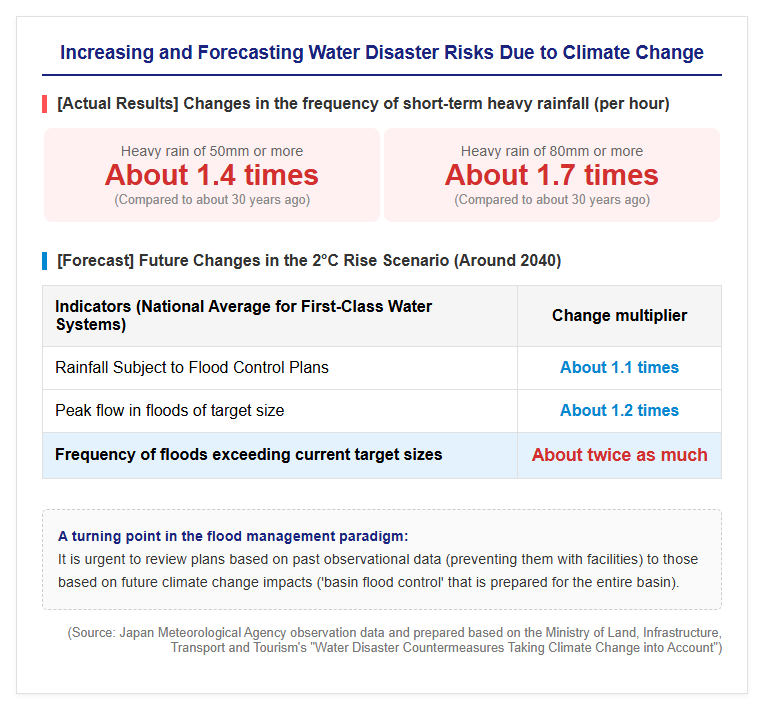
The Ministry of Land, Infrastructure, Transport and Tourism is leading a shift from measures based on facility capacity to a new paradigm based on increased external forces caused by climate change.
Shift to ‘Basin-wide Flood Management’: A New Public-Private Approach to Water Disasters
In response to increasingly severe water disasters, the Ministry of Land, Infrastructure, Transport and Tourism is promoting a shift from the traditional approach of “preventing with facilities like levees” to “basin flood control,” where all stakeholders collaborate throughout the entire river basin. This is a multi-layered approach that combines hard measures such as levee maintenance and dam construction, as well as soft measures such as utilizing rice paddies, dams, and retention basins, as well as promoting relocation from high-risk areas and building water resistance.
Participation from businesses and residents is also a key pillar of this plan. For example, cooperation in strengthening flood control functions of water utilization dams, setting insurance premium rates according to water disaster risks, and introducing incentives such as preferential loan interest rates are being considered. Additionally, measures to suppress runoff are recommended, such as installing rainwater storage and infiltration facilities in each household and promoting permeable pavement.
Local construction companies are also strengthening a public-private support system by supporting recovery activities as partners in the “TEC-FORCE (Emergency Disaster Response Team).” Everyone in the basin has a sense of ownership and takes actions to avoid and mitigate risks from their respective positions, which forms the foundation for building a disaster-resilient society.
Future Outlook: The Future of Disaster Prevention Opened by Society 5.0 and DX
The key to future disaster prevention measures lies in advancing DX (digital transformation) toward realizing Society 5.0. By leveraging IoT, big data, and AI, it becomes possible to achieve precise situational understanding and rapid decision-making, which was previously difficult. For example, real-time flood monitoring using images from drones and satellites, and AI-based analysis of social media information for rescue support, are anticipated.
Innovative initiatives have also begun at the municipal level. In Shibuya, Tokyo, we have introduced the nation’s first evacuation shelter opening support app, “N-HOPS.” This allows staff to manage the status of shelter openings in real time via smartphone, aiming to quickly digitalize the often confusing initial response. Additionally, drone-specialized companies such as ACSL have demonstrated aerial support capabilities through activities such as pharmaceutical delivery in disaster areas and monitoring of landslide dams.
In the face of the unavoidable threat of climate change, it is urgent to build a “resilient nation” that minimizes damage by combining cutting-edge technology, community bonds, and appropriate legal frameworks. Learning from this heavy rain, continuing to update disaster prevention capabilities from both institutional and technical perspectives will be the best preparation for the next disaster.
[#令和8年6月24日大雨 #国土交通省 #流域治水 #線状降水帯 #防災DX #安全配慮義務 #気候変動 #Society5.0]
」_en.png)

コメント