
Nippon Shuppan Hanbai (Nippan), Japan’s largest publishing distributor, has acknowledged that it sold a massive volume of books to the U.S. generative AI developer Anthropic. Behind this development are the AI companies’ strategy of seeking high-quality Japanese text to improve generative AI performance, and the management crisis facing the domestic publishing distribution industry amid soaring logistics costs and mounting deficits.
- Key points of Nippan’s book sales issue to US-based Anthropic
- Contents of the “Nippan Japan” mention in US copyright lawsuit court documents
- Mitigation of piracy risks and physical scanning via “Project Panama”
- Publishing Distributors Facing a 3.6 Billion Yen Deficit and the Temptation to Secure Revenue
- The Gap Between the Exhaustion of the Right of Transfer Under the Copyright Act and Domestic Guidelines
- Future Developments and Building a Sustainable Reward Distribution Platform
Key points of Nippan’s book sales issue to US-based Anthropic
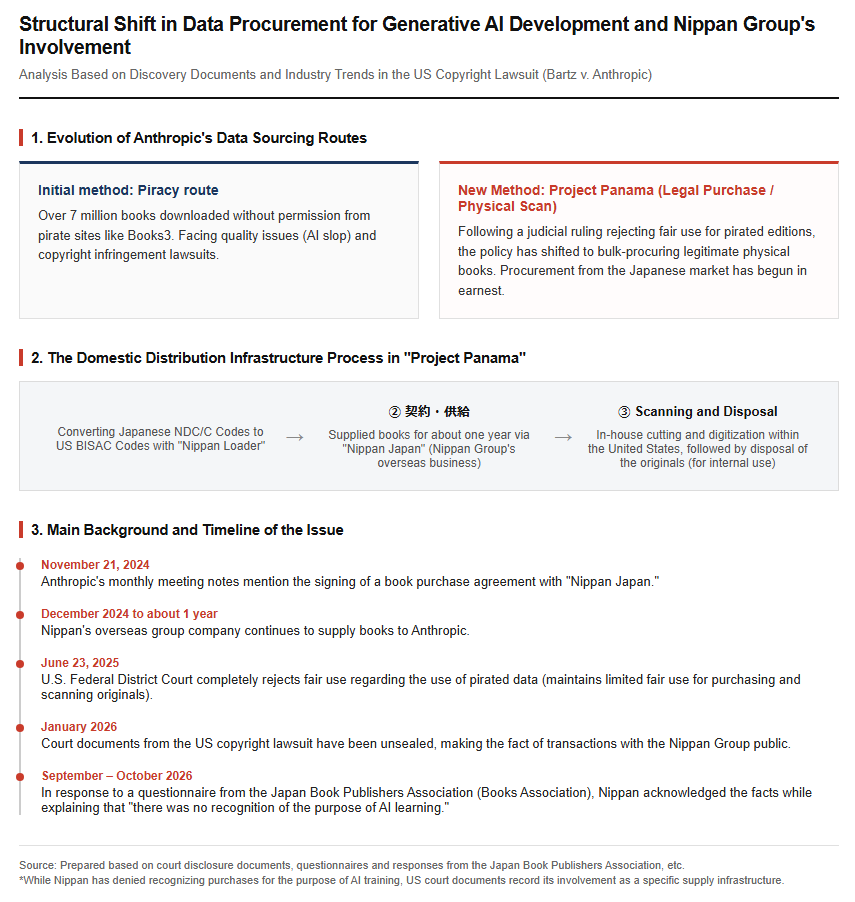
It was revealed in September 2026 that a group company of Nippon Shuppan Hanbai (Nippan), one of Japan’s largest publishing distributors, had sold large quantities of books to the US generative AI development company Anthropic. In response to a questionnaire sent by the Japan Book Publishers Association (JBPA) to Nippan Group Holdings on September 17, 2026, the company replied by October 6, 2026. According to the response, the Nippan group company handling overseas operations acknowledged the fact that it had supplied books to Anthropic for approximately one year starting in December 2024. Meanwhile, Nippan explained that it was not aware the purchases were intended for use in AI training. It is believed that Anthropic shredded and scanned the procured physical books to convert them into digital data, used them for AI training, and subsequently discarded the originals, sparking widespread confusion and significant backlash among publishers and authors. This issue goes beyond a mere transaction by a single company, exposing the reality that Japan’s publishing distribution infrastructure has been functioning as a resource-procurement route for generative AI development.
Contents of the “Nippan Japan” mention in US copyright lawsuit court documents
The fact that this book sale came to light originated from disclosure documents in a copyright infringement class-action lawsuit filed by American authors against Anthropic in the U.S. District Court for the Northern District of California (Bartz v. Anthropic PBC). Court documents from the lawsuit, unsealed in January 2026, included monthly meeting notes by Anthropic’s data partnerships and finance divisions. Those meeting notes explicitly stated that the signing of a book purchase agreement with “Nippan Japan” had been completed on November 21, 2024. Furthermore, another document in the court records listed an item called “Nippan Loader” as a data processing procedure to map the Nippon Decimal Classification (NDC) and C-codes assigned to Japanese books to the Book Industry Standards and Communications (BISAC) codes used in the United States. These entries indicate a process of ingesting bibliographic data of Japanese books and systematically purchasing books to build a database. Although Nippan has denied awareness of their use for AI training purposes, the fact that specific company names and contract details were recorded in U.S. court filings has sent shockwaves through the publishing industry.
AI Data Procurement Strategies and the Management Structure of Publishing Distribution
Mitigation of piracy risks and physical scanning via “Project Panama”
Behind Anthropic’s massive procurement of Japanese physical books, involving enormous shipping and scanning costs, lie the intensifying competition in AI development and the avoidance of legal copyright risks. In training generative AI, it is considered essential to avoid low-quality AI-generated text (AI slop) flooding the internet and to use clean, high-quality data edited and refined by human hands. Anthropic initially downloaded and used over 7 million book datasets without permission from pirated sites such as Books3, but was sued by a group of authors. On June 23, 2025, U.S. District Judge William Alsup completely rejected fair use regarding the use of pirated data and ruled it copyright infringement. On the other hand, he recognized limited fair use for the act of cutting and scanning legally purchased physical books, discarding the originals, and restricting their use to internal purposes. Following this judicial decision, the company shifted course from pirated editions to the bulk procurement of legal physical books, promoting a massive digitization project called “Project Panama.” Please refer to the figure below.
Publishing Distributors Facing a 3.6 Billion Yen Deficit and the Temptation to Secure Revenue
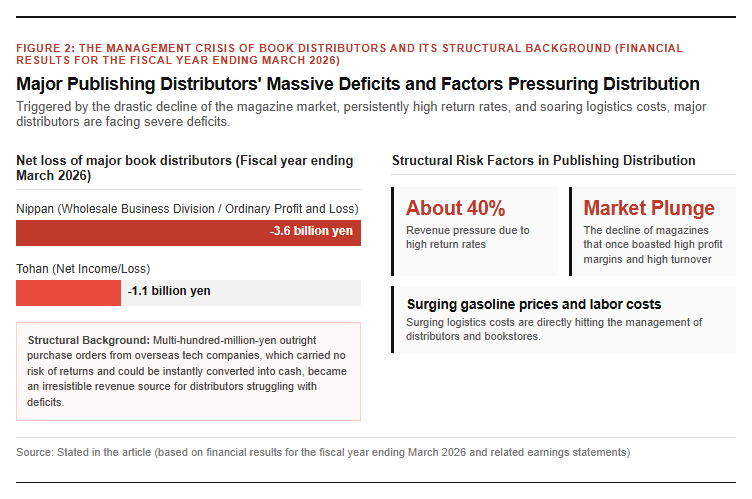
Behind Nippan’s decision to fulfill large-scale orders without prior consultation with the publishing industry or rightsholders lies a structural and severe management crisis facing Japan’s publishing wholesale business. Japan’s publishing distribution has long been supported by three mechanisms: the resale price maintenance system, the consignment sales system, and pattern-based book distribution. It operated on a structure where high-margin, fast-selling magazines absorbed logistics costs, but the magazine market has drastically plummeted due to digitization and the widespread adoption of smartphones. Moreover, alongside surging logistics costs such as gasoline and labor expenses, a soaring return rate of around 40% has severely squeezed wholesalers’ finances. In the financial results for the fiscal year ending March 2026, Nippan’s wholesale business segment posted an ordinary loss of 3.6 billion yen, while rival Tohan also plunged into a net loss of 1.1 billion yen. By May 2026, the situation had escalated to the point where Nippan Group Holdings President Ken Togashi openly mentioned the possibility of withdrawing from the wholesale business. Under these conditions, outright purchase orders for physical books from an overseas tech company—reportedly worth several hundred million yen, carrying zero return risk, and offering immediate cash conversion—became a revenue source that deficit-ridden wholesalers could hardly refuse.
Legal and Institutional Challenges and the Future of Japan’s Publishing Industry
The Gap Between the Exhaustion of the Right of Transfer Under the Copyright Act and Domestic Guidelines
Regarding the legal framework in Japanese law, this relates to the “exhaustion of the right of transfer” stipulated in Article 26-2, Paragraph 2, Item 1 of the Copyright Act. The act of distributors purchasing and reselling books legitimately placed into distribution by publishers in itself involves the exhaustion of the distribution right accompanying the transfer of ownership, making it difficult to establish copyright infringement. Therefore, the essence of the issue becomes contractual disputes—such as the presence or absence of restrictions on resale destinations and usage, and the appropriateness of discount rates—within transaction contracts or resale price maintenance contracts (resale contracts) between publishers and distributors. Within Japan, on August 25, 2026, the Cabinet Office released the “Principles and Code on Intellectual Property Protection and Transparency for the Appropriate Utilization of AI,” demanding that AI businesses ensure transparency regarding training data and disclose their collection policies in advance. Furthermore, on October 31, 2025, 19 publishing companies and creator organizations, including Kodansha and KADOKAWA, issued a joint statement demanding fair compensation. However, when physical books are purchased outright, taken overseas, and shredded and scanned, domestic voluntary targets and guidelines are rendered hollow, highlighting a structural issue where Japanese copyright holders are left empty-handed (“stolen with no recourse”). Please refer to the figure below.
Future Developments and Building a Sustainable Reward Distribution Platform
This incident is strongly pressing Japan’s publishing industry to break away from the traditional business model of “selling a book to readers once and for all.” Globally, there is an accelerating trend toward providing commercial licenses by segmenting rights based on AI use cases, such as AI training (Training), RAG and search reference (Reference), and reading assistance (AI Reading). For example, as seen with Europe’s Bookpact.ai, common platforms are being built where publishers and authors can set licensing conditions by use case and duration, collecting fair compensation and usage logs. In Japan too, establishing a mechanism to securely distribute and clear AI usage rights on an ISBN basis—by integrating bibliographic information management systems like JPRO, e-book distributor infrastructure, and AI-ready technologies advanced by DNP and TOPPAN—has become an urgent task. Whether we can build rights-processing rails that prevent the outflow of knowledge through one-time bulk book sales and sustainably funnel compensation back to creators and publishers will significantly determine the future of Japan’s linguistic culture and content industry.
Reference page
- [Bartz v. Anthropic PBC District Court Opinion (June 23, 2025)] https://fingfx.thomsonreuters.com/gfx/legaldocs/jnvwbgqlzpw/ANTHROPIC%20fair%20use.pdf
- 【Cabinet Office: Principle Code on Intellectual Property Protection and Transparency for the Appropriate Use and Utilization of Generative AI (August 25, 2026)】https://www.cas.go.jp/jp/seisakukaigi/titeki2/ai_kentoukai/kaisai/pdf/ai_principle_code.pdf
【#Nippan #Anthropic #AITrainingData #PublishingDistributor #Copyright #GenerativeAI】


コメント