
Following the arrest of three individuals, including a Ground Self-Defense Force member, by the Aomori Prefectural Police on suspicion of bribery involving the Acquisition, Technology & Logistics Agency’s Shimokita Test Center, the Aomori prefectural government has decided to implement bidding suspension measures against the construction company involved. The discovery of misconduct at a defense facility responsible for equipment testing is sending major ripples through both the Self-Defense Forces’ procurement ethics and local government debarment systems.
- The Arrest of a Ground Self-Defense Force Member and the Structure of Corrupt Entertainment Surrounding Contracted Services
- Legal Status of Self-Defense Forces Personnel and Penal Provisions as Special Position National Public Service Employees
- Decision on Bidding Suspension Measures Against Hashimoto Construction Engineering
- The Impact of Performance Evaluation Criteria and Penalties Associated with Suspension from Bidding
- History of Past Government-Orchestrated Bid-Rigging Incidents and the Evolution of Compliance Enhancement
- Restructuring the Internal Control System and Future Recurrence Prevention Measures
The Arrest of a Ground Self-Defense Force Member and the Structure of Corrupt Entertainment Surrounding Contracted Services
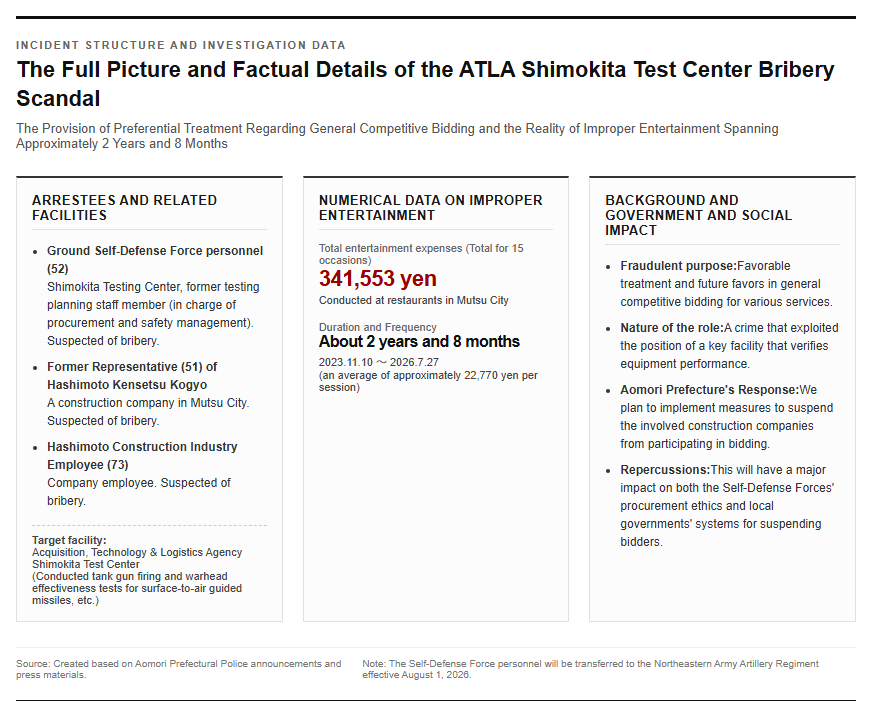
On September 29, 2026, the Aomori Prefectural Police arrested three men in connection with a bribery case surrounding bidding for the Acquisition, Technology & Logistics Agency’s Shimokita Test Center: a 52-year-old Ground Self-Defense Force (GSDF) officer on suspicion of accepting bribes, and a 51-year-old former representative and a 73-year-old employee of Hashimoto Construction Industry, a construction company based in Mutsu City, on suspicion of offering bribes. According to the allegations, the GSDF officer is suspected of having received entertainment, such as meals and drinks worth a total of 341,553 yen across 15 occasions at a restaurant in Mutsu City between November 10, 2023, and July 27, 2026. This was given as a token of gratitude for favorable treatment regarding general competitive bidding for various services ordered by the Test Center, as well as for future favors. This averages out to a little over 20,000 yen per reception, repeated over a period of about two years and eight months. At the time, the GSDF officer served as a test planning staff member in the testing squad, and from March 2023 to July 2026 was in charge of procurement request operations and safety management. The Shimokita Test Center is a facility that conducts tank gun firing tests and surface-to-air guided missile warhead power tests, making this corruption an abuse of his position of verifying the performance of defense equipment. Furthermore, because the GSDF officer had been transferred to the GSDF Northeastern Army Artillery Regiment in Iwate Prefecture on August 1, 2026—just before his arrest—reports referred to him as a “former employee” of the Shimokita Test Center. The diagram below illustrates the structure and timeline of the incident.
Legal Status of Self-Defense Forces Personnel and Penal Provisions as Special Position National Public Service Employees
The arrested Self-Defense Force member is not only a member under the Self-Defense Forces Act, but also holds a special government employee status under the National Public Service Act. Because they directly fall under the category of public servants defined by the Penal Code, they are in a position where accepting bribes related to their duties constitutes the crime of bribery. The statutory penalty for simple bribery is imprisonment for up to 5 years, while the penalty for bribery upon request, in which favors are granted in response to a request, is stipulated as imprisonment for up to 7 years. There are past instances where Self-Defense Forces personnel were apprehended for receiving money and goods by taking advantage of their positions in equipment procurement or construction. For example, a recorded case from 1968 involved a Sergeant First Class (Major in ground forces equivalent translated contextually, keep as 3等陸佐 / Sergeant First Class or similar, wait: 3等陸佐 is Major) in charge of supervision and inspection who was apprehended for accepting over 1.5 million yen in cash from a contractor regarding renovation work for the Japan Self-Defense Forces Central Hospital. For acts that severely impair the integrity expected of a public servant and the fairness of their duties, not only criminal penalties but also strict disciplinary action and dismissal procedures by the Ministry of Defense and the Self-Defense Forces will be applied.
The Mechanism of Suspension from Bidding Measures and Administrative Dispositions by Aomori Prefecture
Decision on Bidding Suspension Measures Against Hashimoto Construction Engineering
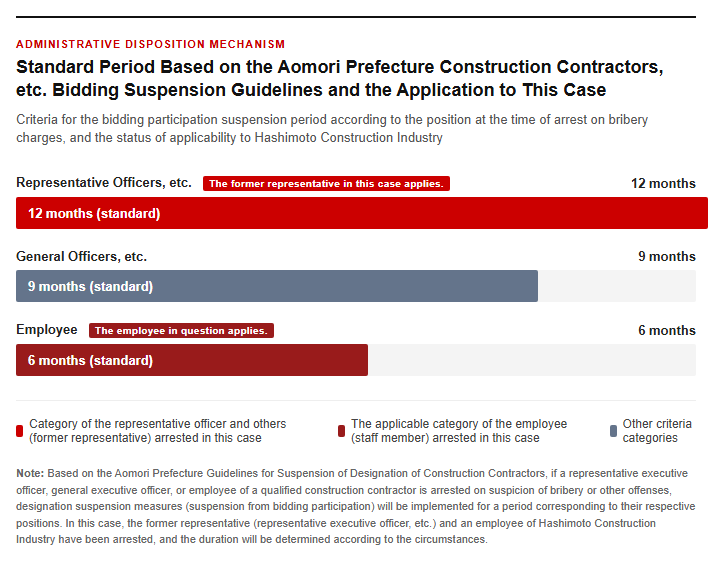
Aomori Prefecture has decided to impose a suspension from designated bidding (suspension of bidding participation) on Hashimoto Kensetsu Kogyo, a construction company based in Mutsu City whose former representative and an employee were arrested in a bribery case involving the Shimokita Test Center. Based on the Aomori Prefecture Guidelines for Suspension of Designated Contractors, if a representative executive, officer, or employee of a qualified construction contractor is arrested or prosecuted on suspicion of bid-rigging, collusive bidding, or bribery, the prefecture is set to impose a bidding suspension for a period determined based on the circumstances. From the date of learning of an arrest on suspicion of bribery, the standard suspension periods are stipulated as 12 months for representative executives, etc., 9 months for general officers, etc., and 6 months for employees. Business operators subject to the suspension are excluded from designated competitive bidding and discretionary contracts for construction work and business outsourcing ordered by Aomori Prefecture during this period, and they are also not permitted to serve as subcontractors or completion guarantors for prefecture-ordered construction work. The flow of the administrative disposition procedure is as follows.
The Impact of Performance Evaluation Criteria and Penalties Associated with Suspension from Bidding
A suspension from bidding not only results in the temporary loss of eligibility to participate in bids, but also imposes severe penalties on a company’s construction track record evaluations and overall credibility. According to Aomori Prefecture’s performance evaluation standards, if accidents or inappropriate incidents caused by the contractor occur during project execution and measures such as bidding suspensions are taken, points are deducted from the comprehensive evaluation score for the project in question. If the suspension period exceeds one month, it is subject to a maximum deduction of 15 points. Furthermore, if contract non-conformity or violations of relevant laws and regulations due to intent or gross negligence are recognized, a mechanism is in place to add a maximum deduction of 20 points. As a result, even after the suspension period expires, technical evaluation scores in comprehensive evaluation bidding methods drop significantly and bidding competitiveness is severely impaired, making it a very heavy administrative disposition that is directly linked to business continuity for local construction companies that depend on public works.
The History of Procurement Fraud and Institutional Reform in the Ministry of Defense and the Self-Defense Forces
History of Past Government-Orchestrated Bid-Rigging Incidents and the Evolution of Compliance Enhancement
Fraudulent practices surrounding procurement and bidding within the Ministry of Defense and the Self-Defense Forces have been a serious issue in the past as well. In 2006, a systematic state-orchestrated bid-rigging incident came to light in construction projects commissioned by the Defense Facilities Administration Agency (DFAA). Following the arrest of agency executives and penalty fee demands exceeding 2.2 billion yen, the situation ultimately escalated to the abolition of the DFAA and its integration into the Ministry of Defense. Furthermore, in fiscal 2008, concerning the procurement of office furniture and other items at the Japan Air Self-Defense Force’s 1st Supply Depot, a defense inspection uncovered state-orchestrated bid-rigging in which SDF personnel had revealed the preferences of intended suppliers prior to the bidding process, leading to massive disciplinary actions against 50 involved individuals. Reflecting on these past incidents, the Ministry of Defense has developed manuals and compliance guidance to prevent bid-rigging, while thoroughly enforcing compliance with the Act on Prevention of Involvement in Bid-Rigging, etc. (Anti-Bid-Rigging Act) and promoting awareness of the Self-Defense Force Personnel Ethics Code. However, the recent discovery of illicit entertainment at the Shimokita Test Ground demonstrates that challenges still persist in embedding a culture of compliance at the operational level.
Restructuring the Internal Control System and Future Recurrence Prevention Measures
To restore trust in future defense procurement, rebuilding the internal check-and-balance system for individual procurement personnel is considered an urgent necessity. Under the crime of obstructing bids, etc., by officials as stipulated in Article 8 of the Act on Prevention of Involvement in Bid Rigging, etc., by Public Employees, severe criminal penalties of up to 5 years of imprisonment or a fine of up to 2.5 million yen are imposed for actions such as disclosing bidding secrets or acts that impair fairness. The Ministry of Defense and the Acquisition, Technology & Logistics Agency (ATLA) are continuing to promote the thorough separation and mutual checking between procurement-request departments and contracting departments, the expansion of electronic bidding, and the strengthening of statistical verification against unnatural winning-bid situations. Furthermore, active utilization of helplines with external attorneys as a contact point and whistleblower systems is being encouraged so that misconduct can be reported even when it is difficult to consult with supervisors. Maintaining a high sense of ethics at defense operational sites and ensuring a highly transparent procurement process are essential keys to preventing recurrence.
Reference Page
- [Compliance Guidance [For Managers] – Ministry of Defense, Defense Inspector General’s Office] https://www.mod.go.jp/igo/compliance/guidance/pdf/cg7kanri-full.pdf
- [Manual for the Prevention of Bid Rigging – Ministry of Defense] https://www.mod.go.jp/atla/koueki/r01tsuho_format_1.pdf
- 【Acquisition, Technology & Logistics Agency Shimokita Test Center】https://www.mod.go.jp/atla/shimokita.html
【#ATLA #ShimokitaTestCenter #BriberyScandal #AomoriPrefecture #SuspensionFromBidding #SelfDefenseForces #Compliance #PublicProcurement】

コメント