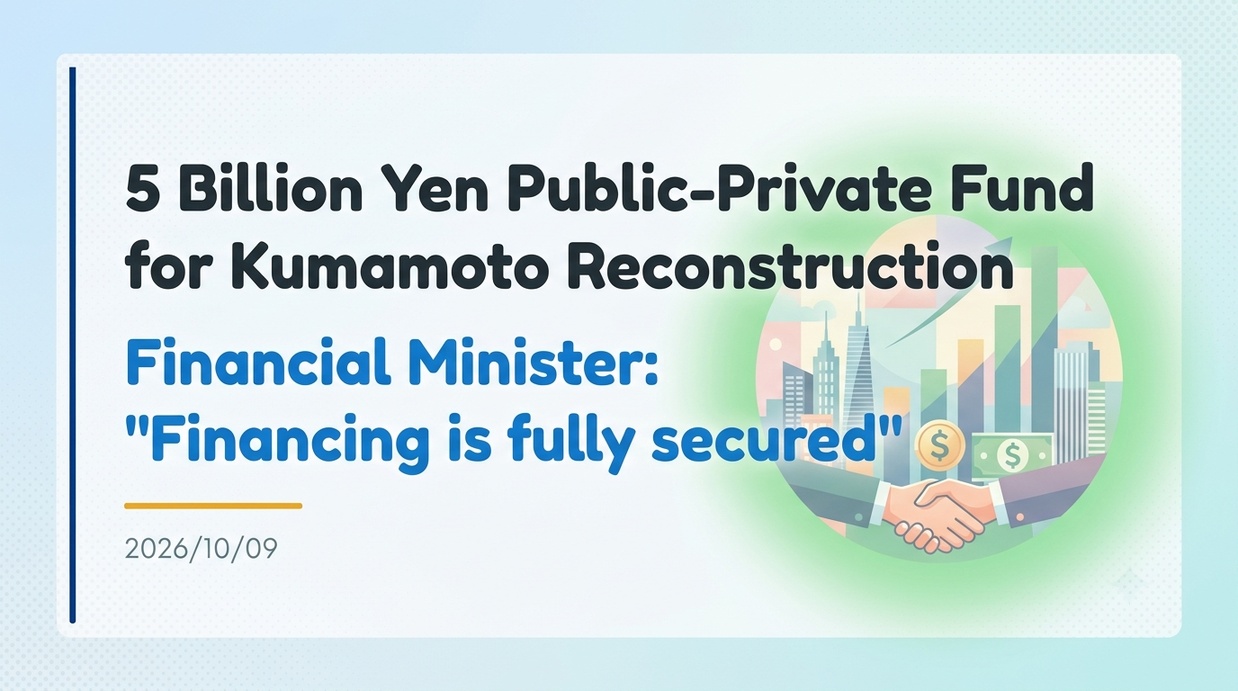
On October 9, 2026, State Minister for Financial Services Satsuki Katayama announced the establishment of a public-private fund (reconstruction fund) on a scale of up to 5 billion yen to support the reconstruction of businesses affected by the Kumamoto earthquake. This initiative is driven by the need to resolve the “double loan” problem—where affected business operators accumulate new borrowings for restoration on top of existing debts—and to strengthen cash flow support to sustain the recovery of the regional economy.
- Key Points of the Public-Private Fund Creation and the Financial Minister’s Statement
- Fund Structure and Collaboration Among Major Institutional Investors
- Challenges of Existing Debt and New Financing Faced by Disaster-Stricken Businesses
- Lessons Learned and Track Record of Past Disaster Reconstruction Funds
- Rollout of Business Turnaround and Hands-On Management Support through Public-Private Partnerships
- Future Outlook for the Regional Economy and Key Points to Watch
Key Points of the Public-Private Fund Creation and the Financial Minister’s Statement
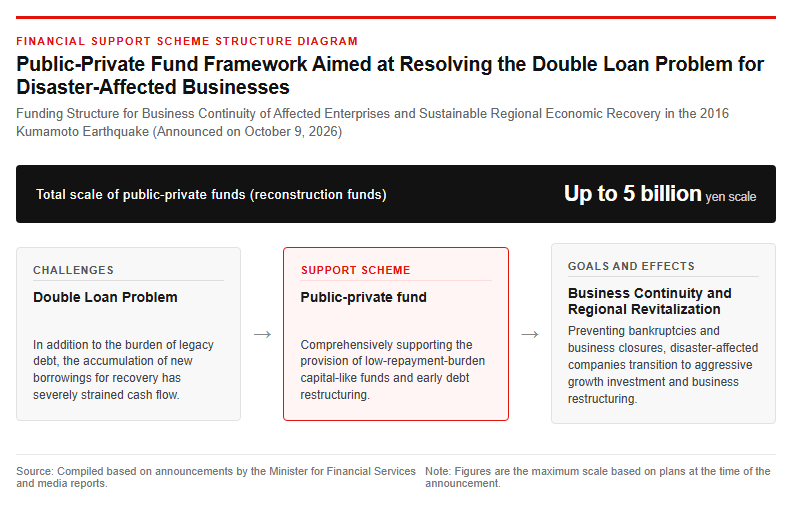
At a post-Cabinet press conference on October 9, 2026, Minister for Financial Services Satsuki Katayama revealed that a public-private reconstruction fund of up to 5 billion yen will be newly established to strongly support the business reconstruction and management improvement of companies affected by the Kumamoto earthquake. At the press conference, the Minister strongly emphasized, “We will make every possible effort to handle cash flow and debt issues,” clearly demonstrating a proactive stance on rapid financial support to maintain the foundation of the regional economy. The creation of this public-private fund is positioned as an emergency, structural financial support measure designed to support the recovery of small, medium, and mid-sized businesses battered by natural disasters and to prevent bankruptcies and closures that force companies to abandon operations. In the disaster-hit regions, severe impacts—such as the total destruction of buildings, equipment damage, and prolonged slumps in sales—have persisted, and an increasing number of cases make it difficult to continue operations through conventional debt financing from financial institutions alone. Consequently, launching a comprehensive fund scheme featuring the provision of equity-like funds with lighter repayment burdens and early debt restructuring had become an urgent priority. By coordinating public and private efforts to supply risk capital, the initiative aims to build a solid financial footing that enables affected companies to embark once again on aggressive growth investments and business restructuring.
The following figure illustrates the overall framework of capital supply and support schemes by public-private funds.
Fund Structure and Collaboration Among Major Institutional Investors
The newly established reconstruction fund, with a scale of up to 5 billion yen, is expected to be operated through a public-private joint investment by the Regional Economy Vitalization Corporation of Japan (REVIC)—which has a wealth of experience in supporting the revitalization of local businesses—and local financial institutions with a strong footing in Kumamoto Prefecture. Following the past Kumamoto Earthquake, the “Kumamoto Future Creation Fund” (totaling 5 billion yen) and the “Kumamoto Earthquake Business Reconstruction Support Fund” (totaling 4,960 million yen) brought together a wide range of organizations, including the Organization for Small & Medium Enterprises and Regional Innovation, Japan (SMRJ), The Higo Bank, The Kagoshima Bank, The Kumamoto Bank, local shinkin banks and credit cooperatives, and the Kumamoto Credit Guarantee Corporation, to provide capital-like funds such as subordinated loans and equity investments. In this current fund as well, such strong public-private cooperative frameworks will be followed and expanded, with expert teams from investment firms and REVIC Capital providing hands-on support involving business improvement and debt purchasing for business operators. Specifically, for businesses suffering from excessive debt, the fund will perform partial purchases of existing claims and rights adjustments to dramatically reduce their monthly repayment burdens while preferentially supplying the working capital and capital expenditure funds necessary for business restructuring. Through these measures, a system is in place to powerfully drive essential business revitalization that goes far beyond the mere deferral of funds.
The Double Loan Problem Hindering Reconstruction and the Background of Support
Challenges of Existing Debt and New Financing Faced by Disaster-Stricken Businesses
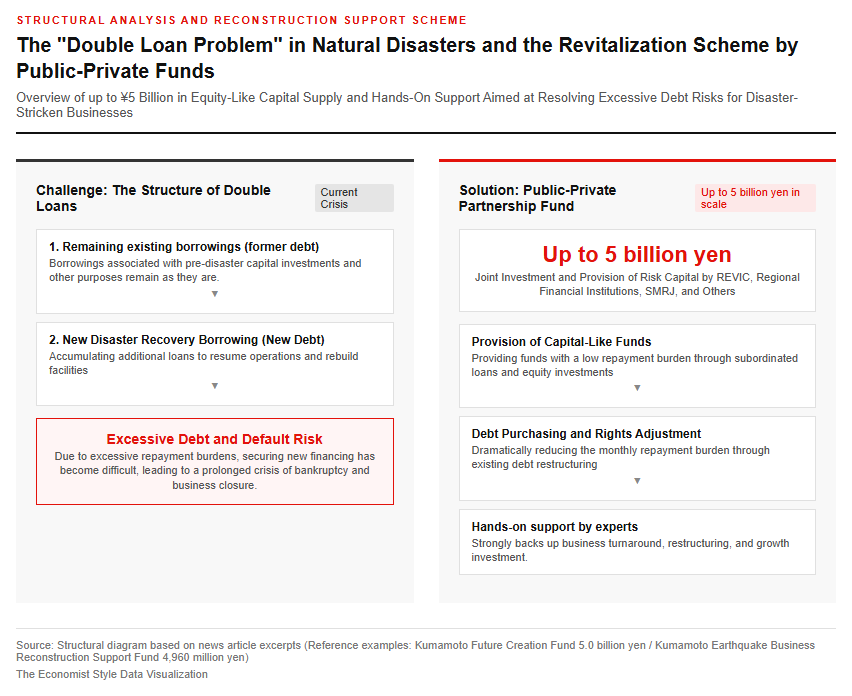
When disaster-affected business owners who have lost business assets, stores, or factories strive for recovery, the single biggest barrier they face is the “double loan (double debt) problem.” A double loan refers to a structural problem in which the repayment burden becomes excessively heavy because a business takes on new borrowings (new debt) to resume operations or construct facilities while existing borrowings (old debt) tied to pre-disaster capital investments and other expenses still remain. When burdened with existing debt, the screening process for new loans from financial institutions becomes stricter, and cases where securing additional financing becomes impossible are ceaseless. In response to the occurrence of the 2026 Kumamoto Earthquake, the Ministry of Finance and the Financial Services Agency have requested public and private financial institutions to provide thorough cash flow support, such as the application of Safety Net Guarantee No. 4, the implementation of disaster recovery loans, the suspension of repayments on existing debts, and flexible changes to lending conditions. However, loans from private financial institutions alone often only amount to the deferral of principal repayments or grace periods for interest, failing to achieve a fundamental reduction in debt. In order for businesses not to fall into the mire of excessive debt and to rebuild a sustainable revenue model, public support schemes such as debt purchases that alleviate repayment obligations and subordinated loans that can be counted as capital are indispensable.
The structure of double loans faced by disaster-affected businesses and their cash flow burden are organized in the diagram below.
Lessons Learned and Track Record of Past Disaster Reconstruction Funds
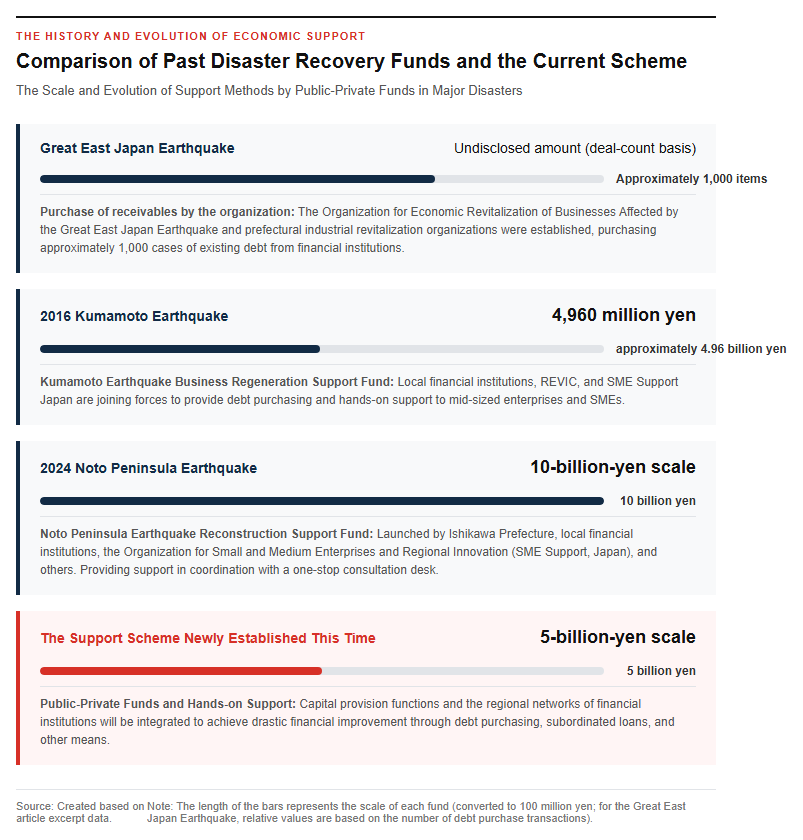
Reconstruction support measures for disaster-affected businesses in Japan have evolved incrementally through large-scale disasters such as the Great East Japan Earthquake, the 2016 Kumamoto Earthquake, and the 2024 Noto Peninsula Earthquake. In the wake of the Great East Japan Earthquake, the Great East Japan Earthquake Business Rehabilitation Support Organization and prefectural industrial reconstruction organizations were established, contributing significantly to the resumption of business and maintenance of employment at affected companies by purchasing approximately 1,000 cases of existing debt from financial institutions. Furthermore, under the “Kumamoto Earthquake Business Rehabilitation Support Fund” (totaling 4,960 million yen) established after the 2016 Kumamoto Earthquake, local financial institutions, REVIC, and the Organization for Small & Medium Enterprises and Regional Innovation, JAPAN (SMRJ) worked in unison to purchase claims and provide hands-on managerial support for mid-sized and small enterprises trapped in excessive debt, successfully executing numerous business turnarounds. Following the 2024 Noto Peninsula Earthquake, Ishikawa Prefecture, local financial institutions, and SMRJ have also established a 10-billion-yen Noto Peninsula Earthquake Reconstruction Support Fund, deploying support tied to the opening of a one-stop consultation desk. What these past lessons make clear is that launching public-private funds in the early stages following a disaster, with financial institutions and support organizations cooperating closely to execute prompt debt restructuring, serves as the single most critical key to preventing the collapse of regional economies.
Strengthening Regional Financial Capabilities and Sustainable Economic Recovery
Rollout of Business Turnaround and Hands-On Management Support through Public-Private Partnerships
The newly established 5-billion-yen public-private fund is characterized not merely by the provision of capital (finance), but by the integrated offering of comprehensive, hands-on support for business operators’ management improvements. Expert teams dispatched from financial institutions and REVIC will carefully examine the actual condition evaluations (business viability assessments) of affected business operators and support the formulation of highly feasible management rehabilitation plans. For example, they will actively provide modern, non-financial solutions, such as developing new sales channels to restore sales, improving operational efficiency through the introduction of digital transformation (DX), and offering advice on M&A and business succession for companies struggling with a lack of successors. In addition, in recent years, changes in the business environment—such as soaring raw material costs, labor shortages, and rising interest rates—have become severe, and passive cash flow support alone often fails to yield sufficient revitalization effects. Therefore, emphasis is placed on regional hubs such as regional banks, shinkin banks, and credit cooperatives collaborating with external support organizations and local governments to implement early, hands-on support based on predictive management. By fusing the capital supply function of the public-private fund with the regional networks of financial institutions, it is expected that affected companies will not simply return to their pre-disaster state, but transform into robust business entities capable of creating new added value.
The network structure of hands-on management support and the coordination framework is shown in the figure below.
Future Outlook for the Regional Economy and Key Points to Watch
State Minister for Financial Services Katayama’s announcement of the 5 billion yen public-private fund for Kumamoto’s reconstruction provides a great sense of relief to businesses and regional financial institutions in the disaster-affected areas, while also serving as a solid foothold for the full-scale recovery of the regional economy moving forward. Looking ahead, the first key point of focus is the specific launch timing of the fund and the speed at which investment projects are formed. Many affected companies are facing a depletion of their working capital, and swift project adoption in coordination with special financial measures and special consultation desks is desired. The second point is the linkage with the expansion of capital participation systems and fund delivery systems based on the Act on Special Measures for Strengthening Financial Functions. In regions where population decline and depopulation are progressing, enabling regional financial institutions themselves to strengthen their management foundations and secure the capacity to take risks is directly linked to maintaining regional financial capabilities over the long term. The third point is the development of a permanent financial support framework that responds to multiple disasters and structural changes in the economic environment. There are strong expectations that this public-private fund will serve as a successful model, horizontally deployed as knowledge for disaster response and regional revitalization across the country. We will continue to keep a close eye on these sustainable reconstruction support efforts, which unite the Financial Services Agency, local finance bureaus, local governments, and local financial institutions.
Reference page
- [House of Councillors, Standing Committee Research Office] Background and Issues Surrounding Financial Support Measures During Disasters: https://www.sangiin.go.jp/japanese/annai/chousa/ripou_chousa/backnumber/20241101.html
- [Financial Services Agency] Support for Disaster Victims, etc. and Requests for Financial Measures in the Event of Disasters, etc.: https://www.fsa.go.jp/
[#KumamotoReconstructionFund #DoubleLoanCountermeasures #PublicPrivateFund #RegionalFinance #BusinessTurnaround #CashFlowSupport]
コメント