The Ministry of Land, Infrastructure, Transport and Tourism has decided to launch three new follow-up surveys starting in late October 2026, aimed at ensuring the on-site adoption of “standard labor costs” under the revised Construction Business Act. This comes against the backdrop of identifying structural issues that prevent fair wages from reaching construction workers and enhancing the effectiveness of improving their working conditions.
- Overview and Objectives of Three New Surveys Launching in Late October
- Full Implementation of the Revised Construction Business Act and the Background to the Introduction of “Standard Labor Costs”
- Discrepancy Survey Between Estimates and Standard Values for Rebar and Formwork Contractors
- Investigation into Barriers to “Thorough Dissemination” in Private Construction and Public Civil Engineering
- Comparison of Actual Annual Incomes of Skilled Workers Utilizing CCUS and Standard Values by Skill Level
- Summary of February 2027 Results and Outlook for the Second Survey
- Ensuring Effectiveness for On-Site Implementation and the Role of Construction G-Men
Overview and Objectives of Three New Surveys Launching in Late October
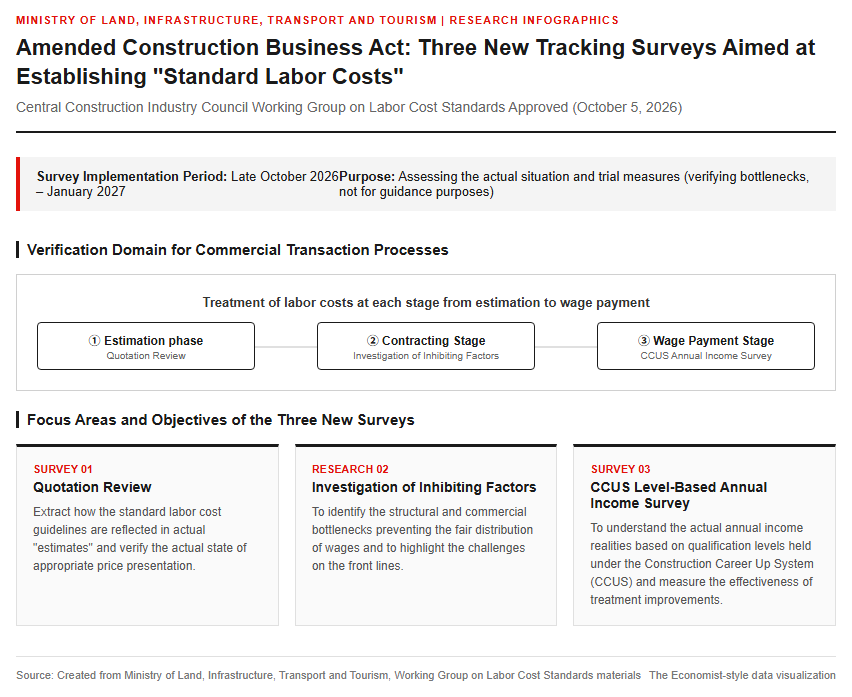
To understand the actual situation of the “labor cost standards” (standard labor costs) introduced under the amended Construction Business Act, the Ministry of Land, Infrastructure, Transport and Tourism (MLIT) will conduct three new follow-up surveys from late October 2026 to January 2027. This survey policy was officially approved on October 5, 2026, at the Working Group on Labor Cost Standards of the Central Council for Construction Business. The main purpose of this survey is to examine the handling of labor costs at each stage from estimates to contracting and actual wage payments, and to highlight the bottlenecks preventing them from reaching workers on-site. The survey targets are divided into three areas: the “Estimate Survey,” the “Hindering Factor Survey,” and the “CCUS Level-based Annual Income Survey,” with specific sites and companies selected for multifaceted interviews and document reviews. Note that these new surveys are not intended for crackdowns or disciplinary actions, but are positioned as fact-finding and trial measures for future policy considerations. Akio Sudo, Director-General of the Real Estate and Construction Economy Bureau at the Ministry of Land, Infrastructure, Transport and Tourism, has expressed his intention to accurately grasp the status of standard utilization and challenges to lead to improvements. An image of the actual on-site survey is shown below.
Full Implementation of the Revised Construction Business Act and the Background to the Introduction of “Standard Labor Costs”
The construction industry has long faced severe labor shortages and an aging workforce, making the improvement of working conditions and compensation for skilled workers an urgent priority. However, under past business practices, labor costs were easily squeezed in the process of bidding competition, creating a structural issue where even increases in public works design labor unit prices did not directly lead to wage increases for frontline skilled workers. To break through this situation, the revised Construction Business Act, amended in 2024 and fully implemented in December 2025, established “labor cost standards (standard labor costs)” recommended by the Central Construction Business Council for each job category. Under this system, both clients and contractors are prohibited from submitting estimates or entering into contracts that fall significantly below the labor costs recognized as normally necessary, and violations will result in measures such as official recommendations and the public disclosure of company names. To ensure the effectiveness of the system, it is considered essential not merely to establish rules, but also to conduct continuous follow-up surveys to verify whether labor costs are properly secured at actual construction sites and reaching frontline skilled workers.
Details of Three New Investigations Aimed at Clarifying the Actual Situation
Discrepancy Survey Between Estimates and Standard Values for Rebar and Formwork Contractors
“Estimate Surveys,” one of the pillars of the new survey, will be conducted targeting two occupations: rebar workers and formwork carpenters, for which efforts to secure appropriate labor costs are more advanced. The reason for their selection is that standard values have already been established for these two trades, and the preparation of standard estimates is progressing. The survey will select approximately one company for each of the country’s prefectures, targeting about two sites per company. Contractors will be asked to submit the final estimates they provided to clients in the format of a standard estimate, and a close examination will be made of any discrepancies between them and the published standard values, public works design labor unit prices, and standard labor productivity rates. Additionally, questionnaire surveys regarding construction conditions and work details will be conducted to analyze in detail how appropriate labor costs are reflected in the cost estimation stage and whether pressure for price reductions has been applied.
Investigation into Barriers to “Thorough Dissemination” in Private Construction and Public Civil Engineering
The second “impediment factor survey” will be conducted across three categories with different ordering structures to clarify the factors preventing labor costs paid by project owners from reaching frontline craftworkers. Specifically, about one project each will be designated: large-scale private construction work by major developers, private housing construction work by major housing manufacturers, and public civil engineering work commissioned by prefectures. For large-scale private construction, up to about 20 companies will be targeted, and for housing construction, up to about 15 companies. Contractual documents will be reviewed and interviews will be conducted with project owners, primary contractors, and subcontractors (covering structural, finishing, and equipment work types). Meanwhile, for public civil engineering work, which has a relatively simple structure, all contractual relationships related to the target project will be investigated. The survey will identify impediment factors by conducting interviews regarding the awareness of standard labor costs at each stage, the background of price negotiations, the securing of expenses other than labor costs, and the discrepancy between the labor costs received by subcontractors and the actual wages paid.
Comparison of Actual Annual Incomes of Skilled Workers Utilizing CCUS and Standard Values by Skill Level
The third, the “CCUS Level-based Annual Income Survey,” is a survey examining the actual treatment of skilled workers focusing on two trades: plasterers and interior workers. In the Construction Career Up System (CCUS), standard and target values for annual income by level are established based on the experience and ability of skilled workers. This survey selects multiple companies from each of the nine regional blocks nationwide, and confirms the actual annual income of affiliated skilled workers over the most recent year through wage ledgers and worker registries. By comparing the obtained data with the CCUS level-based annual incomes, it verifies whether wages commensurate with the skill levels of the workers are actually being paid. The findings obtained from this survey are planned to be utilized as crucial foundational data for future measures to improve the treatment of skilled workers and to revise evaluation systems.
Impact on the construction industry, future schedule, and challenges
Summary of February 2027 Results and Outlook for the Second Survey
These three new follow-up surveys will start in late October 2026 and be conducted over a period of about three months until January 2027. Following data aggregation and analysis, the survey results are scheduled to be compiled and reported to a working group of the Central Council for Construction Contracting by February 2027. In addition, the Ministry of Land, Infrastructure, Transport and Tourism has positioned this survey as a trial, and based on the issues and results obtained, has set a policy to conduct a second survey from April 2027 onward. In the second survey, the expansion of targeted job categories and project scales is being considered, and the degree of penetration of labor costs across the broader construction market is expected to be verified. Through the continuation of these phased surveys, a process is being established to prevent the system from becoming a mere formality and to enhance the effectiveness of fair trade practices.
Ensuring Effectiveness for On-Site Implementation and the Role of Construction G-Men
To establish the standard labor cost system at construction sites, strengthening the monitoring and corrective system is indispensable in addition to grasping the actual situation through surveys. The Ministry of Land, Infrastructure, Transport and Tourism is expanding the structure of the “Construction G-Men,” which monitors malicious price squeezing and unjustified demands for price reductions, and is broadening the scope of its investigations from contractors licensed by the Minister to those licensed by prefectural governors. Furthermore, a trial operation of a system allowing skilled workers to directly report their actual wage conditions is planned to start in January 2027. A mechanism is being established where the Construction G-Men will conduct on-site inspections and other measures if wage payments falling below standard values are suspected. While some point out that price pressures driven by market principles tend to operate in private construction projects, it is expected that actual condition surveys and monitoring systems by the administration will function as two wheels of a cart to secure appropriate labor costs and sustainably improve the treatment of skilled workers.
Reference Page
- 【Ministry of Land, Infrastructure, Transport and Tourism Labor Cost Standards Portal Site】https://roumuhi.mlit.go.jp/
【#MLIT #StandardLaborCosts #ConstructionBusinessActAmendment #ConstructionGMen #SkilledWorkersTreatmentImprovement #CCUS #UnfairPriceSqueezing】


コメント