In September 2026, the number of corporate bankruptcies in Saitama Prefecture reached 40, exceeding the same month of the previous year for the fourth consecutive month. This trend is driven by the prolonged impacts of high prices and labor shortages, along with the gradually widening effects of deteriorating cash flows caused by rising interest rates.
- Overview of September Bankruptcies and the Background Behind Four Consecutive Months of Increase (Key Points)
- Occurrence Status and Structural Factors by Industry and Scale
- The double punch of soaring costs and labor shortages
- New Cash Flow Risks Posed by Rising Interest Rates
- Responding to Business Partner Bankruptcy and the Importance of Credit Preservation
- Future Outlook of Regional Economies and Utilization of Support Systems (Future Developments and Key Points to Watch)
Overview of September Bankruptcies and the Background Behind Four Consecutive Months of Increase (Key Points)
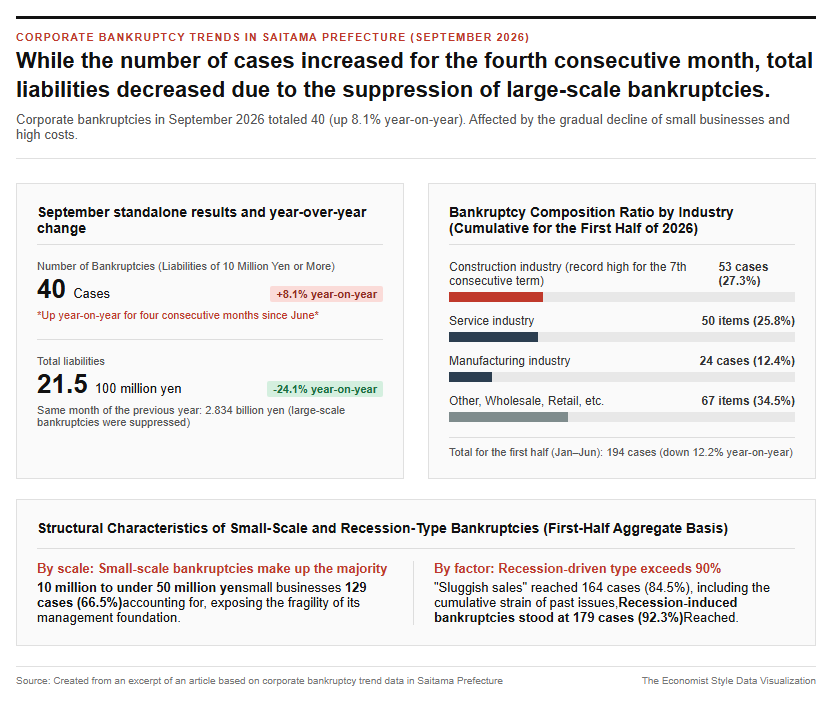
In September 2026, the number of corporate bankruptcies in Saitama Prefecture (with liabilities of 10 million yen or more) stood at 40, an 8.1% increase from 37 in the same month of the previous year. This is the fourth consecutive month that the monthly tally has exceeded the same month of the previous year, following 36 cases in June, July, and August. Meanwhile, the total liabilities for the month remained at 2.15 billion yen, a 24.1% decrease compared to 2.834 billion yen in the same month of the previous year. While large-scale bankruptcies were kept in check, bankruptcies of small and medium-sized enterprises and small-scale businesses with relatively small liabilities are driving up the number of cases.
For the cumulative total of the first half of 2026 (January to June), the number of bankruptcies stood at 194 (a 12.2% decrease compared to the same period last year), recording a low level below 200 for the first time in three years. However, the tide has turned since the summer, and the monthly pace of bankruptcies is gradually accelerating. In the background are multifaceted cost increases, such as persistently high energy prices and raw material costs, rising import costs due to the rapid depreciation of the yen, and soaring labor costs. Combined with the conclusion of various support measures implemented since the COVID-19 pandemic, the number of companies reaching their limits in managing their own cash flow is steadily increasing, even within Saitama Prefecture.
Occurrence Status and Structural Factors by Industry and Scale
An analysis of bankruptcies by industry highlights the severity facing the construction sector. In Saitama Prefecture, the construction industry has recorded the highest number of cases for seven consecutive half-year periods since the first half of 2020, and accounted for 53 cases (a 27.3% share) in the first half of 2026 as well. This strongly reflects the impact of soaring material prices, widespread labor shortages in the construction industry, and the working hour regulations that took effect in April 2024. This was followed by the service industry with 50 cases (25.8% share) and the manufacturing industry with 24 cases (12.4% share), indicating that the blow is spreading broadly, particularly among industries reliant on domestic demand.
Broken down by liabilities, small-scale bankruptcies ranging from 10 million yen to under 50 million yen accounted for the majority with 129 cases (66.5% of the total), revealing that smaller companies have increasingly fragile management foundations. Broken down by cause, “sluggish sales” was overwhelmingly the most common at 164 cases (84.5% of the total), with “recession-driven bankruptcies”—including the lingering effects of past pressures—reaching 179 cases (92.3% of the total). Examples of large-scale bankruptcies include agricultural drone developer and seller Nileworks (Minami-ku, Saitama City, liabilities of approximately 2.5 billion yen), which went bankrupt in May 2026, but overall, bankruptcies driven by the slow decline of small and micro-sized businesses remain predominant.
Compound Risks and Impacts Pressuring Corporate Management
The double punch of soaring costs and labor shortages
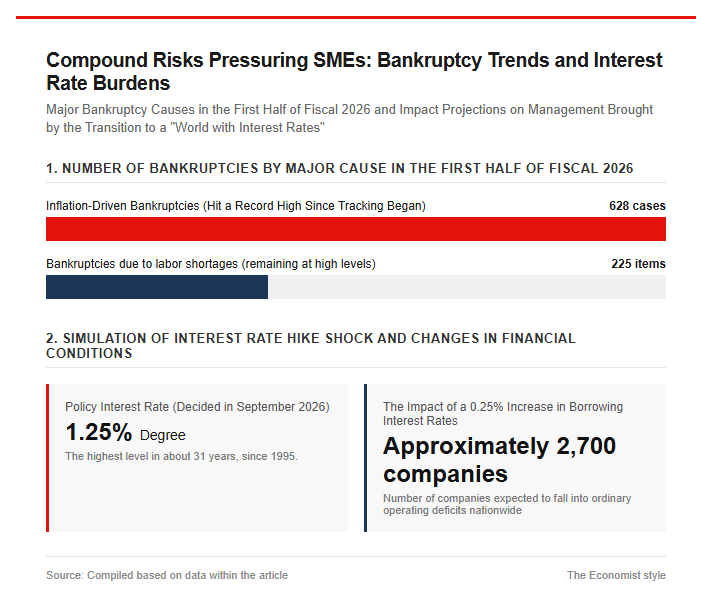
In the business operations of small and medium-sized enterprises (SMEs), the dual burden of soaring prices and labor shortages is casting a severe shadow. Nationally, inflation-driven bankruptcies in the first half of fiscal 2026 reached 628 cases, breaking the record high since the start of data compilation, while labor shortage-related bankruptcies also remained at a high level of 225 cases. Saitama Prefecture is no exception, as companies unable to fully pass on rising raw material and procurement costs to their selling prices find themselves in dire straits. This is because they face the dilemma that easily raising prices amid heightened consumer awareness of household budget protection will lead to a loss of customers.
Furthermore, the minimum wage increases that took effect sequentially across prefectures starting October 1, 2026, have directly increased the burden of labor costs even further. For small-scale businesses with fewer than 10 employees, securing the financial resources for wage increases aimed at addressing hiring difficulties and preventing existing staff from resigning is in an extremely difficult situation. With the loss of order opportunities due to labor shortages and the rise in labor costs happening simultaneously, an increasing number of companies are falling into a vicious cycle of rapidly deteriorating profitability. Please refer to the figure below.
New Cash Flow Risks Posed by Rising Interest Rates
In addition to rising costs, changes in the financial environment are rapidly emerging as a management risk. At its Monetary Policy Meeting on September 18, 2026, the Bank of Japan decided to raise the policy interest rate to around 1.25%. This is the highest level in approximately 31 years, since 1995, and marks the full-scale transition from the long-running era of ultra-low interest rates to a “world with interest rates.” With the rise in lending rates by private financial institutions, the interest payment burden on companies carrying interest-bearing debt will inevitably increase. According to estimates, just a 0.25% increase in borrowing rates is expected to plunge approximately 2,700 companies nationwide into ordinary losses.
For companies in Saitama Prefecture, the full-scale repayment of COVID-19 zero-interest, zero-collateral loans introduced in past years, along with borrowings that have been managed through debt restructuring (rescheduling) due to sluggish performance, are becoming a heavy burden. Particularly in industries with a high reliance on external financing, such as real estate and construction, businesses are vulnerable to the impact of rising interest rates. As interest burdens grow while earnings fail to improve, there is a rising risk that potential bankruptcies—companies that have managed to stay afloat until now—will be driven into cash-flow insolvency.
Future Outlook and Defensive Measures Required for Businesses
Responding to Business Partner Bankruptcy and the Importance of Credit Preservation
Due to the high rate of corporate bankruptcies, companies must heighten their vigilance not only against their own direct poor business performance, but also against the risk of chain-reaction bankruptcies triggered by the failure of business partners. This is because if a business partner enters formal insolvency proceedings, recovering accounts receivable and unpaid bills becomes difficult, which can deal a devastating blow to the company’s cash flow. To mitigate this risk, thorough credit management during normal times and the early detection of warning signs are essential. The occurrence of payment delays, sudden requests to change transaction terms, and the mass departure of executives and employees are crucial indicators of a management crisis.
In the unlikely event that a business partner’s bankruptcy is discovered, it is necessary to immediately check the type of bankruptcy proceedings (such as bankruptcy, civil rehabilitation, or corporate reorganization), accurately organize the claim amounts and contract details, and promptly file a proof of claim. It is also important to consider the possibility of recovery through legal means, such as exercising the right of set-off or confirming retention of title. As a measure to prepare for the risk of uncollected receivables, utilizing credit guarantee services (such as “Mamotte”) provided by private financial institutions or Ricoh Leasing to establish a system where guarantee payouts can be received in the unlikely event of a bad debt is also an effective defensive measure. Please refer to the figure below.
Future Outlook of Regional Economies and Utilization of Support Systems (Future Developments and Key Points to Watch)
Looking ahead, corporate bankruptcies in Saitama Prefecture are expected to remain at a high level through the second half of fiscal 2026, with the polarization of business performance among companies projected to become even more pronounced. While some companies will benefit from growth sectors such as semiconductors and AI, the gap is steadily widening between them and small and medium-sized enterprises (SMEs) that are struggling with interest rate burdens while failing to pass on rising costs. With no signs of soaring material costs or rising labor expenses subsiding, there are growing concerns that companies with depleted financial strength will increasingly be forced to give up on continuing their businesses.
In such challenging environments, it is crucial for companies facing financial distress to consult with specialized institutions early and take action before it is too late. Within Saitama Prefecture, public support frameworks are well-established, such as the “Re-Challenge Support” program provided by the Saitama Prefecture SME Revitalization Council. Even when business rehabilitation is difficult, making an early decision makes it possible to smoothly maintain employment and operations through business transfers, as well as to settle guaranteed debts based on the Guidelines for Corporate-Personal Guarantees (standalone type). Rather than stubbornly insisting solely on independent restructuring, achieving a soft landing through timely judgment and the use of public support will be a critical focal point for the future regional economy.
Reference page
- [Re-challenge Support – Saitama Small and Medium Enterprise Revitalization Council] https://www.saitama-kasseika.go.jp/challenge/
- 【Nationwide Corporate Bankruptcy Statistics Data Analysis – Tokyo Shoko Research】https://www.tsr-net.co.jp/news/data_analysis/index.html
【#Saitama #CorporateBankruptcies #EconomicTrends #SurgingPrices #RisingInterestRates #BusinessSupport #SMEs】


コメント