KAORU LLC, headquartered in Shin-Kamigoto Town, Nagasaki Prefecture, has announced two AI engines that utilize generative AI and large language models to discover new touchpoints with the region and deep-seated values. This initiative stems from a recognition of the challenge to address regional contexts and travelers’ emotions that cannot be captured by conventional keyword searches, and to bridge the gap between the perception of a region created by AI and its reality.
- Background and Key Points of the Two AI Engine Announcements
- The Gap Between the Regional Image Seen by LLMs and Reality
- How the Emotion Search Engine SHUN Works and Its Features
- Features of the Regional Career Research Engine TOKI
- Trusted Regional Data Structuring and Demonstration Cases
- Future Developments and Partnership Opportunities
Background and Key Points of the Two AI Engine Announcements
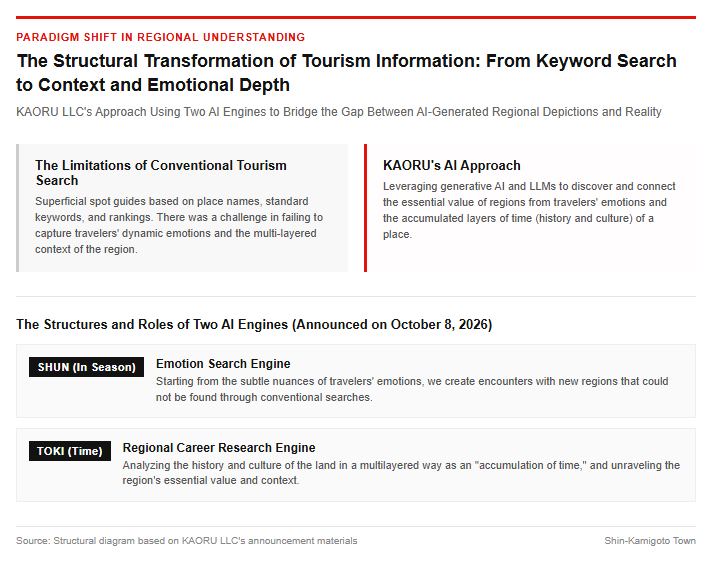
On October 8, 2026, KAORU LLC, headquartered in Shin-Kamigoto Town, Minamimatsuura District, Nagasaki Prefecture, announced two regional understanding AI engines powered by generative AI and large language models (LLMs). The two newly announced engines are “SHUN,” an emotional search engine that creates encounters with local regions starting from the traveler’s emotions, and “TOKI,” a regional career research engine that analyzes the history and culture of a land as an accumulation of time. Established in April 2023, KAORU LLC has been promoting initiatives to connect advanced technology with practical applications in local communities through regional co-creation projects with West Nippon Expressway Company (NEXCO West) and business operations based on contracts with local governments across Kyushu. This announcement is positioned as a challenge to go beyond conventional tourism guides limited to place-name searches and tourist spot rankings, and to intrinsically interpret the value of local regions through AI.
The Gap Between the Regional Image Seen by LLMs and Reality
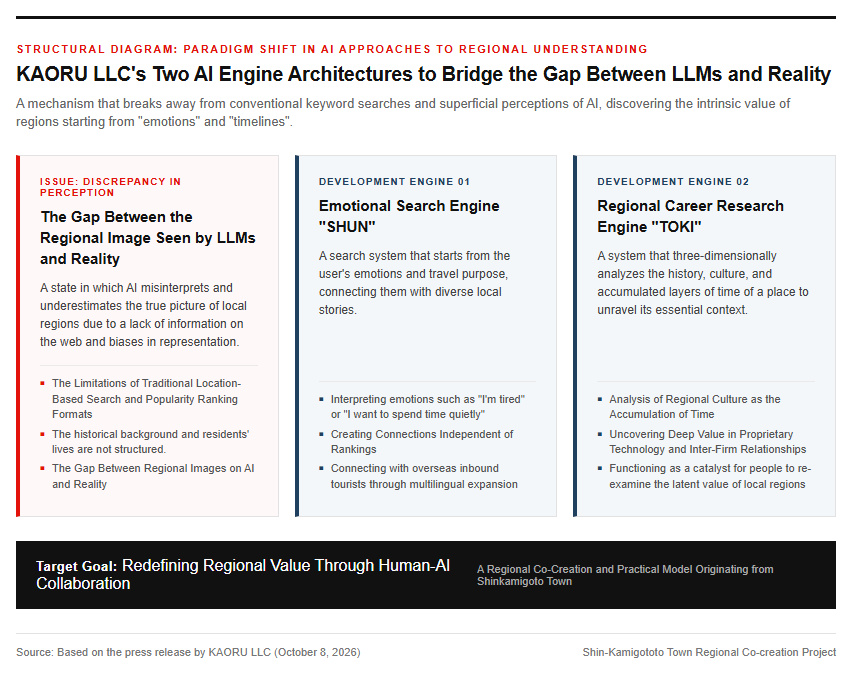
With the rapid adoption of generative AI, users are increasingly exploring the appeal of local regions through interactions with AI. However, a persistent issue is that the regional profiles internally maintained and output by large language models do not necessarily accurately reflect actual local conditions. Regions accumulate a vast amount of knowledge and value—such as historical backgrounds and traditional cultures that are not structured or expressed on the internet, local industries with proprietary technologies, the daily lives of residents, and relationships between businesses. Due to a lack of web-based information and biases in online representation, there are numerous instances where AI misinterprets regional characteristics or fails to present them adequately. Focusing on this discrepancy between the “region as seen by LLMs” and the “actual state of the region,” KAORU LLC has proposed a technical approach that uses AI as a catalyst for humans to re-examine the latent value of local areas, rather than simply evaluating or scoring AI responses.
A Technical Approach Starting from Emotion and Time
How the Emotion Search Engine SHUN Works and Its Features
Unlike conventional destination searches, the emotional search engine “SHUN” is a search system that starts from the user’s emotions, such as “what kind of mood they want to travel in,” and the meaning they seek in a journey. For example, by inputting subtle human states and desires such as “I’m a bit tired,” “I want to spend time in a quiet place,” or “I want to gain new discoveries and learning,” an LLM interprets the intent and proposes the optimal travel direction by linking it with elements such as nature, culture, food, daily life, and seasonal stories from various regions across Japan. It does not aim to guide users to popular tourist destinations or create rankings; its major uniqueness lies in connecting the user’s state of mind with the inherent characteristics of local regions. In addition, it is designed to be capable of multilingual deployment in languages such as English, Chinese, and Korean, and is expected to serve as a technological foundation for creating new touchpoints between inbound international travelers and local Japanese regions.
Features of the Regional Career Research Engine TOKI
The regional career research engine “TOKI” is a research foundation that multilaterally interprets the history, natural environment, industrial structure, culture, and demographic transitions that regions have undergone from the past to the present as an “accumulation of time (regional career).” Rather than visualizing regions solely through point-in-time figures such as current population fluctuations and economic indicators, it analyzes the process of what the land has inherited and what it has newly generated. In its analysis, thorough cross-checking with official statistics and regional materials is conducted, and a design is introduced to clearly distinguish and handle AI-based interpretations and objective factual evidence. For example, in the analysis of Tsunagi Town, Kumamoto Prefecture, the results are output as “TOKISTORY,” which turns the region’s path into a narrative, functioning as a research tool for people involved with the region to re-recognize the value of their land and generate questions and discussions for the future.
Social Implementation and Future Outlook
Trusted Regional Data Structuring and Demonstration Cases
For AI to correctly recognize regions, companies, and tourism resources and reflect them in its answers, the optimization of “Entities”—data units that can be distinguished from others—is essential. If region-specific companies and cultural activities are not properly organized as digital data, there is a risk that they will be omitted from AI searches and recommendations. KAORU LLC is promoting the quantitative observation of AI recognition status and the structuring of official information, working to deliver accurate and reliable information to both AI and humans rather than engaging in arbitrary evaluation manipulation. These practices have already begun through “W-NEXCO Direct,” a co-creation platform with West Nippon Expressway Company (NEXCO West), and the dissemination of regional information in Tsukumi City, Oita Prefecture. Furthermore, trials are underway for “FuruAd” (Hometown Advertisement), which deploys regional content to overseas digital signage and advertising media to guide users toward multilingual information.
Future Developments and Partnership Opportunities
KAORU LLC is now looking ahead to broad collaborations with local governments, universities, research institutions, and private companies, and has begun recruiting participants for joint research and demonstration experiments utilizing “SHUN” and “TOKI.” Two types of slots have been established: “Joint Research and Business Alliance Partners,” who will engage in technological development for discovering local value and disseminating information, and “Municipalities Participating in Study Sessions and Proof of Concepts,” which will learn regional DX in the AI era. Rather than treating AI-driven decisions as the absolute truth, the initiative aims to establish a “human-AI collaborative” regional management model where humans verify local histories and on-site realities based on AI-generated questions and hypotheses, translating them into subsequent policies and actions. Bridging advanced technology and local sites, this initiative is attracting attention as a new form of infrastructure for future regional and tourism DX.
Reference Page
- [Press Release] Rethinking “Regions as Seen by LLMs.” https://prtimes.jp/main/html/rd/p/000000005.000163685.html
- KAORU LLC Official Website https://kaoru-narao.com/
[#GenerativeAI #LLM #RegionalDX #RegionalRevitalization #KAORU LLC #SHUN #TOKI #TourismDX]
コメント