It is expected that special bonuses reaching approximately nine times the annual salary will be paid as performance-based compensation in Samsung Electronics’ semiconductor division for 2026. This is driven by a surge in demand for High Bandwidth Memory (HBM) and other products amid the AI boom, along with unprecedented financial performance.
- 【Key Takeaways】Semiconductor division to issue special bonuses of approximately 9 times annual salary
- [Grant Methods and Conditions] Company Stock-Based Compensation Structure and the Reality of the 49.5% Maximum Tax Rate
- [Business and Market Background] Unprecedented Strong Financial Results Driven by the AI Demand Surge and Soaring HBM Prices
- [The Depths of Internal Conflict] Labor Union Division Caused by a 100-Fold Disparity with the DX Department
- [Competitor & International Comparison] Comparison of Compensation Structures with SK Hynix, TSMC, and Major U.S. Companies
- [Future Outlook and Key Points] The Hurdle of the March 2026 Shareholders’ Meeting and Mid-to-Long-Term Risks
【Key Takeaways】Semiconductor division to issue special bonuses of approximately 9 times annual salary
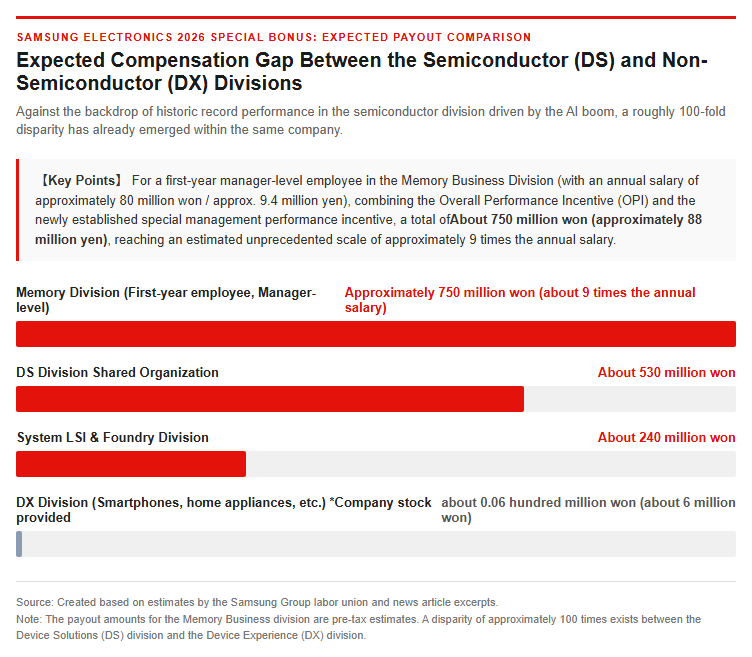
In October 2026, Samsung Electronics announced internal details regarding the special business performance bonuses for 2026 targeting executives and employees of the Device Solutions (DS) division, which oversees its semiconductor business. According to calculations by the Samsung Group’s conglomerate-wide labor union, a first-year manager-level employee in the Memory Business Division (with an annual salary of approximately 80 million won, or about 9.4 million Japanese yen) is projected to receive a pre-tax amount of approximately 750 million won (about 88 million yen), combining the conventional Overall Profit Incentive (OPI) and the newly established special business performance bonus. This is an unprecedented scale equivalent to approximately nine times their annual salary, with the payout reaching a maximum of roughly 65 million to 67 million yen.
In other business divisions within the DS division, the estimated amounts are approximately 530 million won for the common organization and about 240 million won for the System LSI and Foundry divisions. Meanwhile, company shares to be granted to employees in the Device eXperience (DX) division, which oversees smartphones and home appliances, are expected to be limited to about 6 million won (approximately 710,000 yen). Consequently, an extreme bonus gap of roughly 100-fold has arisen between the semiconductor and non-semiconductor divisions within the same company. Please refer to the figure below.
[Grant Methods and Conditions] Company Stock-Based Compensation Structure and the Reality of the 49.5% Maximum Tax Rate
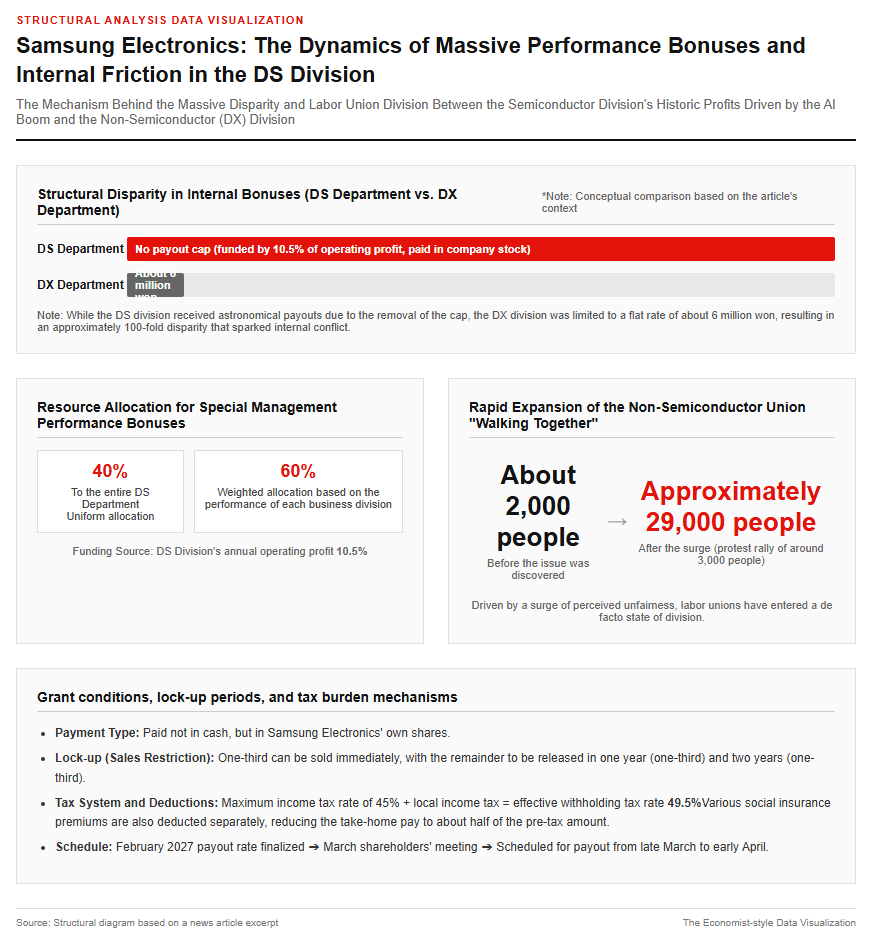
This special management performance bonus is a system that was agreed upon and introduced between labor and management following negotiations that brought them to the brink of a strike during the May 2026 wage negotiations. The funding source is set at 10.5% of the DS division’s annual operating profit. While the conventional Over-Performance Incentive (OPI) has a payment cap set at 50% of the annual salary, the defining characteristic of this special management performance bonus is that there is no payment cap. 40% of the funding source is distributed uniformly to all executives and employees across the entire DS division, while the remaining 60% is allocated proportionally based on the performance of each business unit.
Instead of cash, the payout will be made in Samsung Electronics’ own shares. One-third of the received shares can be sold immediately after the payout, while the remaining two portions of one-third each are subject to a one-year and two-year sales restriction (lock-up), respectively. From a tax perspective, to prevent additional tax collection during year-end adjustments, a flat withholding tax of 45%, which is the maximum income tax rate, will be applied. When combined with local income tax, the effective withholding tax rate reaches 49.5%, and with various social insurance premiums also deducted separately, the take-home pay will be about half of the pre-tax amount. The payout schedule is expected to have the distribution rates by business division finalized in early February 2027, and following the regular shareholders’ meeting in March 2027, the distribution will be carried out between the end of March and early April.
[Business and Market Background] Unprecedented Strong Financial Results Driven by the AI Demand Surge and Soaring HBM Prices
Behind Samsung Electronics’ ability to offer massive special bonuses is the tight supply of general-purpose DRAM and high-bandwidth memory (HBM), driven by the rapid expansion of the global artificial intelligence (AI) market. A surge in demand for AI servers has caused DRAM prices to skyrocket about sixfold over the past year. This has led to a sharp recovery in Samsung Electronics’ financial performance, with cumulative operating profit from the first to the third quarter of 2026 reaching 254 trillion won, and the market estimating that the company will record an operating profit on the scale of approximately 370 trillion won (about 43.5 trillion yen) for the full year.
On the technological front, Samsung Electronics announced the commercial shipment of HBM4 utilizing a 6th-generation 10nm-class DRAM process and a 4nm logic process in February 2026. HBM4 features a 12-layer stack with a capacity of 24GB to 36GB, achieving a bandwidth of up to 3.3TB/s per single stack. Furthermore, the company plans to sample HBM4E in the second half of 2026, and aims to provide samples of custom HBM tailored to customers’ AI chip designs by 2027. Such overwhelming technological prowess in advanced AI memory and the expansion of market share are the factors that have dramatically driven up the profit levels of the DS Division.
Escalating Internal Organizational Friction and Its Structural Impact on the Global Semiconductor Industry
[The Depths of Internal Conflict] Labor Union Division Caused by a 100-Fold Disparity with the DX Department
The decision to award astronomical bonuses in the DS division is creating intense friction and conflict within the company. Although the achievement of record company-wide profits was backed by contributions from non-semiconductor divisions and the redistribution of resources, bonuses for employees in the DX division were limited to around 6 million won, causing dissatisfaction to erupt all at once. On July 16, 2026, a protest rally involving approximately 3,000 people, centered around the non-semiconductor division labor union “Walk Together Labor Union,” was held in front of Samsung Electronics’ headquarters in Suwon.
As a result of this impact, the labor union, which had traditionally advocated for “One Samsung,” has effectively split into semiconductor and non-semiconductor factions. Following the exposure of the issue, the membership of the “Standing Together Labor Union” surged from about 2,000 to nearly 29,000, with some employees raising fierce protests that the non-semiconductor business is being neglected. Although management agreed to lift the cap with the aim of preventing top semiconductor talent from defecting to other companies, they now face a new organizational challenge: eliminating the sense of unfairness between departments. Please refer to the figure below.
[Competitor & International Comparison] Comparison of Compensation Structures with SK Hynix, TSMC, and Major U.S. Companies
The profit-sharing structure of South Korea’s top two semiconductor giants is extremely unique even on a global scale. According to estimates by the Bank of Korea, the total amount of pre-tax performance bonuses paid by Samsung Electronics and SK Hynix reaches approximately 62 trillion won (about 7.3 trillion yen) annually, which is equivalent to roughly 2.5% of South Korea’s GDP. Their rival, SK Hynix, uses 10% of its operating profit to fund performance bonuses, adopting a payout policy that combines 50% cash and 50% company stock. It differs from Samsung Electronics in that it has prepared an alternative plan (Plan B) to pay out the full amount in cash even if the issuance of shares is rejected at a shareholders’ meeting.
On the other hand, compared to global competitors, Taiwan’s TSMC merely sets a minimum threshold of 1% or more of its annual operating profit, with the actual payout ratio being flexibly determined by a committee consisting mainly of outside directors, taking into consideration capital investment plans and other factors. Furthermore, major U.S. tech companies such as Micron Technology, Intel, Google, and Meta primarily utilize Restricted Stock Units (RSUs) based on individual performance evaluations, and do not have a mechanism to uniformly distribute a fixed percentage of operating profit to all employees. South Korea’s unique fixed-distribution bonus system represents an approach in stark contrast to global standards.
[Future Outlook and Key Points] The Hurdle of the March 2026 Shareholders’ Meeting and Mid-to-Long-Term Risks
The biggest focus moving forward will be whether or not approval is granted at Samsung Electronics’ annual general meeting of shareholders to be held in March 2027. Due to the amended South Korean Commercial Act enacted in March 2026, a shareholder vote has become absolutely essential when utilizing treasury stock as compensation for executives and employees. Because the massive issuance of treasury shares could reduce free cash flow and constrain resources for shareholder returns and future capital expenditures (CapEx), strict scrutiny from minority shareholders and institutional investors is anticipated.
Particularly in the case of Samsung Electronics, since no alternative compensation plan has been disclosed in the event of a vote down at the shareholders’ meeting, concerns remain that a failure to gain approval could develop into renewed labor-management conflict. Furthermore, there are pointed risks that the entrenchment of a massive fixed allocation amounting to 10.5% of operating income would diminish funds available to redirect toward the construction of next-generation semiconductor manufacturing lines and R&D investment, thereby eroding mid- to long-term competitive advantages. Toward the shareholders’ meeting in March 2027, a major focus moving forward will be how management fulfills its accountability to shareholders and balances organizational alignment with future investment capacity.
Reference page
- 【Samsung Ships Industry-First Commercial HBM4 With Ultimate Performance for AI Computing】https://news.samsung.com/global/samsung-ships-industry-first-commercial-hbm4-with-ultimate-performance-for-ai-computing
- 【Samsung Unveils HBM4E, Showcasing Comprehensive AI Solutions, NVIDIA Partnership and Vision at NVIDIA GTC 2026】https://semiconductor.samsung.com/news-events/news/samsung-unveils-hbm4e-showcasing-comprehensive-ai-solutions-nvidia-partnership-and-vision-at-nvidia-gtc-2026/
【#SamsungElectronics #Semiconductor #SpecialIncentive #HBM #AISemiconductor #KoreanEconomy】
コメント