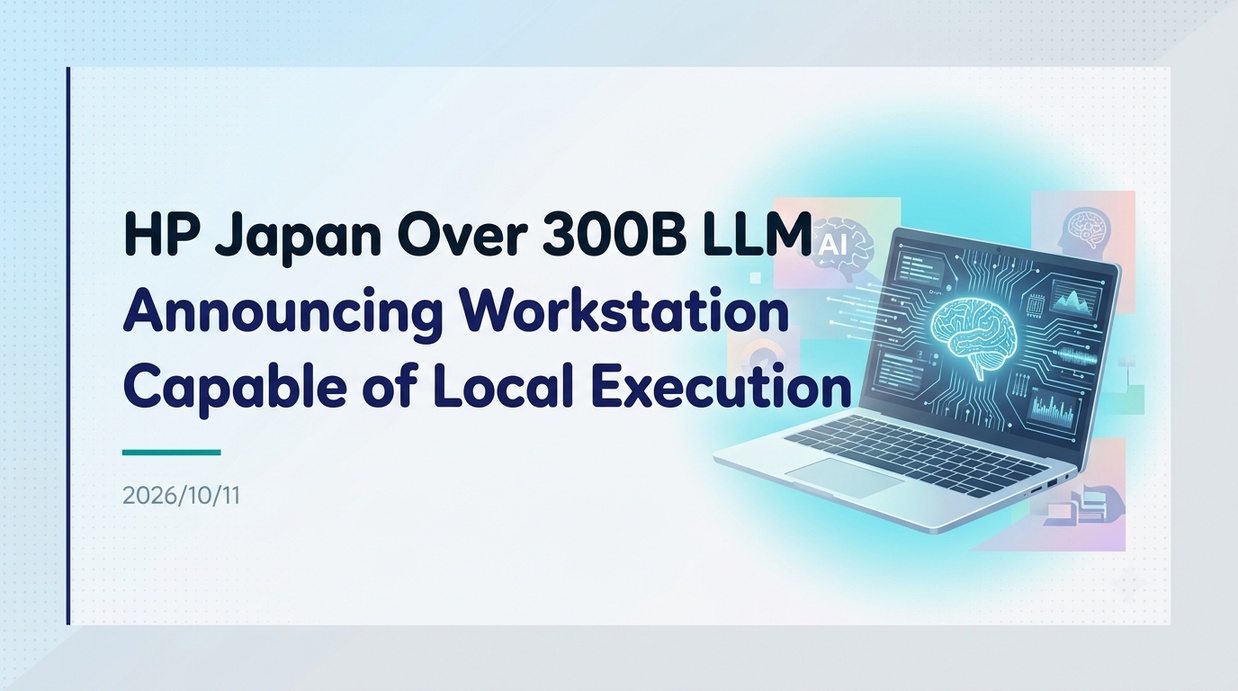
HP Japan has announced the “HP ZBook Ultra G3a 16 inch,” a mobile workstation capable of running a 3,000-billion-parameter large language model locally. This announcement is driven by the growing corporate need to eliminate cloud dependency—which brings rising inference costs and security concerns—and to process advanced AI agents and design workflows at high speeds on-device.
- Key points of the events and overview of product announcements
- Strengths in Hardware Specifications and Local Processing Performance
- The Cost and Security Barriers Faced by Cloud-Based AI
- Practical Application and Impact on Engineering Operations
- Comparison with existing systems and the advantages of a hybrid architecture
- Future Outlook and Key Points to Watch in the Enterprise Market
Key points of the events and overview of product announcements
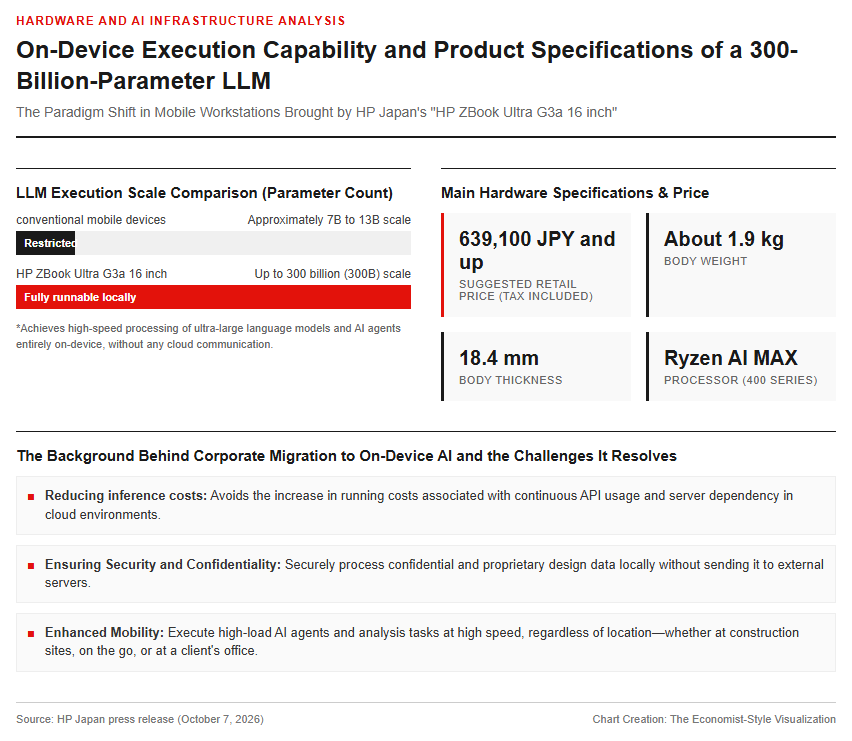
On October 7, 2026, HP Japan Inc. announced the “HP ZBook Ultra G3a 16 inch,” a new mobile workstation powered by AMD Ryzen AI MAX PRO 400 series processors, and began sales on the same day. The standout feature of this product is its ability to run large language models (LLMs) with up to 300 billion (300B) parameters—previously considered impossible on mobile devices—in a fully local environment without relying on the cloud. The suggested retail price starts at 639,100 yen including tax. The device achieves a thin and lightweight mobile form factor weighing approximately 1.9 kg and measuring 18.4 mm in thickness, enabling full-scale AI development and high-load analysis work anywhere, whether on the go, at a construction site, or at a client’s office. As corporate adoption of generative AI shifts from mere experimentation to full-scale implementation in actual business operations, it is attracting significant attention as a product that provides an environment for high-speed local processing of large-scale data and AI agents. Please refer to the exterior image below.
Strengths in Hardware Specifications and Local Processing Performance
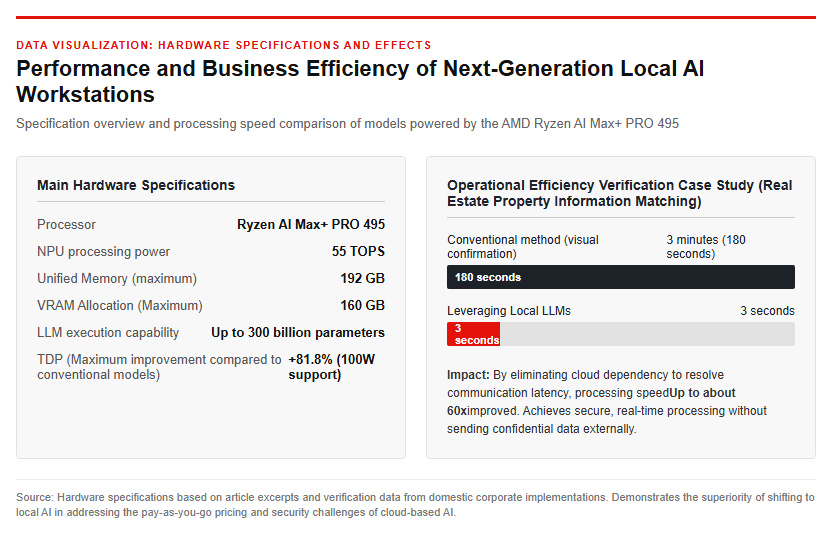
The product’s exceptional local AI processing capabilities are built on an innovative architecture achieved through close collaboration with AMD. It features up to an AMD Ryzen AI Max+ PRO 495 processor, integrating an NPU (Neural Processing Unit) capable of 55 TOPS of processing performance. Furthermore, it is equipped with up to 192GB of unified memory, allowing up to 160GB of it to be allocated to the graphics side as VRAM (video memory). This makes it possible to simultaneously process massive AI models and handle advanced multitasking that could previously only be managed by traditional desktop workstations. Additionally, it features an advanced 100W-compatible cooling design that boosts the Thermal Design Power (TDP) by up to 81.8% compared to previous models. The power supply includes a compact, lightweight 180W USB-C adapter incorporating Gallium Nitride (GaN) technology.
The key points of the main hardware specifications and compatible software are as follows.
- Processor and AI Platform: Up to AMD Ryzen AI Max+ PRO 495 with built-in 55 TOPS NPU
- Memory architecture: Up to 192GB unified memory (up to 160GB VRAM allocation)
- Execution Capability: Local inference for up to 300-billion-parameter LLMs and concurrent AI agent processing
- Main supported applications: Autodesk Revit 2027, Autodesk 3ds Max, Chaos Enscape
Challenges of Cloud Dependency and the Background of the Local AI Shift
The Cost and Security Barriers Faced by Cloud-Based AI
In recent years, while the adoption of generative AI has progressed in many companies, challenges regarding relying entirely on cloud-based AI services have come to light. The first barrier is the pay-as-you-go inference costs that swell depending on the frequency of model usage and the amount of data. As the scale of use expands, an increasing number of cases show that cloud API costs are putting pressure on fixed expenses. The second barrier is communication latency, which acts as a bottleneck in design verification and image analysis that require real-time performance. Furthermore, the most critical challenge is ensuring information security and data privacy. Sending architectural and manufacturing CAD data, financial and medical personal information, and corporate trade secrets to a public cloud entails the risk of data leaks and the risk of violating various regulations such as the GDPR. Against this backdrop, transitioning to a local LLM environment that can safely operate AI while keeping confidential data within internal networks and devices has become an urgent necessity.
Practical Application and Impact on Engineering Operations
Setting up a local LLM environment brings dramatic transformations to workflows in engineering fields such as architecture, manufacturing, and software development. Because there is no round-trip communication with the cloud, response times to prompts are significantly improved, enabling complex code generation using AI agents and automated checks of design data to be completed instantly. In fact, in a deployment verification conducted by a Japanese company, visual confirmation work for matching real estate property information—which used to take 3 minutes per item—was reduced to just 3 seconds through the use of a local LLM, demonstrating up to approximately a 60-fold increase in operational efficiency. By using this unit, highly skilled professionals can safely and comfortably receive assistance from generative AI from any location without having to export data outside the company. Below is an overview of how AI is utilized in engineering settings.
The main use cases expected to improve operational efficiency are as follows.
- Architecture and Civil Engineering: Local AI Analysis and Real-Time 3D Rendering of BIM/CAD Data
- Manufacturing Engineering: Automated Verification of Design Documents and Extraction of Structured Data from Specifications
- Software Development: Secure Code Completion in a Local Environment Referencing the Internal Codebase
Comparison with Existing Technologies and Future Prospects of On-Device AI
Comparison with existing systems and the advantages of a hybrid architecture
For local inference of conventional ultra-large-scale LLMs (ranging from billions to tens of billions of parameters or more), large desktop PCs with multiple expensive discrete GPUs installed in large chassis or dedicated data center servers have been indispensable. In contrast, the “HP ZBook Ultra G3a 16 inch” is innovative in that it leverages a unified memory architecture to achieve an LLM execution environment on the scale of 300 billion parameters within a standalone 1.9 kg mobile chassis. Furthermore, when compared to public cloud services, it boasts high availability, maintaining stable offline operation even during network outages. As for future enterprise AI strategies, a “hybrid AI” configuration—using cloud AI for large-scale processing that requires advanced and universal intelligence, and allocating local AI for highly confidential routine tasks and processes requiring immediacy—is expected to take root as the optimal solution.
Future Outlook and Key Points to Watch in the Enterprise Market
This release of high-performance mobile workstations by HP Japan symbolizes the accelerating trend of “AI device implementation (on-device AI / local LLM)” spanning from 2026 to 2027. For enterprises to elevate AI from a mere tool for trial and error into a foundation that generates tangible business results, a hardware environment capable of running AI agents securely and at high speeds on the device side is indispensable. To enhance maintainability for IT departments, thoughtful design features conscious of extending device longevity, such as a simplified keyboard replacement design, have also been implemented. Moving forward, it is anticipated that an era will arrive where “each and every individual carries a large-scale LLM in their pocket or bag” across various business settings, starting with regulated industries such as legal, medical, financial, and manufacturing. With the maturation of local AI technology, it is certain that both work flexibility and productivity will dramatically improve.
Reference page
- [HP Japan Press Release] https://prtimes.jp/main/html/rd/p/000000200.000068112.html
[#HPJapan #Workstations #LocalLLM #GenerativeAI #AMD #ZBook #AITech #MobileWorkstations]

コメント