On October 9, 2026, an accident occurred at the construction site for anti-terrorism facilities at Tohoku Electric Power’s Onagawa Nuclear Power Plant Unit 2, in which a worker fell from scaffolding approximately 25 meters high and died. Underlying this incident are the full-scale progression of large-scale construction work based on strict safety standards, as well as challenges regarding occupational safety management and securing personnel at construction sites.
- Circumstances of the Accident and Details Revealed at the Scene
- Background of Construction and Schedule Revision for Specific Severe Accident Countermeasure Facilities
- Safety Harness Operation and Accident Prevention Measures for Working at Heights
- The Impact of the Multi-Layered Subcontracting Structure in the Construction Industry on Safety Management
- The Worsening Shortage of Skilled and Specialized Talent in the Nuclear Energy Sector
- Ensuring Reliable Construction and Future Focus Toward Restart
Circumstances of the Accident and Details Revealed at the Scene
Around 9:40 a.m. on October 9, 2026, an emergency 119 call was made reporting that “a worker has fallen from scaffolding and is unable to move” on the premises of Tohoku Electric Power’s Onagawa Nuclear Power Plant, located in Onagawa Town and Ishinomaki City, Miyagi Prefecture. The accident occurred at a construction site near the reactor building of Onagawa Nuclear Power Plant Unit 2. The victim was Seiya Iwakaku, a 36-year-old company employee from Ishinomaki City working for a partner company. He was rushed to a hospital in Ishinomaki City in an unconscious state, but his death was later confirmed.
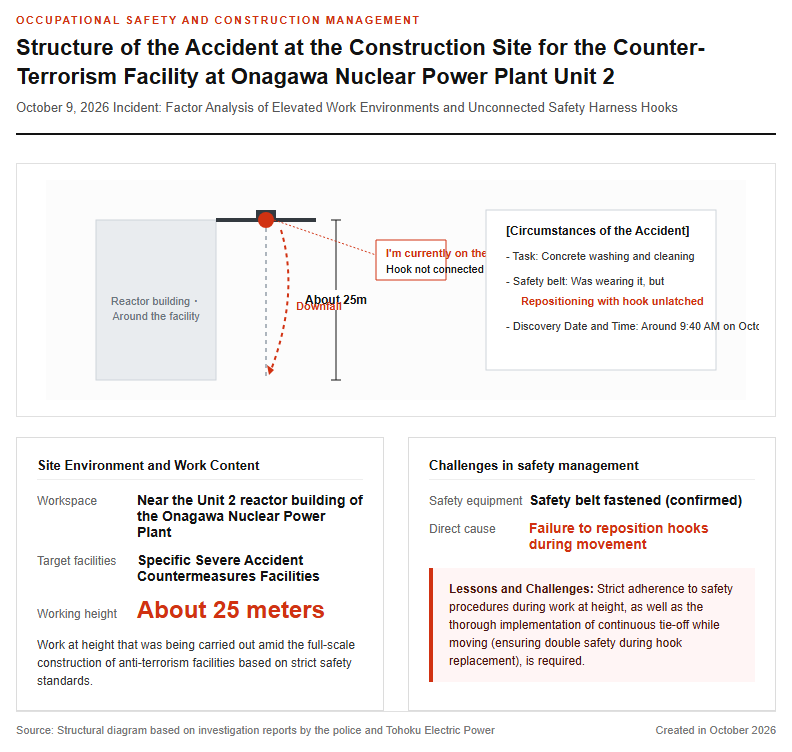
At the time of the accident, Mr. Iwakaku was engaged in construction work for a specific significant accident management facility—which serves as a counter-terrorism facility for Unit 2—and was performing concrete washing and cleaning work at a height. Mr. Iwakaku is believed to have fallen from scaffolding approximately 25 meters high. Investigations by the police and Tohoku Electric Power have revealed that while he was wearing a safety belt to prevent falls during the work, the safety belt’s hook was not secured to the scaffolding because he was in the process of moving his working position. At the site, a detailed investigation into the cause of the accident is being conducted by the police, and questions are once again being raised regarding safety management procedures for work at height and the thorough implementation of hook-switching operations during movement.
The following figure shows an image of the area surrounding the facility where the accident occurred.
Background of Construction and Schedule Revision for Specific Severe Accident Countermeasure Facilities
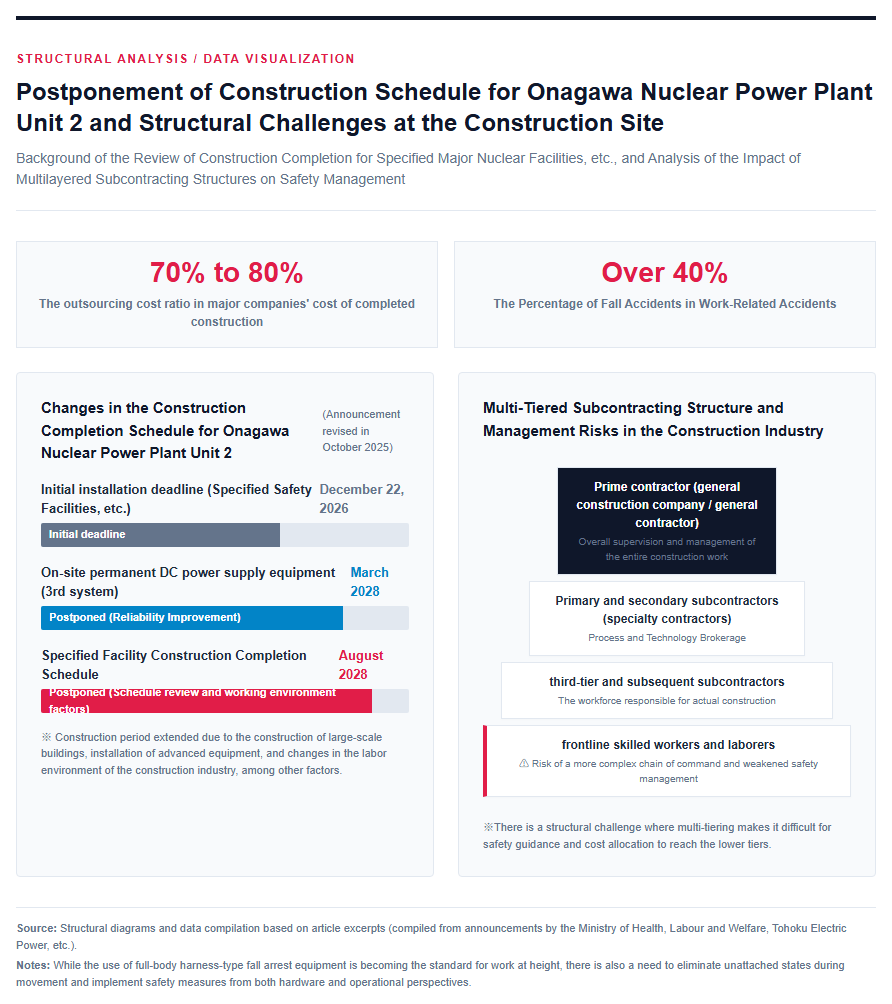
The Specific Serious Accident Countermeasure Facility (Tokuju Facility), which was the setting of the accident, is vital equipment whose installation was mandated by the new regulatory standards enacted in response to the 2011 Fukushima Daiichi Nuclear Power Station accident. To prevent the reactor containment vessel from being damaged by large aircraft collisions or terrorism, it is equipped with the function to remotely depressurize and cool the inside of the reactor pressure vessel. Under the new regulatory standards, installation is required within five years from the approval of the construction plan for the main facility, and the initial installation deadline for Onagawa Nuclear Power Station Unit 2 was set for December 22, 2026.
However, as a result of carefully examining the impact on work processes—such as the determination of construction specifications associated with large-scale building construction and advanced equipment installation, as well as recent changes in the labor environment within the construction industry—Tohoku Electric Power announced a revision to the completion schedule in October 2025. The completion date for the specially designated safety facilities has been postponed to August 2028, and the completion date for the permanent on-site DC power supply equipment (third system) additionally installed to improve reliability has been postponed to March 2028. While Onagawa Nuclear Power Plant Unit 2 itself is taking steps toward a restart following safety countermeasure work, balancing on-site safety and reliable construction management has become an extremely critical challenge as large-scale construction work, including the specially designated safety facilities, continues over the long term.
Safety Harness Operation and Accident Prevention Measures for Working at Heights
Among industrial accidents at construction sites, fall accidents account for more than 40% of all fatalities, prompting both the Ministry of Health, Labour and Welfare and the Labour Standards Inspection Offices to call for vigilance as a top-priority countermeasure. Particularly in work at height, the 2019 revision of the Ordinance on Industrial Safety and Health made the wearing of full-harness-type fall arrest equipment mandatory in principle, and following a transitional period, the use of compliant equipment has been thoroughly enforced. However, at actual work sites—such as during movement or scaffolding reconfiguration—there is always a lurking risk of accidents happening in the brief moment when workers unhook their safety belts to move.
In past construction accidents at other power plants, deviations from basic operational practices—such as failure to thoroughly follow work procedures, inadequate assignment of safety guides, and the presence of blind spots—have been cited as causes. In this accident as well, although the worker was wearing a safety belt, it was not hooked to the scaffolding during movement, leading to a fatal result. To prevent accidents during work at height, it is essential to eliminate unhooked states when switching using twin-lanyard (double-hook) systems, implement structural protective measures for the scaffolding itself (such as leading-edge handrail installation methods and expanded protective netting), and firmly establish training programs that enhance the safety awareness of every single worker. As large-scale construction projects accelerate within power plants, there is a pressing need to continuously implement effective safety measures from both hardware and software perspectives.
Structural Factors Surrounding Nuclear Power Plant Restarts and Future Outlook
The Impact of the Multi-Layered Subcontracting Structure in the Construction Industry on Safety Management
When examining the background of the accident, it is impossible to avoid the multi-layered subcontracting structure deeply rooted in Japan’s construction industry. In the construction work for large plants and nuclear power plants, a general contracting company (general contractor) acts as the prime contractor to supervise the entire construction work, under which specialized construction contractors—such as primary, secondary, and tertiary subcontractors—are linked in multiple tiers to carry out the work. Subcontracting costs account for 70% to 80% of the completed construction costs of major companies, and the majority of the actual on-site work is carried out by skilled laborers from subcontractor companies.
While this multilayered structure efficiently brings together diverse specialized technologies, it also has the downside that the more subcontractor tiers there are, the harder it is for construction management and safety oversight to reach the front lines. With more intermediaries, safety management and labor costs tend to become opaque, and it has also been pointed out that adequate funds for safety measures and fair wages fail to trickle down to frontline workers. Additionally, the complex chain of command on-site increases the risk that verifying work procedures and conducting hazard prediction activities (KY activities) will become hollowed out. In nuclear power plant construction sites where safety is paramount, how to build and maintain a consistent safety management system—ranging from the primary contractor down to the lowest-tier subcontracted workers—remains a structural challenge for the entire construction industry.
The following diagram illustrates the multi-layered management structure and safety measures at a construction site.
The Worsening Shortage of Skilled and Specialized Talent in the Nuclear Energy Sector
Another structural factor making safety management at construction sites even more difficult is the severe labor shortage underway in the nuclear sector and the construction industry as a whole. According to a survey by the Japan Atomic Industrial Forum, about 70% of nuclear-related companies reported feeling that securing human resources is difficult, with a notable shortage of electrical, mechanical, and civil engineering technicians and skilled laborers responsible for plant design, construction, and maintenance. The reorganization of nuclear-related departments in universities and the decline of young researchers and faculty members aged 40 and under are also progressing, flashing yellow lights for the transfer of on-site technology.
Even in the construction industry as a whole, aging is progressing markedly, with the proportion of young workers aged 15 to 29 remaining below 10%, while older workers aged 50 and over exceed 30%. A shortage of skilled workers at nuclear power plant construction sites, which require advanced skills, increases the opportunities for inexperienced workers to engage in hazardous high-altitude work and complex tasks. The tighter work schedules and increased burden per person resulting from labor shortages lead to a decline in concentration and the shortcutting of procedures, which directly drives up the risk of occupational accidents. Strengthening the human resource foundation from a medium- to long-term perspective—such as through industry-academia-government collaborative training programs and accepting human resources from other fields—has become an urgent task.
Ensuring Reliable Construction and Future Focus Toward Restart
The restart of Onagawa Nuclear Power Plant Unit 2 and the development of related facilities play a crucial role in improving Tohoku Electric Power’s earnings, ensuring a stable regional power supply, and furthering the nation’s decarbonization policy. Although the economic and environmental benefits brought by the restart—such as the reduction of thermal fuel costs and carbon dioxide emissions—are significant, they are all predicated on the “ensuring of unwavering safety.” The worker fatality accident that occurred this time could become a factor that raises concerns among local municipalities and residents regarding the safety management system.
The biggest focus moving forward is whether Tohoku Electric Power and the construction contractors can promptly implement effective recurrence prevention measures, based on the investigation into the cause by the police and the Labour Standards Inspection Office. In the schedule management of safety countermeasure construction, including facilities for addressing specific severe accidents, it is essential to thoroughly re-establish an on-site culture that prioritizes worker safety above all else. Furthermore, improvements in both hardware and software aspects are strongly demanded, such as clarifying the lines of responsibility within the multi-tiered subcontracting structure, improving the working environment for workers, and introducing safety monitoring systems that leverage the latest technology. Toward regaining the trust of the local community and achieving sustainable safe operations, the continued sincere efforts of the electric power company and the construction industry working as one are being closely watched.
Reference Page
- [Revision of Construction Completion Schedule for “Specific Severe Accident Management Facilities” and “On-site Permanent DC Power Supply Facilities (3rd Train)” at Onagawa Nuclear Power Station Unit 2 | Tohoku Electric Power] https://www.tohoku-epco.co.jp/news/atom/1247642_2549.html
[#OnagawaNuclearPowerPlant #OccupationalSafety #SpecificSevereAccidentManagementFacilities #TohokuElectricPower #ConstructionIndustry]

コメント