
On October 2, 2026, the Kanto District Transport Bureau of the Ministry of Land, Infrastructure, Transport and Tourism issued a 20-day vessel suspension order to Tokai Kisen for repeated, serious violations of laws and regulations, such as operating vessels under the influence of alcohol and navigating with gangway doors left unclosed. Behind this are long-neglected practices of drinking on board, the hollowed-out enforcement of alcohol testing, and a severe lack of a safety management system.
- 20-Day Suspension Order for Vessel Operations and Affected Routes (Key Points of the Event)
- Successive Violations of Laws and Regulations and Hollowed-Out Safety Management
- Alternative schedule through the deployment of other companies’ vessels as part of a group-wide all-out effort
- Concerns Regarding Daily Life, Logistics, and Healthcare, and the Struggles of Local Communities
- Recurrence Prevention Measures Through Technology Adoption and Organizational Restructuring
- Renewal of Corporate Culture and Future Focus Points (Future Developments and Key Points to Watch)
20-Day Suspension Order for Vessel Operations and Affected Routes (Key Points of the Event)
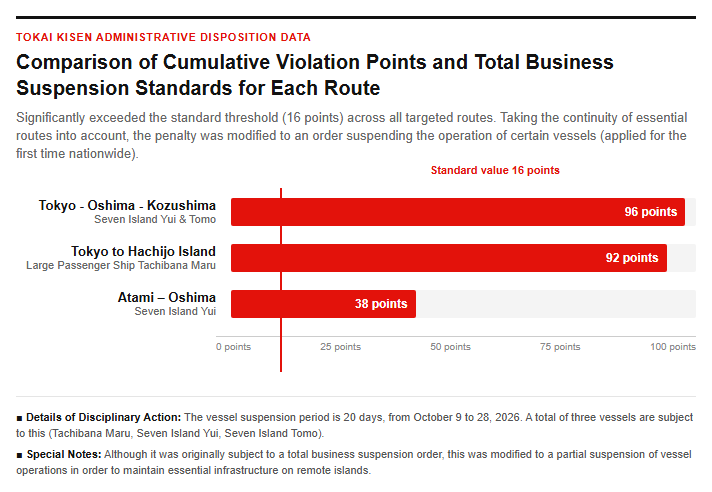
On October 2, 2026, the Kanto District Transport Bureau of the Ministry of Land, Infrastructure, Transport and Tourism issued an order to Tokai Kisen Co., Ltd. to suspend the use of certain vessels pursuant to Article 17 of the Marine Transportation Act. The suspension period is 20 days, from October 9 to October 28, 2026. The vessels subject to the suspension order are a total of three out of the five main ships operated by the company on the Izu Islands routes: the large passenger ship Tachibana Maru (5,681 tons), and the high-speed jet foils Seven Island Yui (176 tons) and Seven Island Tomo (164 tons). The affected routes span three systems: the Tokyo–Hachijojima route, the Tokyo–Oshima–Kozushima route, and the Atami–Oshima route. The company’s cumulative demerit points across the respective routes reached 92, 96, and 38 points, vastly exceeding the standard threshold of 16 points, which originally placed the company in a position subject to a full business suspension order. However, in consideration of the continuity of these essential lifeline routes—which serve as the only regular maritime transportation for the residents of the Izu Islands—and contingent upon the effectiveness of the improvement plan submitted by the company, the disposition was modified to the suspension of specific vessels. This marks the first nationwide application of the vessel use suspension order system, which was established in April 2022. Changes to the operational schedule resulting from this disposition are as follows.
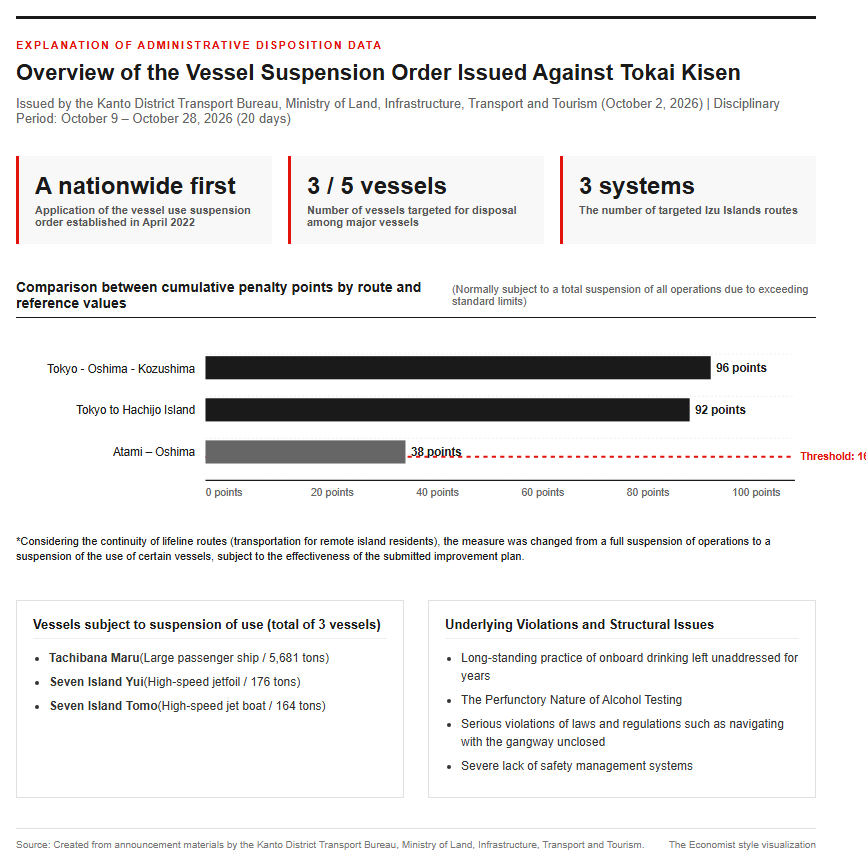
- Suspension period: 20 days from 0:00 AM on October 9, 2026, to October 28
- Suspended vessels: A total of 3 ships, including the Tachibana Maru, Seven Island Yui, and Seven Island Tomo
- Vessels continuing operation: Two ships, the large passenger ship Salvia Maru and the high-speed jet ship Seven Island Tairyo.
Successive Violations of Laws and Regulations and Hollowed-Out Safety Management
The direct cause of the administrative disposition was extremely malicious violations of laws and regulations that had been repeatedly committed over many years. On New Year’s Day, January 1, 2026, a mass drinking incident occurred aboard the large passenger ships Salvia Maru and Tachibana Maru, in which multiple crew members, including the captain and crew members on navigational watch, drank alcohol and assumed watchkeeping duties without undergoing alcohol testing. It has been revealed that the estimated breath alcohol concentration after drinking significantly exceeded the standard limit of 0.15 mg. Furthermore, on April 25, 2026, aboard the jetfoil Seven Island Yui, a proxy alcohol test took place in which a second officer, fearing the discovery of the previous day’s drinking, had a third officer take the alcohol test on their behalf. On a daily basis, it had also become routine to create false records by entering zero for test results without conducting tests for crew members who self-reported no drinking habits. In addition, in November and December 2025, a serious safety management regulation violation occurred in which the large passenger ship Salvia Maru sailed between Tokyo and Oshima, and between Shikinejima and Kozushima, without closing the boarding gates. An on-site inspection by the Ministry of Land, Infrastructure, Transport and Tourism identified a total of 13 violations, including the falsification of pre-departure inspection records and failure to report accidents, and orders to dismiss the safety general manager and operation manager had been issued as a prior measure in August 2026.
Alternative Operation Plans and the Ripple Effects on Island Life
Alternative schedule through the deployment of other companies’ vessels as part of a group-wide all-out effort
To compensate for the decline in transport capacity during the suspension period of three vessels, Tokai Kisen will operate alternative services on a special timetable from October 9 to October 28, 2026. An unusual operational structure has been established, temporarily deploying vessels from related shipping companies in addition to the company’s own operational large passenger ship Salvia Maru and high-speed jetfoil Seven Island Tairyo. For the Tokyo-Oshima route, Ogasawara Kaiun’s large passenger ship Ogasawara Maru will be deployed, operating as an alternative service available at the same second-class fare as regular sailings. Additionally, the cargo-passenger ship Kuroshio Maru, operated by Izu Shoto Kaihatsu, will be assigned as the overnight passenger ship on the Tokyo-Oshima-Kozushima route. For the Tokyo-Miyakejima-Hachijojima route, which is normally served by the Tachibana Maru, the company aims to maintain passenger transport by reassigning the Salvia Maru. However, regarding cargo transport, delivery delays of approximately one to three days compared to the regular timetable are expected due to changes in large ship operations. Tokai Kisen is currently notifying passengers with reservations during the applicable period of changes to their departure times individually via SMS and phone. The main substitute vessel allocations for each route are as follows.
- Tokyo–Oshima Route: Ogasawara Kaiun – Ogasawara Maru
- Tokyo – Oshima – Kozushima Route (Overnight): Izu Islands Development Kuroshio Maru
- Tokyo – Miyakejima – Hachijojima Route: Tokai Kisen Salvia Maru
Concerns Regarding Daily Life, Logistics, and Healthcare, and the Struggles of Local Communities
The regular shipping routes connecting the Izu Islands and the mainland are used by approximately 600,000 people annually, serving as an irreplaceable lifeline that supports the daily lives of island residents, the supply of daily necessities, and medical visits. In response to the 20-day suspension order for ship operations, voices of anger and deep anxiety have emerged one after another from residents and business owners in the served islands. Hachijo Town Mayor Tomoya Yamashita expressed concern that disruptions in the supply of daily necessities and foodstuffs would have a serious impact on residents’ lives, and strongly demanded responsible and safe operation as a public transportation service. A business owner in Kozushima who handles fresh fish shipping and operates a supermarket is concerned about the blow to the local fishing industry as a whole due to stagnation in purchasing and shipping, and transport operators have also expressed urgent anxiety over delays in the arrival of pharmaceuticals and regular freight. In addition, on remote islands prone to isolation such as Mikurajima, risks have been pointed out regarding restrictions on transportation means for patients who make regular visits to specialized hospitals on the mainland. Tokyo Governor Yuriko Koike emphasized the heavy social mission of the island shipping routes at a regular press conference, expressing that the disposition was extremely regrettable. The Tokyo Metropolitan Government has issued a document to the company instructing it to rebuild its safety management system and ensure thorough alternative transportation.
Formulation of Preventive Measures and Challenges for Future Reconstruction
Recurrence Prevention Measures Through Technology Adoption and Organizational Restructuring
Following a series of scandals, Tokai Kisen established a special investigation committee composed of external experts in August 2026, and has proceeded with cause analysis and the verification of corrective measures. Starting June 29, 2026, the company introduced facial recognition-based alcohol testing systems across all its vessels. This thoroughly ensures identity verification while automatically recording and shore-managing measurement data, revamping the system into one where skipping tests or making false entries is impossible. Additionally, the role of Safety Director, which was previously held concurrently by the General Manager of the Marine Department, has been independently separated, strengthening safety monitoring functions as an organization directly under the president. Furthermore, a newly established Safety Management Enhancement Committee, chaired by the president, has started tightening company-wide basic rules regarding alcohol consumption and implementing continuous safety education for all crew members. Regarding the confirmation of side port closure upon departure, the procedure has also been changed to transition to departure operations after confirming closure between on-site locations via walkie-talkie and then contacting the bridge. Regular unannounced onboard audits by shore-based employees are also being conducted.
Renewal of Corporate Culture and Future Focus Points (Future Developments and Key Points to Watch)
It is pointed out that at the root of this scandal lay a corporate environment protected by monopolistic routes, the entrenchment of shortcut work accompanying tight schedules and crew shortages, and an antiquated onboard culture. In particular, the practice of drinking alcohol on board during the New Year, such as sacred sake (omiki) and New Year’s parties, had been overlooked for years with the management’s awareness, highlighting a paralysis of compliance awareness throughout the organization. Moving forward, the biggest focus will be on whether the newly introduced hardware-based prevention systems avoid becoming a dead letter and whether an awareness of safety-first takes root down to the frontline workers. The Tokyo Metropolitan Government and the Kanto District Transport Bureau of the Ministry of Land, Infrastructure, Transport and Tourism held the first meeting of the Improvement and Reform Promotion Council on October 15, 2026, with the company also participating, and plan to regularly monitor and evaluate the implementation status of recurrence prevention measures. Continuous monitoring and a strict improvement process by the administration and the local community are required to see if the company can regain its lost social trust and achieve true revitalization as a public transportation lifeline that protects the lives and livelihoods of remote island residents.
Reference Page
- [Regarding Initiatives to Ensure Safe Operations and Restore Trust – Tokai Kisen] https://www.tokaikisen.co.jp/news/826826/
【#TokaiKisen #MinistryofLandInfrastructureTransportandTourism #AdministrativeDisposition #AlternativeOperation #IslandTransportation #SafetyManagement】

コメント