Regarding public construction projects ordered by Miyakojima City, Okinawa Prefecture, it has been revealed that there have been 12 cases in the past five years where the minimum price limit and the actual winning bid price completely matched down to the exact yen. Against the backdrop of a corruption scandal in which a municipal official was arrested on suspicion of bribery, citizens and the city assembly are subjecting authorities to rigorous scrutiny over structural flaws that cancel out random coefficients and the illicit leakage of bidding information.
- 12 Cases of Exact Matches Between Minimum Limit Prices and Winning Bid Amounts Found in the Past 5 Years
- Arrest of a City Employee on Suspicion of Bribery and Allegations of Receiving 500,000 Yen in Cash
- Lottery coefficients and probabilistic barriers determined on a millisecond basis
- Lax Information Management Systems Leading to Official Bid-Rigging and Methods of Cost Estimation Leaks
- Review of Randomization Coefficients and Introduction of a New System Starting in April 2025
- Verification of Past Orders by a Third-Party Committee and Future Focus
12 Cases of Exact Matches Between Minimum Limit Prices and Winning Bid Amounts Found in the Past 5 Years
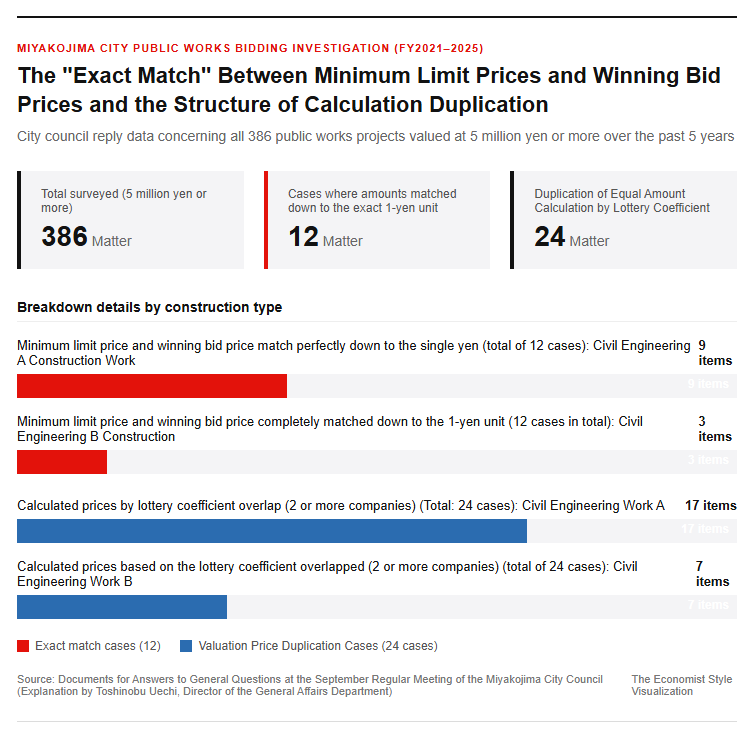
During the general inquiries at the September regular session of the Miyakojima City Assembly convened in October 2026, shocking facts regarding public works ordered by the city came to light. According to the survey results explained by Toshinobu Uechi, Director of the General Affairs Department of the city administration, in response to a question by City Councilman Hitoshi Oshiro, out of a total of 386 public works projects valued at 5 million yen or more conducted over the past five fiscal years from fiscal 2021 to fiscal 2025, there were a total of 12 cases where the minimum limit price set by the city and the winning bid price of the contractor matched down to the exact yen. The breakdown is 9 cases for Civil Engineering A projects and 3 cases for Civil Engineering B projects. Furthermore, a total of 24 bids (17 for Civil Engineering A and 7 for Civil Engineering B) were confirmed in which two or more contractors had matching calculated prices obtained by multiplying the minimum limit standard price by 10 different lottery coefficients. In public works bidding, winning a contract at the exact same amount as the minimum limit price, which is kept undisclosed in advance, occurs with a statistically extremely low probability. Strong distrust has been expressed by the city assembly over whether healthy competition may have been hindered, and concerns are rising over the collapse of an environment where local contractors responsible for regional infrastructure can bid fairly. This has become a serious situation that fundamentally questions the fairness and transparency of the administration. Please refer to the figure below.
Arrest of a City Employee on Suspicion of Bribery and Allegations of Receiving 500,000 Yen in Cash
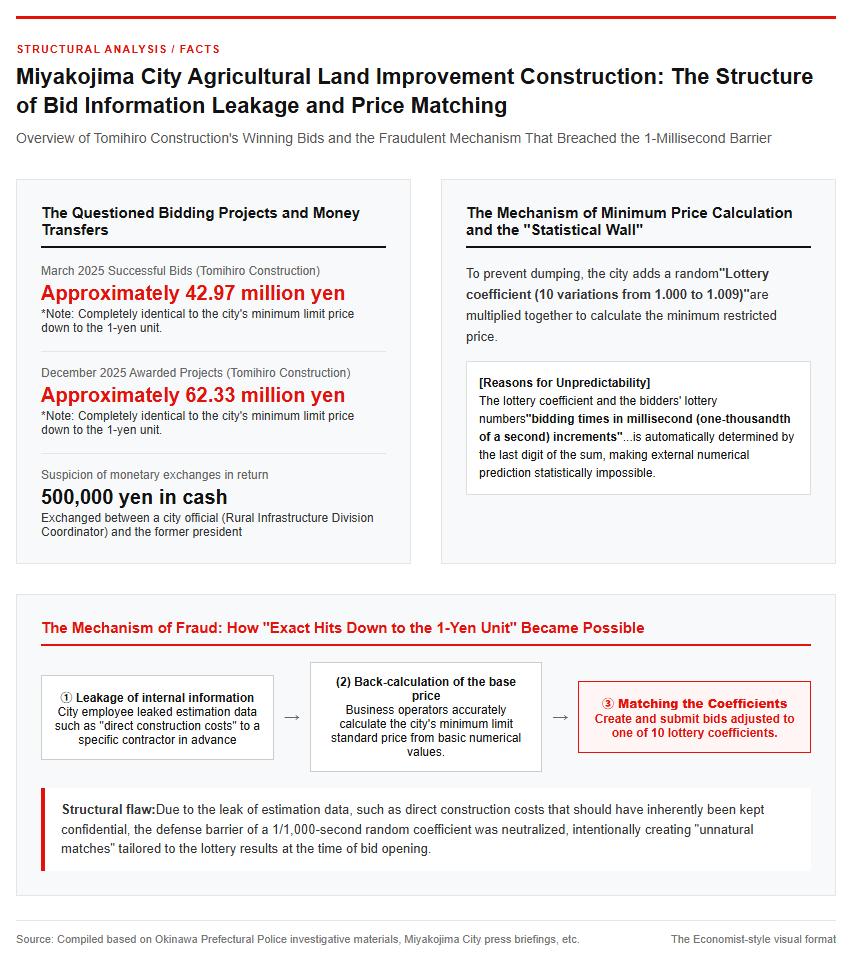
Behind this suspicious bidding incident lies a corruption case involving senior municipal officials. On July 22, 2026, the Second Investigative Division of the Okinawa Prefectural Police arrested Tomihiro Shimoji, a city official, on suspicion of bribery for allegedly accepting cash in exchange for leaking bidding information regarding farmland infrastructure improvement projects commissioned by Miyakojima City to a specific contractor. At the time, Shimoji held the position of coordinator in the Rural Infrastructure Division, and is suspected of having provided confidential information directly tied to the calculation of the minimum price limit, such as estimation sheets, to a specific construction company around August 2025. Simultaneously, Yu Tominaga, the former president of “Tomihiro Construction,” which received the information, was also arrested on suspicion of bribery. According to the prefectural police investigation, Tomihiro Construction won the bids for farmland infrastructure improvement projects for approximately 42.97 million yen in March 2025 and approximately 62.33 million yen in December of the same year, with both winning bids matching the city’s minimum price limit down to the exact yen. A cash bribe of 500,000 yen was reportedly exchanged as a reward, and on the day of the arrests, the city hall was raided and related documents and devices were seized. The reality of monetary exchanges and confidential information leaks abusing official authority has fundamentally shaken public trust in municipal administration.
The Background Behind Unnatural Bidding Accuracy and the Mechanism of the Current Bidding System
Lottery coefficients and probabilistic barriers determined on a millisecond basis
The reason why predicting the minimum limit price down to the exact yen in public works bidding in Miyako City is viewed as abnormal stems from the city’s calculation system. The city sets a minimum limit price to prevent dumping, and its calculation process consists of two stages. First, the city calculates the base minimum limit reference price based on estimation data, and multiplies it by one of 10 lottery coefficients ranging from 1.000 to 1.009, which are randomly determined at the time of bid opening. This lottery coefficient is automatically determined by the last digit of the sum of the “confirmed lottery numbers”—which are calculated by adding the millisecond-unit values of the bidding times recorded by the system to the arbitrary lottery numbers entered by the first and last bidding contractors. Because the bidding timing in millisecond units is unpredictable to anyone, it was considered a statistically nearly impossible barrier to intentionally target the figures from the outside. At a press roundtable in August 2026, Miyako City explained that this could theoretically occur if two conditions overlapped: (1) a match between the contractor’s estimate and the city’s reference price, and (2) the predicted match of the lottery coefficient; however, the unnaturalness remains striking and defies explanation unless internal information was leaked.
Lax Information Management Systems Leading to Official Bid-Rigging and Methods of Cost Estimation Leaks
Behind the neutralization of the lottery system, which should inherently be robust, lie remarkably lax information management within the administration and an organizational culture that fosters corruption. According to investigative sources and related materials, the arrested city employee is alleged to have disclosed breakdown statements and estimation data containing details such as the “direct construction costs” of the project to a specific contractor in advance. By obtaining these basic figures, such as the direct construction costs from the city side, the contractor was able to almost accurately reverse-engineer the minimum restriction reference price presented by the city. Building upon that, by calculating a bid amount tailored to one of the 10 existing lottery coefficients, it was possible to create a winning bid amount that matched the minimum restriction reference price down to the single yen, depending on the lottery result at the time of bid opening. Estimation data for public construction works is extremely confidential information with a high degree of secrecy, and it has been pointed out that the operational reality—where the responsible employee could meet with contractors alone and viewing privileges for electronic data were not appropriately controlled—facilitated the wrongdoing. The internal control failure of the organization, which overlooked preferential treatment toward certain contractors and long-standing personal collusion, is the fundamental cause that rendered the fair bidding system a hollow shell. For details on the mechanism, please refer to the diagram below.
Institutional Reforms to Restore Trust and Future Points to Watch
Review of Randomization Coefficients and Introduction of a New System Starting in April 2025
Following the series of uncovered misconduct and cases of unnatural exact matches, Miyakojima City has begun formulating concrete measures to prevent recurrence. The city issued a notice revising the administrative processing guidelines known as “Miya-Sokei Directive No. 436,” deciding to apply a new coefficient system to the minimum limit reference price records created on or after April 1, 2025. Under the conventional operation, the allocation of coefficient numbers used in calculations was somewhat limited, carrying the risk that specific patterns could be predicted. After the revision, numerical values from 1.000 to 1.009 will be systematically allocated to all numbers from 1 to 10, significantly enhancing randomness and changing the system to eliminate fraudulent predictions.
Moreover, requests from the local construction industry also influenced this system review. In July 2024, the Miyako branch of the Prefectural Construction Industry Association cited labor shortages, soaring material prices, and overtime restrictions due to work style reforms in requesting that the minimum limit price be raised to approximately 95% of the estimated price, alongside a substantive upward revision of the lottery coefficients. The city is promoting transparency in the operation of the system in order to achieve a balance between ensuring fair competition and maintaining a healthy business environment for local construction contractors.
Verification of Past Orders by a Third-Party Committee and Future Focus
Beyond institutional revisions, external verification is also underway to fully clarify the whole picture of the incident and drive organizational reform. Mayor Noboru Kakazu has finalized a policy to establish a “Third-Party Committee” consisting of three external experts, including lawyers and certified public accountants. Following the approval of the necessary budget bill at the regular session of the city council in September 2026, the committee will conduct an investigation and verification of all procurement operations over the past five years, with a deadline set for the end of March 2027 (Reiwa 9). The primary focus moving forward is to clarify whether there was organizational involvement or similar fraudulent activities in other past construction projects, rather than merely individual criminal acts by employees. However, it has also been pointed out that measures excessively increasing randomness lead to a “lottery-like” system that leaves winning bidders at the mercy of luck, which dampens the motivation of contractors possessing technical expertise and accurate cost-estimation capabilities. Mayor Kakazu has promised to uncover the wrongdoing while creating an environment where local companies can properly continue their business operations. Citizens and the related industry are closely watching the verification results of the Third-Party Committee and the direction of the municipal administration’s governance reform to see if a bidding system that truly rewards capable companies can be reconstructed.
Reference Page
- [Regarding the Bidding System of Miyakojima City] https://www.city.miyakojima.lg.jp/jigyousya/kensetsugyou/2026-0803-1405-40.html
【#MyakojimaCity #PublicWorks #MinimumPriceLimit #BiddingFraud #OfficialCollusion #AdministrativeReform】


コメント