US semiconductor giant Nvidia has announced a partnership with six major Wall Street financial institutions to build an AI compute infrastructure financing platform exceeding $500 billion. Behind this move is a situation where the explosively expanding construction and procurement costs for AI data centers are surpassing companies’ internal funds, increasing the necessity to financialize computing resources such as GPUs and attract third-party capital.
- 1-1 Background of the Establishment of the Massive Platform and Key Points of Events
- 1-2 Structural Transition from Traditional Equity Capital to Third-Party Capital
- 2-1 Project Finance Structure Secured by GPUs and Computing Resources
- 2-2 Concerns Over Circular Financing and the Duality of Risk Transfer
- 3-1 Financial Risks Surrounding Technological Obsolescence and Useful Life
- 3-2 Power and Packaging Constraints, Future Developments, and Key Points
1-1 Background of the Establishment of the Massive Platform and Key Points of Events
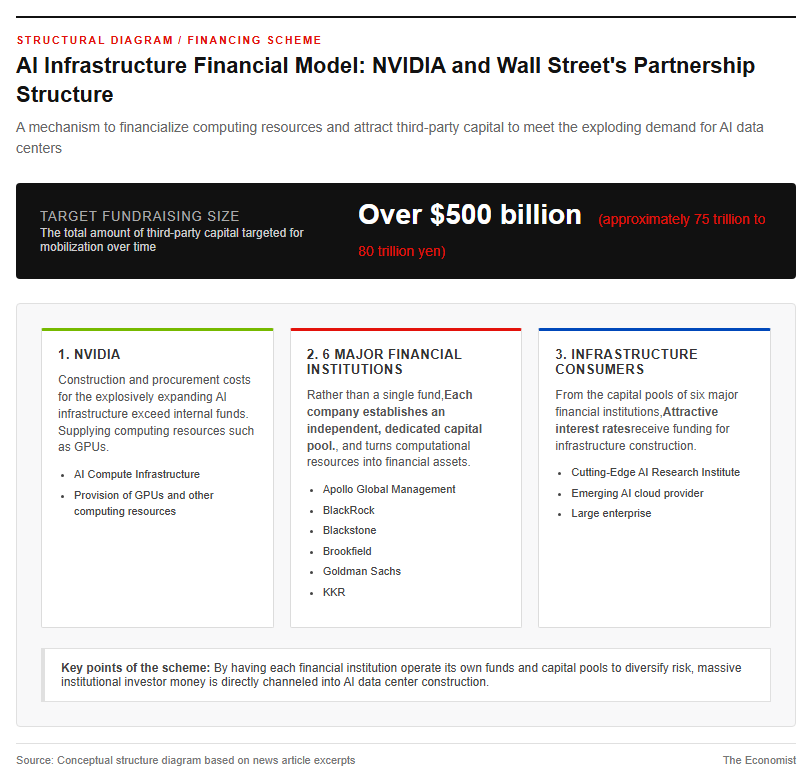
On August 10, 2026, NVIDIA signed a memorandum of understanding to establish an AI computing infrastructure financing platform with six major Wall Street asset managers: Apollo Global Management, BlackRock, Blackstone, Brookfield, Goldman Sachs, and KKR. The scale of third-party capital aimed to be mobilized through this framework will exceed $500 billion (approximately 75 trillion to 80 trillion yen) over time. Rather than creating a single joint fund, the structure involves each of the six firms establishing an independent, dedicated capital pool to provide infrastructure construction financing at attractive interest rates to cutting-edge AI research labs, emerging AI cloud providers, and large enterprises. As shown in the diagram below, a financial model that treats computing resources as independent assets is launching in earnest.
Nvidia CEO Jensen Huang emphasized that in AI, computation is revenue itself, and revealed a plan to transform computing infrastructure—built on graphics processing units (GPUs) and CUDA software—into an investable asset class for institutional investors worldwide.
1-2 Structural Transition from Traditional Equity Capital to Third-Party Capital
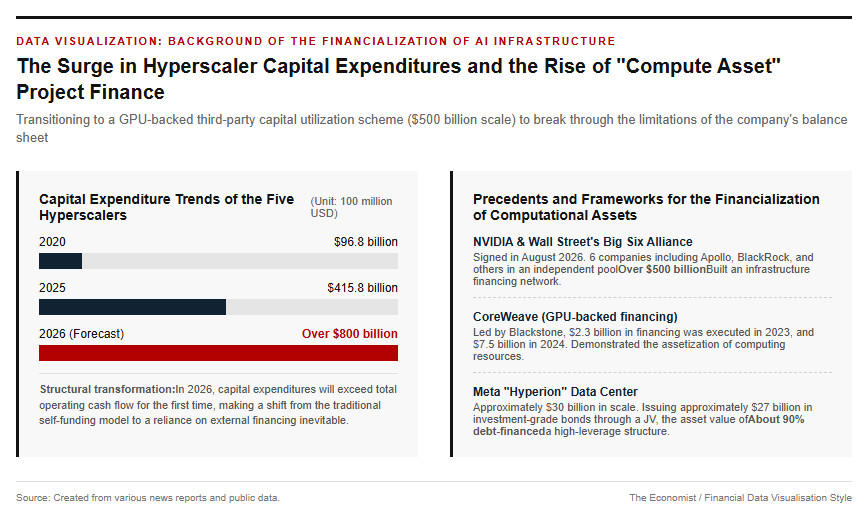
Why is such a large-scale financial platform needed now? The biggest factor is that the scale of funding required for AI infrastructure development has begun to exceed the capital-generating capacity of massive IT companies known as hyperscalers. Capital expenditures by the five companies—Microsoft, Alphabet, Amazon, Meta, and Oracle—are projected to surge from approximately $96.8 billion in 2020 to about $415.8 billion in 2025, and exceed $800 billion in 2026, marking the first time they will surpass total operating cash flow. The traditional investment model relying solely on internal balance sheets and cash on hand is reaching its limits. Furthermore, NVIDIA itself has steered away from the approach of supporting demand through direct investments in customer companies and toward a financial framework that has third-party capital assume credit risk. The aim is to alleviate customers’ purchasing funding constraints by leveraging external investor capital while avoiding direct risk underwriting on its own books, thereby balancing sales of its own products with the expansion of its ecosystem.
The Mechanism and Early Track Record of “Compute Asset” Financialization
2-1 Project Finance Structure Secured by GPUs and Computing Resources
The core of this initiative lies in applying project finance methods—which have traditionally been used for real estate, power plants, and toll roads—to computing resources such as GPUs and data centers. It is a structure in which the business is isolated within a special purpose vehicle (SPV), and the usage fees and contract revenues generated by the business serve as the repayment source. NVIDIA’s GPUs are valued for their high versatility and liquidity as collateral assets, as the CUDA common environment facilitates easy reallocation and repurposing across diverse AI models and operators. As actual preceding examples, AI cloud provider CoreWeave executed GPU-backed financing of $2.3 billion in 2023 and $7.5 billion in 2024, led by Blackstone. Furthermore, in Meta’s Hyperion data center project, valued at approximately $30 billion, about $27 billion in investment-grade bonds were issued through a joint venture, achieving a highly leveraged structure where approximately 90% of the asset value is funded by debt. The following image represents the overall picture of elevating computing assets into financial products.
2-2 Concerns Over Circular Financing and the Duality of Risk Transfer
Immediately following the announcement of this plan, some selling was observed in the stock market. This was because the market was wary of concerns regarding circular financing, in which a manufacturer’s involvement in arranging customer purchase funds inflates apparent sales. However, whereas illegal circular transactions in accounting refer to back-and-forth trades lacking substance, this mechanism does not constitute a fraudulent circular transaction, as actual products are delivered following rigorous screening by third-party investors. The design that protects Nvidia’s balance sheet from direct default risk is commendable. On the other hand, it must be noted that the risk has not disappeared, but has merely been transferred to third-party investors. If monetization through AI services is delayed and the repayment capacity of the borrowing cloud service providers declines, the correlated structure—in which a drop in the value of GPU collateral and a decline in Nvidia’s sales occur simultaneously—remains intact.
The Blind Spots Facing Compute Asset Finance and Future Developments
3-1 Financial Risks Surrounding Technological Obsolescence and Useful Life
Computing assets used as collateral for long-term debt have a unique vulnerability not found in roads or real estate. That is the rapid depreciation of value driven by the remarkable advancement of semiconductor technology. Since new generations of GPUs emerge on a roughly two-year cycle, a severe duration mismatch occurs with long-term debt that spans decades. Jeffrey Gundlach, CEO of DoubleLine Capital, harshly criticized the attempt to use semiconductors of unknown lifespan as collateral, comparing it to issuing long-term securities backed by bananas in a warehouse. In actual accounting practice, views are also divided, as Microsoft and Alphabet extended the useful life of their servers from four to six years to ease depreciation costs, whereas Amazon shortened it to five years in 2025 citing the acceleration of AI development. In the absence of an official used GPU price index, the lack of established yardsticks for assessing collateral value is emerging as a major issue within the financial system.
3-2 Power and Packaging Constraints, Future Developments, and Key Points
Even if a $500 billion funding framework is established, the actual expansion pace of AI data centers will be determined by the ability to deploy power grids and physical infrastructure. Concerns are high that gigawatt-scale grid connections, substation construction, and delays in procuring liquid cooling equipment could become bottlenecks. As a case in point, at the PORTS-Pike Technology Campus in Pike County, Ohio (an 8-gigawatt-scale project) led by SoftBank Group subsidiary SB Energy and leased by OpenAI under a 20-year contract, NVIDIA is moving to secure early access to physical infrastructure by providing a $1.5 billion direct investment and setting up to $105 billion in residual value guarantees. The key points to watch moving forward will be whether this memorandum of understanding transitions into a definitive legal agreement, and what interest rates and risk-sharing terms are established for the initial asset transactions. Whether AI computing resources establish themselves as independent infrastructure assets will become clear through future disclosures and market demand trends.
Reference Page
- [NVIDIA Press Release] https://prtimes.jp/main/html/rd/p/000000646.000012662.html
[#NVIDIA #AIInfrastructure #FundingPlatform #WallStreet #GPUFinance #DataCenter]

コメント