At an event held on October 8, 2026, Google Cloud announced “Gemini agents,” which understand business context and autonomously process complex tasks spanning several days. This development is driven by the rapid shift from traditional chat-based AI to workforce-style AI that directly executes business processes, as well as the growing importance of AI cost and governance management within enterprises.
- Key Points of the Event and Basic Functions as an “AI Colleague”
- Business Application Integration and Autonomous Task Planning and Execution Mechanism
- Cost Optimization Through Multi-Model Support and Smart Routing
- Verified Data from Implementing Companies and Business Productivity Improvement Effects
- Governance, Security Management, and Pay-As-You-Go Billing Management Design
- Competitive Landscape and Future Outlook/Key Points of the AI Agent Market
Key Points of the Event and Basic Functions as an “AI Colleague”
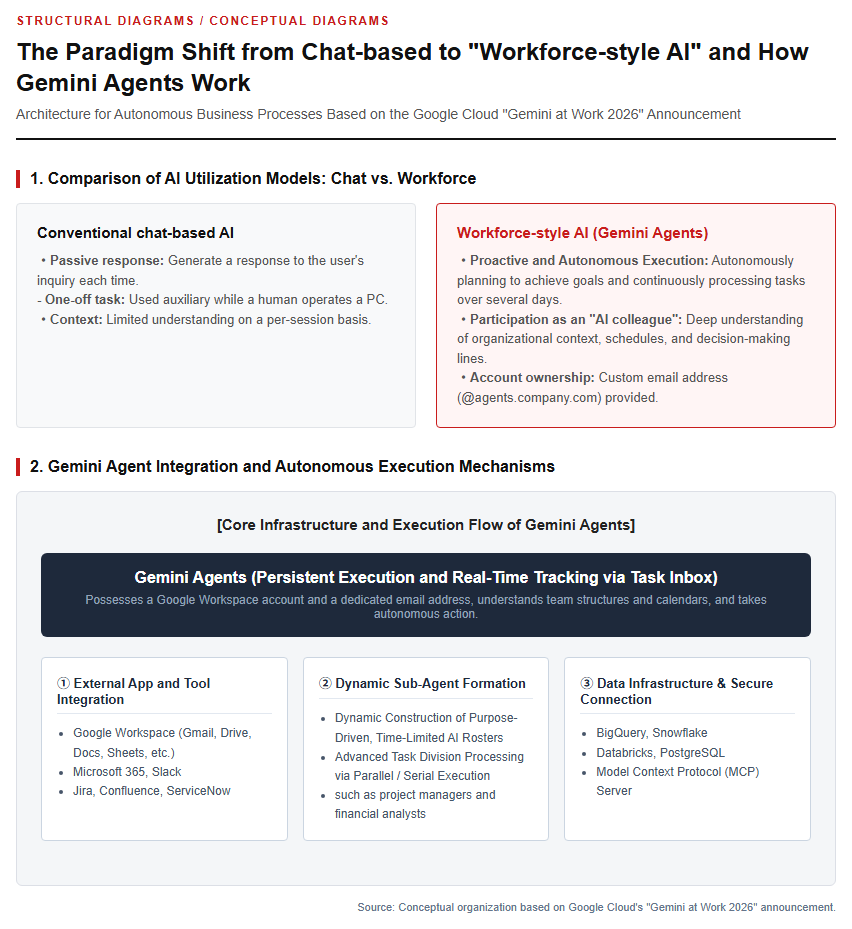
At its “Gemini at Work 2026” annual event on October 8, 2026, Google Cloud officially announced “Gemini Agent,” an integrated enterprise AI agent. Moving beyond the traditional chatbot-style AI that simply answers queries, this service autonomously handles everything from business planning and tool utilization to internal system integration and the creation of deliverables based on assigned goals. Its defining feature is that the AI is provisioned with the same Google Workspace account and a dedicated email address (@agents.company.com) as a human employee. This allows the AI agent to deeply understand organizational team structures, time zones, decision-making hierarchies, and calendar schedules, functioning literally as an “AI colleague with an email account.” Employees can easily delegate work to agents assuming specific roles—such as project managers or financial analysts—by @mentioning them in Google Chat, sending them emails, or adding them to group chats. Additionally, once instructed, it boasts persistent execution capabilities, continuing to run tasks in the cloud for days even after the user shuts down their computer.
Business Application Integration and Autonomous Task Planning and Execution Mechanism
Gemini agents not only function directly embedded within Google Workspace (Gmail, Drive, Docs, Sheets, Slides, and Calendar), but also work closely with third-party communication tools and business management platforms such as Microsoft 365, Slack, Jira, Confluence, and ServiceNow. Furthermore, they support secure connections to data platforms like BigQuery, Databricks, PostgreSQL, and Snowflake, as well as internal and external Model Context Protocol (MCP) servers. When executing tasks, they dynamically organize a roster of sub-agents (time-bound AIs that share specific tasks) necessary to achieve the objective, proceeding with work while coordinating them in parallel or series. Users can visually track the agent’s processing progress and the status of task allocation to sub-agents in real-time through a dedicated “Task Inbox.” Please refer to the conceptual diagram below for an illustration of data visualization in the course of business execution.
All operations performed by the agent are recorded as tamper-proof audit logs that explicitly specify the AI agent itself, rather than a human, as the responsible entity, ensuring transparency that allows a company’s IT department to fully track its activity history.
Cost Optimization Through Multi-Model Support and Smart Routing
The biggest barrier for enterprises deploying AI agents at scale is the sharp increase in pay-as-you-go costs associated with a growing number of processing requests. Gemini agents address this challenge by implementing flexible multi-model orchestration and “smart routing” capabilities. The AI models operating in the backend are not limited to Google’s Gemini family (such as Argon for advanced reasoning, Flash for high-speed processing, and Omni for multimedia support); the system is designed to allow automatic or manual selection of external state-of-the-art models like Anthropic’s “Claude” as well as open-source models. The smart routing function automatically determines the difficulty level of a requested task, allocating high-performance models to processes requiring complex reasoning, and lightweight, inexpensive models to routine search and classification tasks. This makes it possible to minimize token consumption costs while maintaining high response accuracy. Furthermore, real-time spending limits (hard caps) can be set per project on the Google Cloud Billing Console. If the budget is exceeded, agents automatically stop and issue notifications, providing a strict cost-management design that prevents unexpected surges in expenses.
Practical Value in Enterprise Adoption and Impact on the Market and Security
Verified Data from Implementing Companies and Business Productivity Improvement Effects
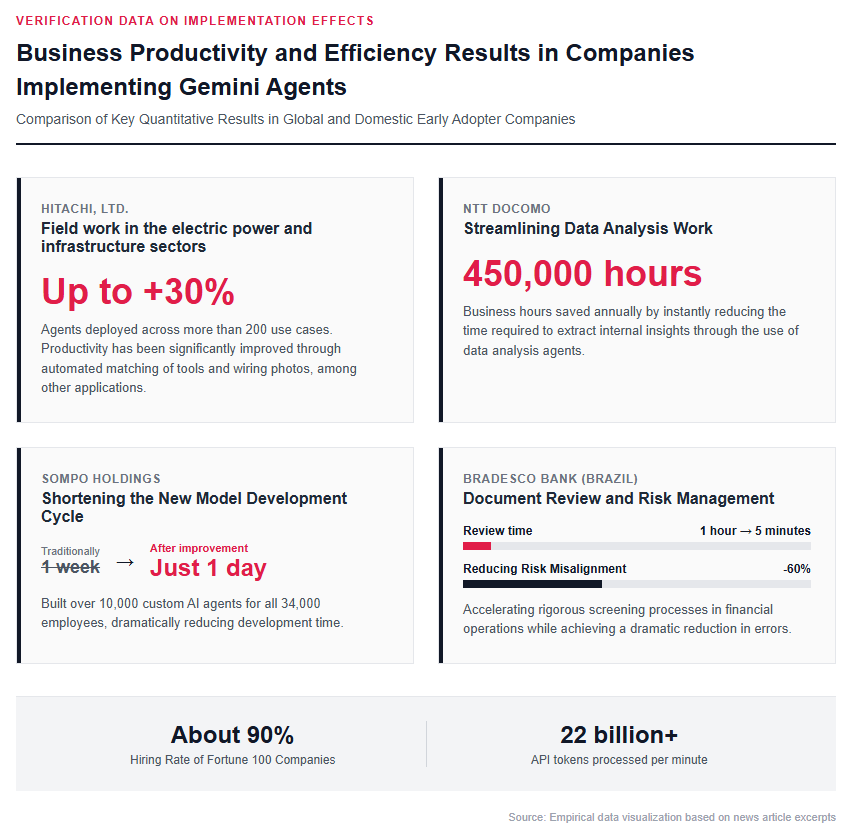
Early adoption of Gemini agents is already underway among global enterprises and major Japanese companies, with phenomenal quantitative results being reported. For example, Hitachi has deployed agents across more than 200 use cases for frontline workers in the power and infrastructure sectors, improving productivity by up to 30% through automated matching of pre-work tools and wiring photographs. NTT Docomo has successfully utilized data analysis agents to instantly reduce the time required to extract internal insights—previously done via photo analysis and manual aggregation—thereby generating 450,000 hours of working time annually. Additionally, SOMPO Holdings has built over 10,000 custom AI agents for all 34,000 employees, compressing new model development time from one week to just one day. In the financial sector as well, Brazil’s Bradesco Bank has shortened document review time from one hour to five minutes, achieving a 60% reduction in risk discrepancies. Currently, approximately 90% of Fortune 100 companies have adopted Gemini Enterprise, with large-scale business processing exceeding 22 billion API tokens per minute routinely operating in the cloud. Please refer to the figure below for a conceptual overview of the implementation effects.
Governance, Security Management, and Pay-As-You-Go Billing Management Design
When deploying autonomous AI agents, what corporate security and compliance departments are most wary of is misconduct caused by excessive access privileges and the proliferation of shadow AI. The autonomous AI operation guidelines published in May 2026 by security agencies from six major countries, including CISA (the US Cybersecurity and Infrastructure Security Agency), also strongly demand strict identity management and the principle of least privilege for agents. To address this challenge, Google Cloud provides as standard the assignment of cryptographically verified agent IDs, the issuance of short-lived temporary credentials (OAuth), an “Agent Sandbox” that delineates network boundaries, and an “Agent Gateway” that centrally applies all communication policies. Through firewall functions that block inappropriate access and data exfiltration in real-time, alongside the recording of detailed execution logs, it has established a control environment that comprehensively covers the risk categories outlined in the CISA guidelines. Enterprises can safely advance business automation while clearly defining the boundaries between AI autonomy and human approval authority (Human-in-the-loop).
Competitive Landscape and Future Outlook/Key Points of the AI Agent Market
Following this announcement, the race to acquire enterprise AI agents in the high-tech market is intensifying even further. As major vendors roll out autonomous agents one after another—such as OpenAI’s “Dots,” Meta’s “Muse,” and Microsoft’s Copilot Studio—Google Cloud is leveraging its massive infrastructure domain (achieving an 80% cost-efficiency improvement per dollar with the 8th-generation TPU 8i) and its overwhelming business touchpoints via Google Workspace to demonstrate a strong competitive advantage. Google Cloud’s Q2 2026 revenue surged 82% year-over-year to $24.8 billion (approximately 3.9 trillion yen), with order backlogs reaching a scale of $514 billion (approximately 81 trillion yen), demonstrating in its financial performance that it is capturing AI demand. Moving forward, in addition to the financial services and legal-focused agents being rolled out early, domain-specific skills for government agencies, healthcare, and retail industries are scheduled to be added sequentially. The era in which AI agents—evolving from mere chat tools into an “organizational digital workforce”—fundamentally redefine corporate organizational structures and labor productivity is finally getting into full swing, and significant attention is focused on future deployment progress and practical examples of governance design.
Reference Page
- Gemini at Work 2026: Introducing Gemini agent | Google Cloud Blog
- 【Agent Development Kit (ADK) Documentation】https://google.github.io/adk-docs/
- 【Vertex AI Agent Builder | Google Cloud】https://cloud.google.com/products/agent-builder
【#GoogleCloud #Gemini #AIAgents #GenerativeAI #DX #Cloud #Security #Governance】
コメント