On September 2, 2026, Google officially launched the general availability of its AI-driven image generation and editing tool, Google Pics. This release marks a key milestone in the company’s AI First strategy, shifting from traditional one-shot generation to a next-generation business creation environment that seamlessly integrates natural-language prompting with direct, precise object-level editing.
- General Availability in September 2026 and Cross-Platform Integration
- Shifting the Design Paradigm with the Next-Generation Nano Banana 2 Model
- Localized Editing via Object Segmentation and In-Image Translation
- Applying SCHEMA: A Structured Framework for Professional Precision
- Streamlining Collaborative Workflows and Consolidating Enterprise SaaS Costs
- Content Provenance with SynthID and the Technical Challenge of Iterative Drift
General Availability in September 2026 and Cross-Platform Integration
On September 2, 2026, Google officially launched the general availability of Google Pics, its advanced AI-powered image generation and editing application. First unveiled as a preview during the Google I/O 2026 developer conference on May 19, 2026, this official release features a significantly expanded tier of eligible subscription plans. The tool is now available to Google Workspace customers on Business Standard and higher tiers, including Business Plus, Enterprise Standard, and Enterprise Plus. It is also accessible to subscribers of personal plans, such as Google AI Pro and Google AI Ultra, as well as education customers on Google AI Pro for Education, with full support for Japanese and English environments. Users can access the tool via a standalone web application (pics.new) or through built-in features directly integrated into core Workspace applications like Google Docs and Google Slides. Any images created are automatically synchronized across all platforms, ensuring a seamless creative workflow.
Shifting the Design Paradigm with the Next-Generation Nano Banana 2 Model
Under the hood, Google Pics is powered by Nano Banana 2, Google’s state-of-the-art multimodal image generation and editing model. Traditional generative AI tools have long relied on a one-shot workflow where users enter a prompt, receive a finished flat image, and must regenerate the entire asset from scratch if even a minor detail is incorrect. Google Pics fundamentally redefines this creative process by focusing heavily on what happens after the image is generated. By combining natural-language prompting with direct canvas interaction, Google Pics allows users to modify specific elements, text, or compositional layouts without losing the overall design structure. Rather than forcing users to manually assemble every graphic element, the tool establishes a hybrid workflow where prompting acts as a flexible, conversational interface, bringing professional-grade, repeatable asset production directly to business users.
Precise Object Control and Practical Workflows with SCHEMA
Localized Editing via Object Segmentation and In-Image Translation
One of the most powerful features of Google Pics is its advanced object segmentation capability. Users can select a specific element in a generated image—or import existing graphics from a computer, Google Drive, or Google Photos—and move, resize, recolor, or replace that object without altering the rest of the frame. Please refer to the diagram below for a visual representation of this workflow.
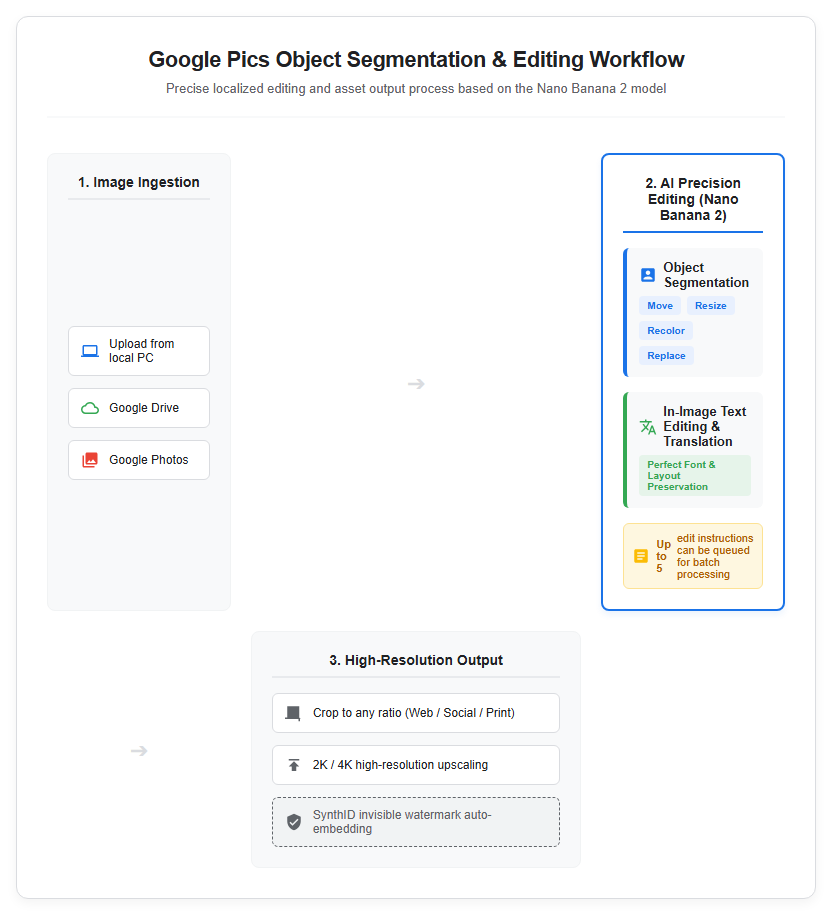
The tool also introduces robust in-image text editing and translation capabilities, allowing users to modify or translate text on the fly while perfectly preserving the original font style, spatial arrangement, and visual design. To streamline professional design workflows, users can queue up to five element-level edits to be processed simultaneously before applying the changes. Finally, completed assets can be scaled up to 2K or 4K resolution, making them ready for web, social media, or high-quality print distribution.
Applying SCHEMA: A Structured Framework for Professional Precision
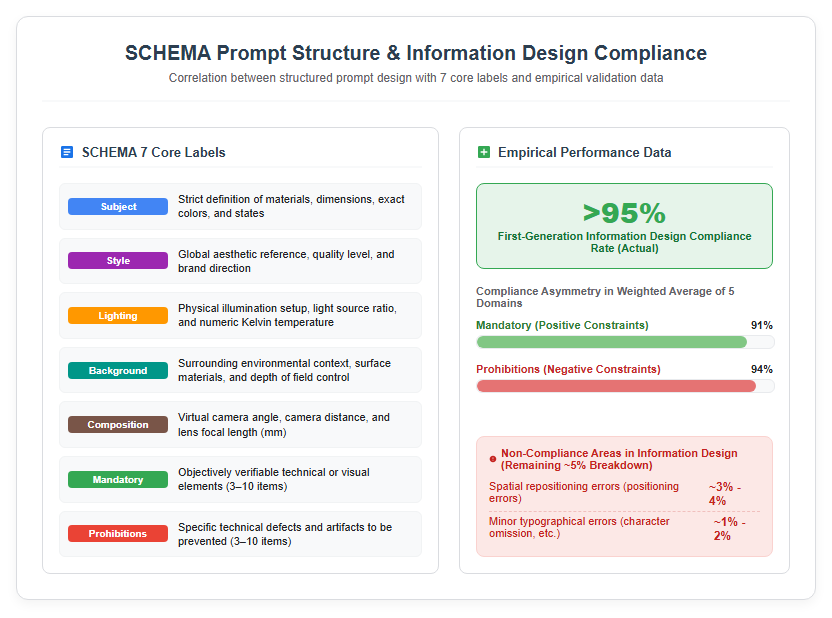
To maximize accuracy in professional production, the AI community has widely adopted SCHEMA, which stands for Structured Components for Harmonized Engineered Modular Architecture. Outlined in a landmark research paper published in February 2026, this structured prompting framework organizes user intent into seven core labels: Subject, Style, Lighting, Background, Composition, Mandatory, and Prohibitions. By defining strict Mandatory parameters (positive constraints) and Prohibitions parameters (negative constraints), professionals can establish a visual contract that minimizes the visual hallucinations typical of diffusion models. Empirical validation has demonstrated that this structured approach yields a 91% compliance rate for positive constraints and a 94% compliance rate for negative constraints across various domains, achieving over 95% first-generation compliance for complex spatial layouts and typographical requirements in information design. The structured hierarchy of the SCHEMA framework and its verified performance rates are illustrated in the following diagram.
The Power of Workspace Integration and Governance Challenges
Streamlining Collaborative Workflows and Consolidating Enterprise SaaS Costs
The true competitive advantage of Google Pics lies in its deep, native integration within the Google Workspace ecosystem. Marketing teams and business professionals can modify presentation decks in Google Slides or documents in Google Docs by simply clicking an image to invoke the Pics editor, entirely eliminating the friction of switching between external design tools. Furthermore, upcoming features will allow users to open and edit almost any image stored in Google Drive with a single click. Pics also inherits Workspace’s native collaborative features, enabling team members to work on a shared canvas simultaneously, share projects via links, and manage assets directly inside Google Drive. For enterprises, this consolidated ecosystem presents a highly cost-efficient alternative to subscribing to multiple standalone design platforms like Canva or Adobe Express.
Content Provenance with SynthID and the Technical Challenge of Iterative Drift
As AI-generated content becomes more prevalent, content transparency and digital safety have emerged as vital corporate governance issues. Google addresses these concerns by embedding SynthID—an invisible, imperceptible digital watermarking technology—into all assets generated or edited through Google Pics. Highlighting its commitment to responsible AI, Google also signed the EU AI Act Code of Practice on Transparency of AI-Generated Content on July 24, 2026. However, professionals must remain mindful of a technical limitation known as Iterative Generative Drift. When users repeatedly edit and overwrite an image over multiple iterations, the cumulative effects of compression and model reinterpretation generate pixel noise and degrade image quality, often making the asset unusable for commercial applications after four or more successive edits. To mitigate this degradation, practitioners are advised to utilize structured prompts like SCHEMA to achieve the desired output in a single, precise generation.
References
- 【Google Workspace Official Announcement】https://blog.google/products-and-platforms/products/workspace/workspace-updates/
- 【Google Pics Product Page】https://workspace.google.com/products/pics/
- 【EU AI Act Code of Practice】https://digital-strategy.ec.europa.eu/en/policies/code-practice-ai-generated-content
【#GooglePics #GenerativeAI #GoogleWorkspace #NanoBanana #EUAIAct #Technology】
コメント