Yields on French government bonds surged, widening the yield spread against German bonds to levels not seen since 2012. Behind this is strong market apprehension regarding ongoing political turmoil amid a massive fiscal deficit, with no clear path to fiscal consolidation in sight.
- Key takeaway from the event: Surge in 10-year bond yields and widening of the Germany-France spread
- Market Anxiety Triggered by Political Turmoil and Budget Stalemate
- Growing Debt Balances and Limited Room for Revenue Improvement
- The Wave of Downgrades and Its Impact on Financial Institutions and Private Markets
- The ECB’s Hurdles for Market Intervention and the Transmission Protection Instrument (TPI)
- Outlook and Key Points: A Test of Fiscal Discipline Ahead of the 2027 Presidential Election
Key takeaway from the event: Surge in 10-year bond yields and widening of the Germany-France spread
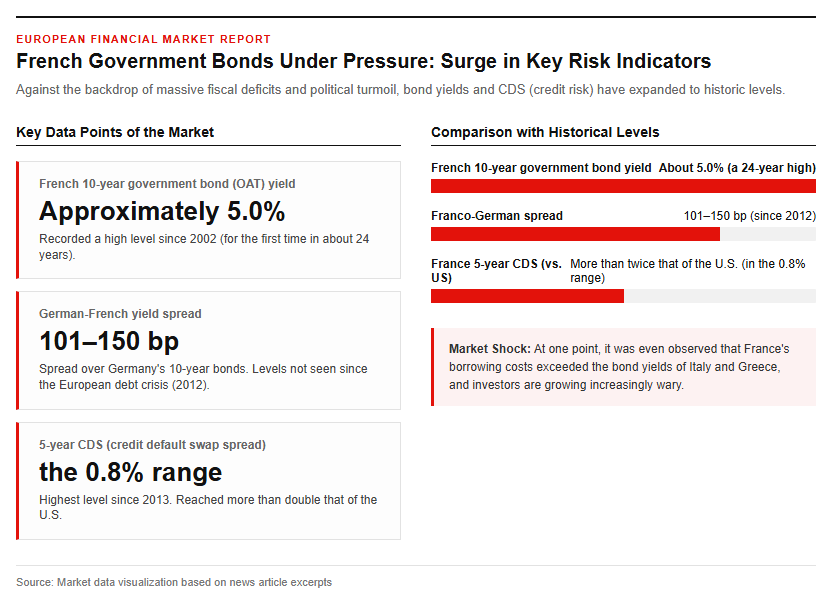
Selling pressure in the French government bond market rapidly intensified, with the yield on the 10-year benchmark French government bond (OAT) temporarily rising to nearly 5%. This marks the highest level in approximately 24 years, since 2002. At the same time, the yield spread between French bonds and benchmark German 10-year bonds temporarily reached 101 to 150 basis points (1.01 to 1.50%), showing an expansion not seen since 2012, when the European debt crisis was intensifying.
At one point, a phenomenon was even observed where France’s borrowing costs exceeded the bond yields of Italy and Greece, sending shockwaves through European financial markets. The guarantee rate for 5-year credit default swaps (CDS), which trade sovereign default risk, also surged to the 0.8% range, recording its highest level since 2013. With France’s CDS spread—which was lower than the U.S. level at the beginning of the year—reaching more than double that of the U.S., the market has rapidly begun pricing in a severe view of France’s credit risk.
Please refer to the figure below.
The direct catalyst for this sharp plunge in government bonds was disappointment over the budget proposal presented by the government. With the 2024 fiscal deficit reaching 5.8% of GDP, the reduction targets presented by the government were insufficient, highlighting the failure to forge a clear consensus on expenditure cuts. Among investors, confidence in French government bonds—long considered a safe-haven asset—is beginning to waver.
Market Anxiety Triggered by Political Turmoil and Budget Stalemate
Behind the recent sell-off in French government bonds lie unmanageable political divisions and a decline in governance. Since President Emmanuel Macron dissolved the National Assembly (the lower house) and called a snap election in June 2024, the legislature’s votes have been split among three major forces: the ruling coalition, the left-wing alliance, and the far-right National Rally (RN), plunging the country into a hung parliament with no single faction holding a majority.
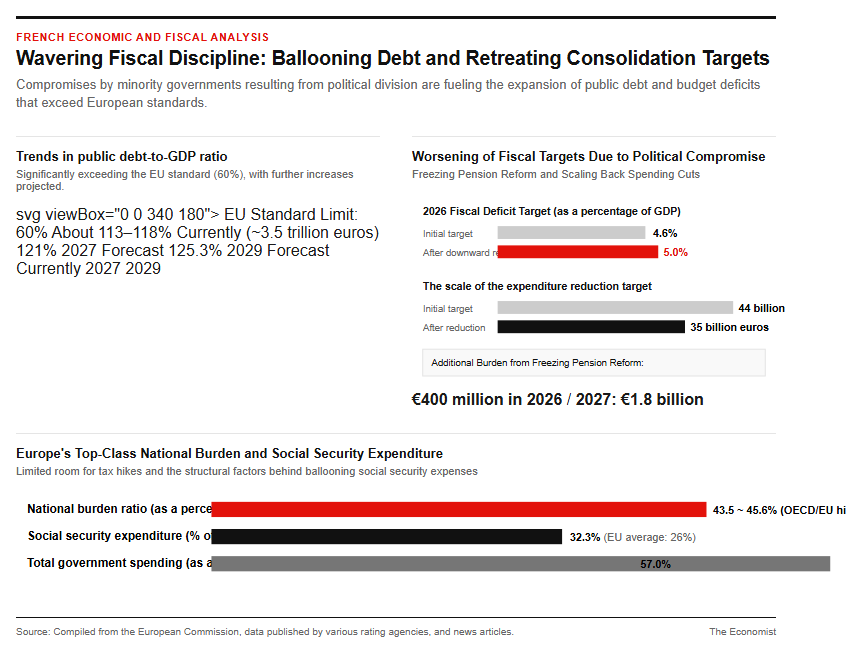
With his political foundation extremely fragile, Prime Minister Sébastien Lecornu—who took office following the resignation of former Prime Minister François Bayrou—was forced to operate as a minority government. To avoid the passage of a no-confidence motion against the cabinet and secure external cooperation from the left-wing Socialist Party, the administration accepted the suspension of the pension system reform (raising the retirement age), a flagship policy of the Macron administration. This concession will result in additional fiscal burdens of 400 million euros in 2026 and 1.8 billion euros in 2027, dealing a significant setback to fiscal consolidation efforts.
The spending cut target was reduced from the initial 44.0 billion euros to a scale of 35.0 billion euros, and the 2026 fiscal deficit target was also downgraded from 4.6% to 5.0% of GDP. Amid intensifying political maneuvering over the budget bill, the market judged that the French government lacked the political will and capability to implement fiscal consolidation, resulting in a spur to government bond selling.
Structural Vulnerabilities of France’s Public Finances and Their Spillover Effects on the European Economy
Growing Debt Balances and Limited Room for Revenue Improvement
France’s fiscal problems are not merely temporary economic factors, but involve serious structural challenges. The country’s public debt has reached approximately 3.5 trillion euros (approx. 580 trillion yen), standing at around 113 to 118 percent of GDP, which significantly exceeds the European Union (EU) threshold of 60 percent. According to estimates by the European Commission and other institutions, if no drastic reforms are implemented, this ratio is projected to expand to 121 percent by 2027 and 125.3 percent by 2029.
Even more challenging is the fact that almost no means are left to increase revenue. France’s tax-to-GDP ratio (taxes and social security contributions relative to GDP) has already reached 43.5% to 45.6%, placing it alongside Denmark at the highest level among OECD and EU member nations. Because any further tax hikes would trigger strong backlash from the domestic economy and public opinion, the scope for further revenue expansion is extremely limited.
Meanwhile, social security and healthcare costs continue to grow due to the aging population, and as of 2023, social security-related expenditures stood at 32.3% of GDP, significantly exceeding the EU average of 26%. Compounded by rising interest payments, total government spending has swelled to 57% of GDP. With over $1 trillion (approx. 158 trillion yen) in government bonds maturing by 2030, the surge in refinancing costs driven by rising interest rates weighs heavily as a debt bomb pressing on the national budget.
The Wave of Downgrades and Its Impact on Financial Institutions and Private Markets
Due to delays in fiscal consolidation and political uncertainty, major rating agencies have successively downgraded French government bonds. Following Moody’s downgrade of its rating outlook in December 2024, Fitch Ratings lowered France’s credit rating from “AA-” to “A+” in September 2025, pushing it down into the single-A category. The following October, S&P Global similarly executed a downgrade to “A+”.
Sovereign downgrades are also having a negative impact on the financing conditions of private companies. In the markets, the “sovereign ceiling” (the concept that a sovereign credit rating acts as a ceiling for the ratings of domestic companies) has come into focus, and shares of major French banks such as BNP Paribas and Société Générale have plummeted in tandem with the drop in government bond prices. There is a growing sense of caution regarding a vicious cycle in which the decline in the value of domestic government bonds held by banks damages their financial soundness, thereby triggering further credit uncertainty.
Please refer to the figure below.
However, compared to the time of the 2012 euro crisis, the holding ratio of domestic government bonds by European banks has declined from 22% in 2014 to around 14%. Furthermore, southern European countries such as Spain and Portugal have had their credit ratings upgraded due to improvements in fiscal discipline, and the current market volatility is recognized not as contagion across the whole of Europe, but as a risk unique to France.
The European Central Bank’s (ECB) Response and Future Macroeconomic Outlook
The ECB’s Hurdles for Market Intervention and the Transmission Protection Instrument (TPI)
While some in the market expect support for French government bonds, it is considered unlikely that the European Central Bank (ECB) will readily intervene. ECB President Christine Lagarde and Bundesbank President Joachim Nagel have repeatedly stated that the widening of yield spreads in the market reflects each country’s fundamentals and that the conditions for market intervention are not currently in place.
Strict preconditions exist for the activation of the Transmission Protection Instrument (TPI), which the ECB holds to prevent excessive fragmentation in the government bond market. Specifically, it is stipulated as a primary condition that the target country must “comply with EU fiscal rules.” However, France is currently facing a recommendation under the Excessive Deficit Procedure (EDP) issued by the EU Council in July 2024, as its fiscal deficit exceeds the criteria.
If the ECB were to purchase government bonds for countries under the Excessive Deficit Procedure (EDP), it could trigger moral hazard (a lack of ethical restraint) and undermine each country’s voluntary efforts toward fiscal consolidation. Additionally, the large-scale government bond purchases previously conducted by the central bank have now shifted to halting the reinvestment of maturing bonds (quantitative tightening). In the government bond market, having lost the central bank as the buyer of last resort, an environment has emerged where the market’s autonomous price-formation function operates strongly.
Outlook and Key Points: A Test of Fiscal Discipline Ahead of the 2027 Presidential Election
The primary focus going forward will be how the French administration can pass the 2026 budget bill in parliament and demonstrate to the markets its capability to execute medium-term fiscal consolidation. Prime Minister Lecornu has stated his policy of securing a majority without using special legislative procedures (Article 49, Paragraph 3 of the Constitution), but caught between the left, which rejects austerity, and the right and far-right, which demand further spending cuts, budget deliberations are expected to face extreme difficulty.
If political turmoil protists for a long time, there are concerns that it could lead to stagnation in the real economy through the deterioration of sentiment among businesses and households. Already, France’s Purchasing Managers’ Index (PMI) and consumer confidence index are sluggish compared to other major eurozone countries, and combined with the entrenchment of high interest rates, the risk of an economic downturn is increasing. In the market, it has also been pointed out that government bond spreads could widen further to 120 to 150 basis points.
In the long term, the economic policies of each political camp leading up to the French presidential election scheduled for the spring of 2027 will be the primary focus. Marine Le Pen and other figures leading the far-right National Rally (RN) have begun releasing platforms calling for fiscal deficit reduction and expenditure reviews, but many remain skeptical about their specificity and feasibility. The intertwining of political uncertainty and fiscal deterioration, including the risk of a change in government in 2027, will remain a major risk factor for European financial markets for the next several years.
Reference page
- [European Commission: France Economic and Fiscal Surveillance Report] https://economy-finance.ec.europa.eu/economic-surveillance-eu-member-states/country-pages-including-country-reports/country-report-france_en
- 【European Central Bank (ECB) Transmission Protection Instrument (TPI) framework】https://www.ecb.europa.eu/press/pr/date/2022/html/ecb.pr220721~973e6e7273.en.html
- OECD Revenue Statistics (France)
[#FrenchGovernmentBonds #FiscalDeficit #PoliticalUncertainty #ECB #EuropeanEconomy #InterestRateHike #Downgrade]


コメント