According to the Bank of Japan’s Flow of Funds Accounts for the April–June quarter of 2026, financial assets held by Japanese households reached a record high of ¥2,519.1 trillion, representing an 11% increase year-on-year. This surge was driven by global stock price gains and a steady shift from cash deposits to equities and investment trusts, particularly among working generations following the expansion of the new NISA program.
- Key Highlights and Crucial Data Points of the Record High
- Shift to Risk Assets Driven by Rising Stock Prices and the New NISA
- Paradigm Shift: Moving Away from Deflation and Cash Holdings
- Global Comparisons Highlight Vulnerabilities in Japan’s Portfolio
- Concentrated Wealth Among Seniors and the Dawn of a Massive Inheritance Era
- Key Focus Areas and the Urgency of Financial Literacy
Key Highlights and Crucial Data Points of the Record High
In the preliminary Flow of Funds Accounts for the April–June quarter of 2026 released by the Bank of Japan, financial assets held by Japanese households reached ¥2,519.1289 trillion, marking an 11% year-on-year increase and setting a new historical record. A detailed breakdown reveals that equity holdings jumped 47% from the previous year to approximately ¥486 trillion, boosted by surging stock prices, while investment trust holdings expanded rapidly by 36.8% to around ¥193 trillion. Conversely, household liabilities also grew by 4.1% year-on-year to ¥416 trillion, largely driven by an increase in housing loans. This remarkable expansion in total assets demonstrates that Japanese households, historically known for their heavy reliance on cash and bank deposits, have significantly boosted the valuation of their risk assets thanks to strong equity markets and new tax-advantaged investment frameworks. Please refer to the diagram below.
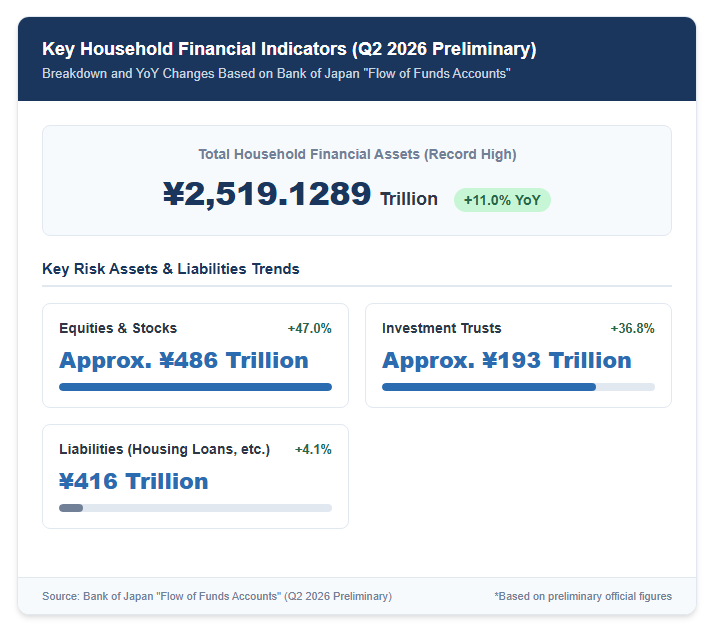
Market-linked assets are rapidly gaining prominence within the overall household financial portfolio, signaling that individual asset formation behavior in Japan is entering a period of fundamental transformation.
Shift to Risk Assets Driven by Rising Stock Prices and the New NISA
The single largest driver behind this surge in financial assets is the full-scale adoption and integration of the new NISA (Nippon Individual Savings Account) program launched in January 2024. By expanding the lifetime tax-free investment limit to ¥18 million and allowing the simultaneous use of the Growth Investment and Dollar-Cost Averaging Investment tracks, the program has dramatically accelerated participation among working generations, from young adults to those in their 50s. Annual purchases through NISA accounts in 2024 reached approximately ¥18 trillion—a record-breaking threefold increase compared to the previous year. A granular analysis of the Flow of Funds data reveals that while valuation gains from rising market prices accounted for nearly 80% to 90% of the increase in risk assets, net transaction flows—representing new capital inflows centered on investment trusts—have also built up steadily every quarter. Notably, nearly 30% of people in their 30s now hold NISA accounts, with regular monthly automated investments in global equity funds, US equity index funds, and high-dividend domestic stocks becoming a staple of everyday financial planning.
Asset Defense in an Era of Inflation and Structural Challenges
Paradigm Shift: Moving Away from Deflation and Cash Holdings
For decades, Japanese household financial assets retained a deeply conservative structure, with over 50% consistently held in cash and bank deposits. However, structural changes in portfolio allocation have accelerated: in late June 2025, the cash and deposit ratio fell below the 50% mark for the first time in 18 years, dropping further to 47.2% by the end of March 2026. This shift is rooted in the end of Japan’s long-standing deflationary period and the subsequent rise in inflation. According to the Bank of Japan’s Opinion Survey on the General Public’s Views and Behavior, public inflation expectations for one year and five years ahead remain elevated. This has created a widespread realization that keeping wealth purely in cash leads to an erosion of real purchasing power. While investing was once perceived by many as speculative or reserved for wealth-seeking traders, public sentiment has shifted to viewing it as a practical defense mechanism against inflation-driven value erosion. As persistent price growth becomes the norm, reallocating household assets has become an imperative.
Global Comparisons Highlight Vulnerabilities in Japan’s Portfolio
While Japan’s household financial assets and securities holdings continue to reach record highs in local yen terms, international comparisons reveal lingering vulnerabilities. When evaluating Japanese securities growth in US dollar or euro terms, the rate of increase pales in comparison to Western nations due to the sharp depreciation of the yen in recent years. Furthermore, comparing the proportion of cash and deposits across countries shows that while the US remains in the 10% range and European nations stand at 30% to 40%, Japan’s ratio remains exceptionally high at over 47%. Additionally, analysts point out that purchasing power evaluated in gold terms has shrunk significantly compared to the prior year, highlighting the inherent risks of relying solely on single-currency yen deposits. Please refer to the diagram below.
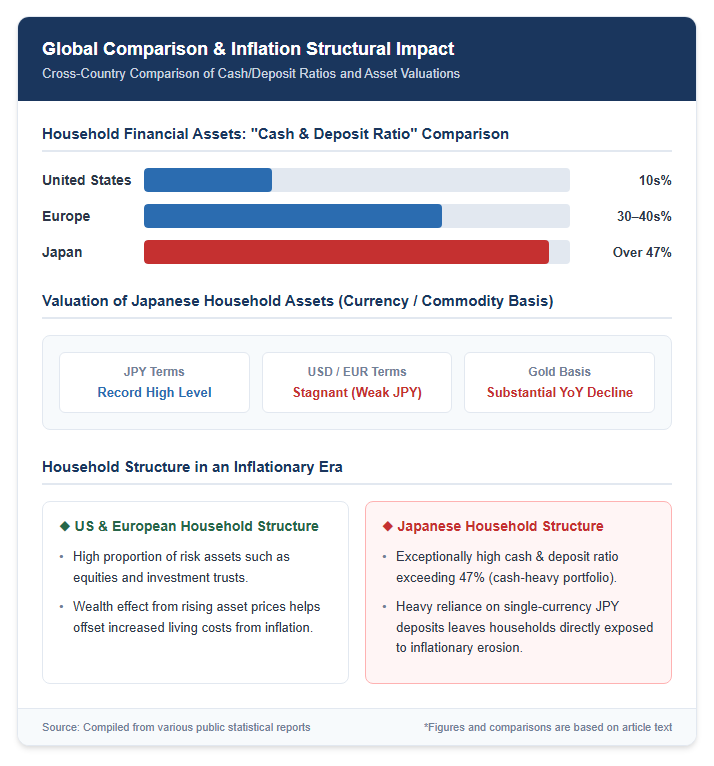
While Western households have been able to offset rising living costs through the wealth effects of stocks and mutual funds, Japanese households remain overly exposed to the direct pressures of inflation due to their heavy concentration in cash and bank deposits.
Intergenerational Wealth Disparities and Future Outlook
Concentrated Wealth Among Seniors and the Dawn of a Massive Inheritance Era
Beneath the headline figure of massive household assets lies a stark intergenerational imbalance and economic disparity. Statistical data reveals that seniors aged 60 and older hold more than 60% of all household financial assets, exceeding ¥1,200 trillion, with households headed by individuals aged 70 and above accounting for approximately ¥648 trillion. As the first baby-boomer generation reaches late-stage senior status (aged 75 and older) from 2025 onwards, Japan is entering a monumental era of intergenerational wealth transfer from 2026 through 2040. Over the next decade or two, a major portion of this ¥648 trillion in assets held by those 70 and older is projected to pass to children and grandchildren. On the flip side, roughly 27% of single-person households aged 70 and older have zero financial assets, and when combined with low-savings households holding ¥2 million or less, that figure reaches nearly 38%. Economic polarization within the elderly population is deepening, making the impact of inflation on jobless households solely dependent on public pensions a pressing social issue.
Key Focus Areas and the Urgency of Financial Literacy
To realize its vision of transforming Japan into a Leading Asset Management Nation, the Japanese government has set ambitious targets to expand the number of NISA accounts to 34 million and total purchase balances to ¥56 trillion by the end of 2027. While progress toward these goals is tracking smoothly, further measures are required to firmly anchor the shift from savings to investment across all segments of society. Beyond sustaining the momentum among working generations, a central challenge will be providing suitable investment options for retirees aged 60 and above, who hold the lion’s share of wealth yet remain heavily skewed toward cash. There is an urgent need to promote financial literacy, including decumulation strategies—managing and drawing down assets safely while navigating longevity risk and potential cognitive decline—supported by bodies like the Japan Financial Literacy and Education Council (J-FLEC). Furthermore, broader structural improvements, such as increasing liquidity in the second-hand housing market and securing real wage growth, will be vital to establishing a truly resilient foundation for individual wealth creation.
References
- 【Flow of Funds Accounts – Bank of Japan】https://www.boj.or.jp/statistics/sj/sj.htm
- 【Research Report on Senior Money (Aged 70+) – Dai-ichi Life Research Institute】https://www.dlri.co.jp/files/macro/495378.pdf
【#HouseholdFinancialAssets #FlowOfFunds #NewNISA #Inflation #AssetBuilding #IndividualInvesting #GreatInheritanceEra】


コメント